

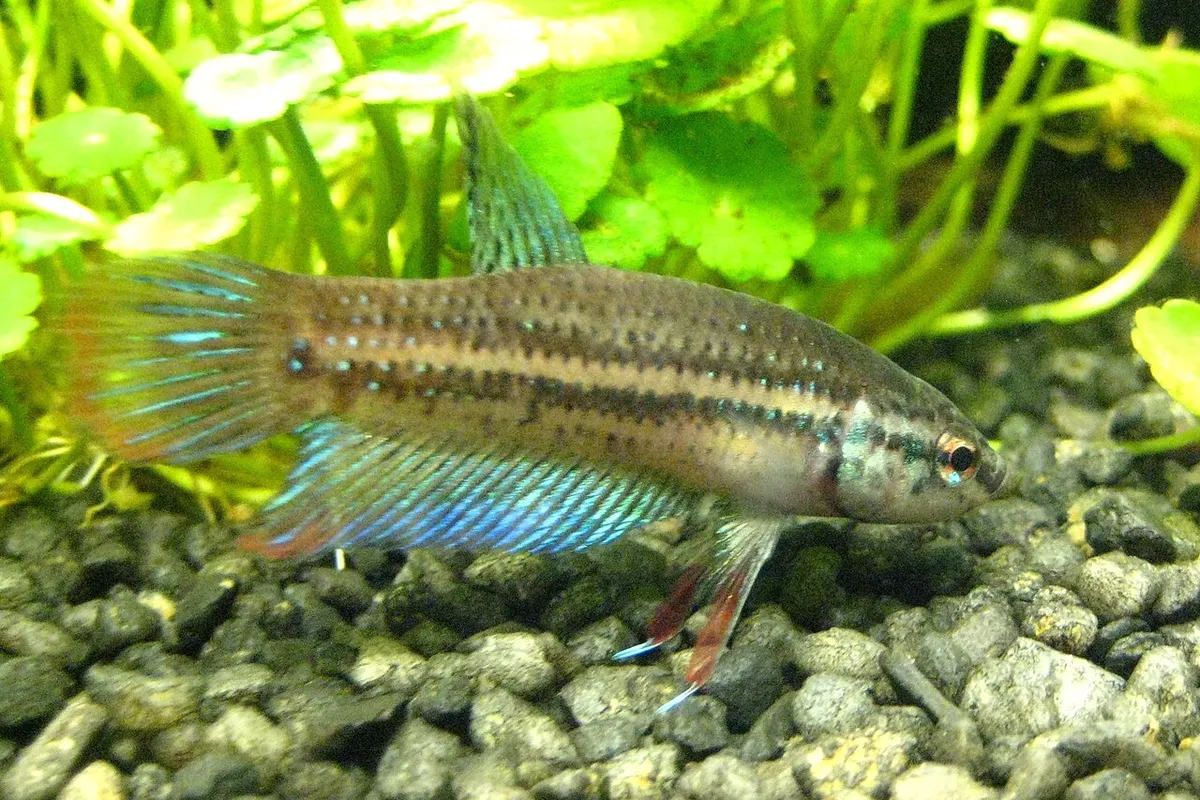
The peaceful betta is a wild cousin of the familiar Siamese fighting fish. Its name is a little generous, since males still squabble, but Betta imbellis is far calmer than Betta splendens. In a large, well-planted tank you can keep a pair or even a small group.
It stays small, about 5 cm, and has short fins. Males in breeding colour show a deep blue-green body, blue-edged fins and a red crescent on the tail.
Where peaceful bettas come from
The species lives in southern Thailand, peninsular Malaysia and Sumatra. It is found in shallow, still or slow water such as swamps, ditches, rice paddies and the edges of streams, usually among thick plants and leaf litter.
Appearance and behaviour
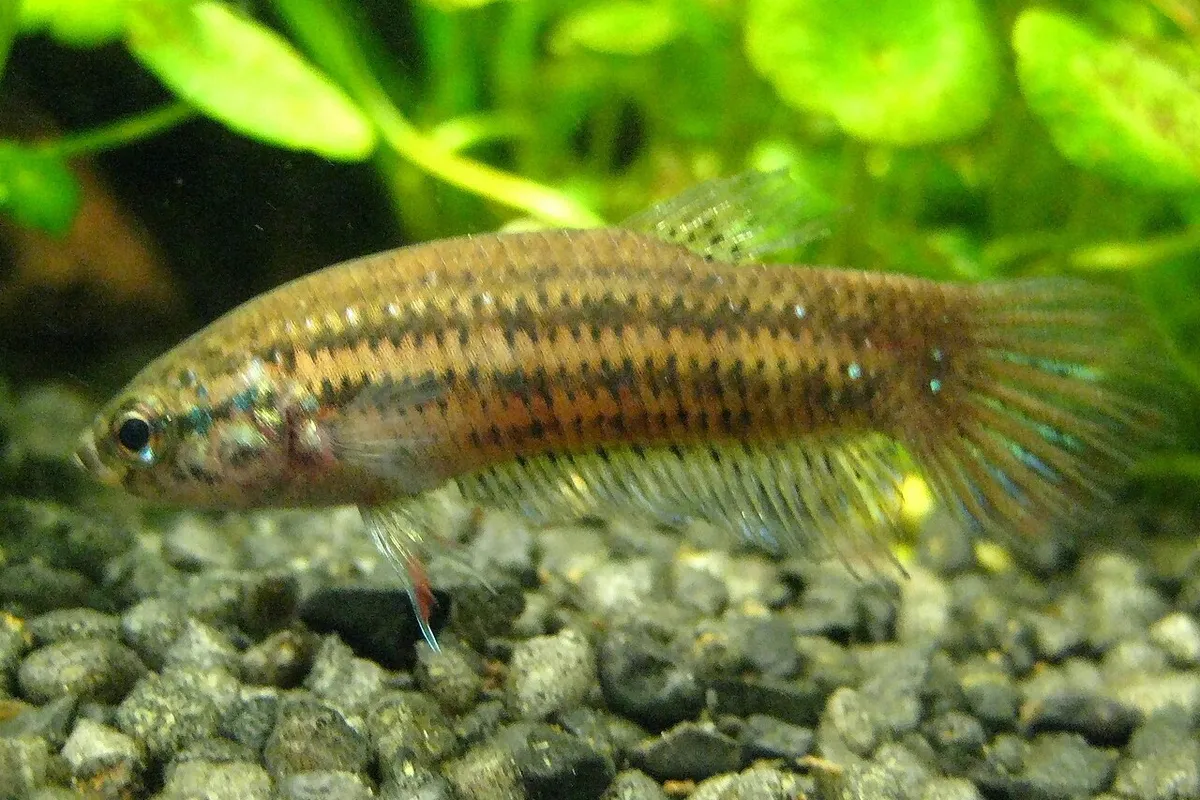
Males are brighter, with longer fins, and darken when displaying. Females are brown with faint lengthwise stripes and often show vertical bars when ready to spawn. Like all labyrinth fish, they breathe air from the surface.
Males flare and chase but rarely do lasting damage if the tank has plenty of cover. Even so, one male per tank under 60 litres is the safe rule.
Tank setup
A pair needs at least 30 litres; a group of one male and several females needs 60 litres or more. Plant heavily, add floating plants and leaf litter, and keep flow gentle. A tight lid keeps the air above the water warm and humid, which protects the labyrinth organ.
Water parameters

- Temperature: 24–28°C
- pH: 5.5–7.0
- Hardness: 2–10 dGH
Soft, slightly acidic water brings out the best colour. Leaf litter and the tannins it releases help; see how to use leaf litter.
Feeding
Peaceful bettas eat small insects in the wild. Feed quality small pellets alongside frozen or live bloodworms, brine shrimp, daphnia and mosquito larvae. Our betta diet guide applies here too.
Tank mates
Small, peaceful fish that stay out of the surface zone work well: small rasboras, pygmy corydoras, kuhli loaches and otocinclus. Avoid fin-nippers and other surface-dwelling labyrinth fish. Never keep them with Betta splendens, since the two hybridise easily.
Breeding
The male builds a bubble nest under a floating leaf, wraps around the female during spawning, and collects the eggs into the nest. Remove the female afterwards. The fry hatch in about two days and are free-swimming two or three days later. Start them on infusoria, then baby brine shrimp.
Common problems and lifespan
Watch for fin damage from fighting, velvet and fin rot in poorly kept tanks. Keep the water clean and soft and they live three to five years.
Explore other topics
Dive into more aquarium guides across the site.