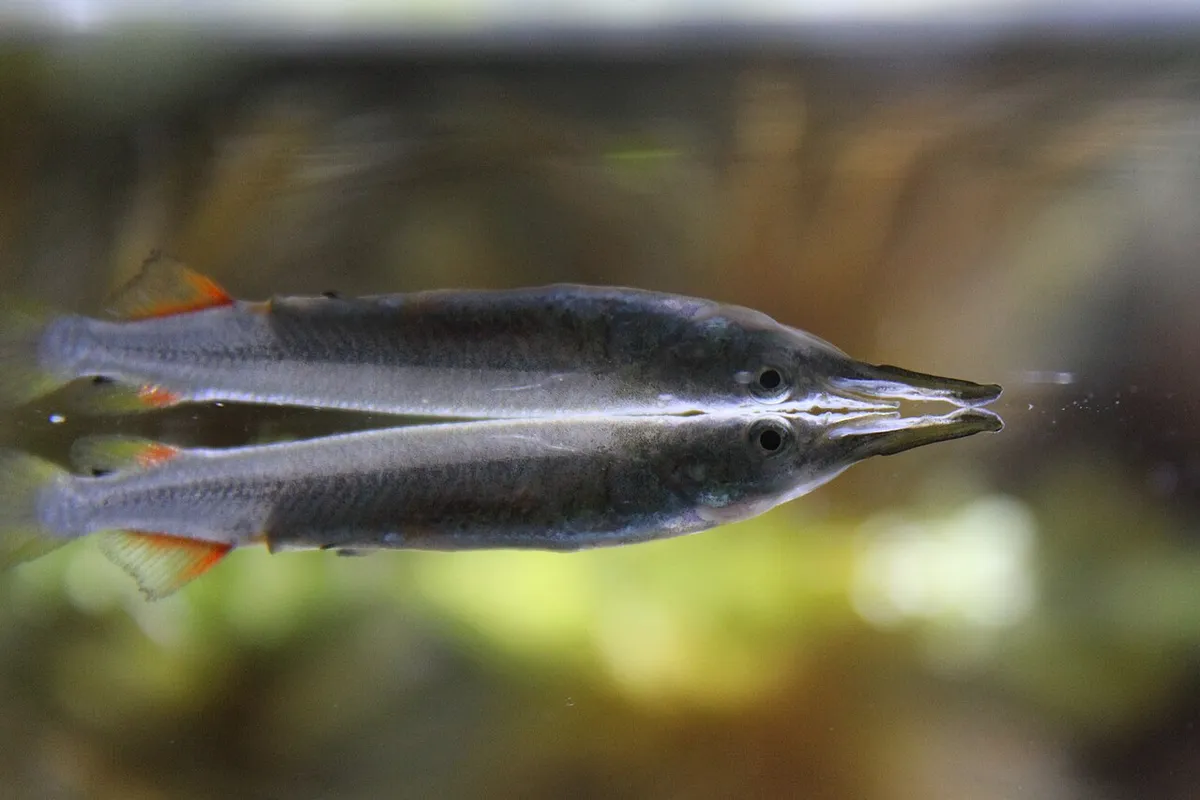
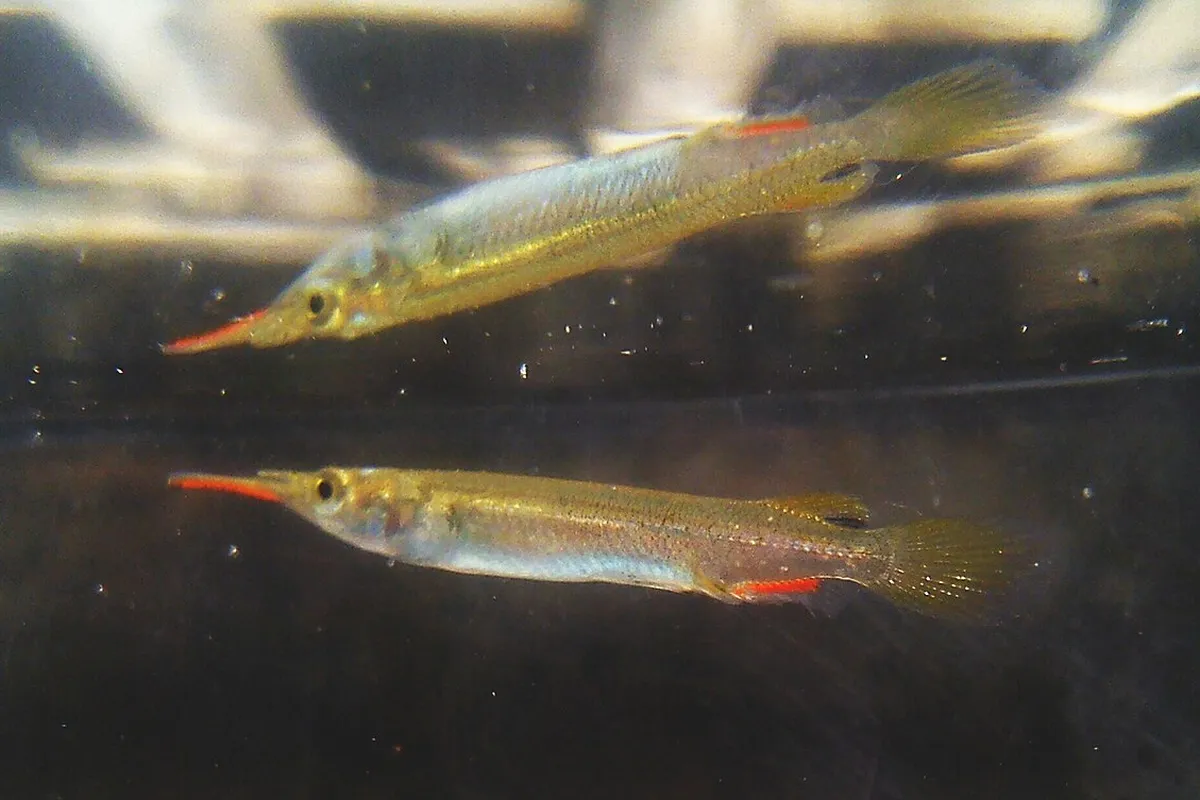
The wrestling halfbeak looks like a tiny needlefish. Its lower jaw is much longer than the upper, which gives the family its name, and it spends almost all its time just under the surface. Males lock jaws and wrestle over territory, hence the common name.
Dermogenys pusilla is a livebearer that grows to about 6 cm. It is easy to keep, but it needs a long tank, a tight lid and small live or frozen food.
Where wrestling halfbeaks come from
The species is widespread in Southeast Asia, from Thailand and Malaysia to Sumatra, Java and Borneo. It lives in slow streams, canals, ponds and rice paddies, and also enters brackish estuaries.
Appearance and behaviour
The body is slim and silver to olive, often with a red or yellow patch on the male's dorsal and anal fins. Males also have a modified anal fin, the andropodium, for internal fertilisation.
Halfbeaks are peaceful with other species but males spar with each other. Keep one male with several females, or several males in a large tank with lots of floating plants to break up sight lines.
Tank setup
A tank of 60 litres or more with a long footprint suits a small group. Water depth matters less than surface area. Add floating plants and leave open water below them. They startle easily and can injure their delicate jaws on the glass, so avoid sudden movements and keep the tank somewhere calm. A tight lid is essential; see how to stop fish jumping.
Water parameters

- Temperature: 22–28°C
- pH: 6.5–8.0
- Hardness: 5–20 dGH
Many keepers add a small amount of aquarium salt, about 1 teaspoon per 10 litres, which this species tolerates well. It is not essential.
Feeding
Halfbeaks take food from the surface. Fruit flies, mosquito larvae, daphnia and brine shrimp are ideal. Many will also eat floating flakes and small floating pellets once settled. Food that sinks past them is usually ignored.
Tank mates
Pair them with peaceful midwater and bottom fish: small rasboras, danios, corydoras, loaches and peaceful gouramis. Avoid other surface specialists, such as hatchetfish, which compete for the same space and food.
Breeding
Females give birth to 10–30 live fry every four to eight weeks. The fry are large and can eat baby brine shrimp and crushed flakes at once. Adults eat their young, so use dense floating plants or move the fry. Pregnant females sometimes give birth to stillborn fry if their diet is poor, so feed them well.
Common problems and lifespan
Jaw injuries from panicked swimming are the most common problem. Starvation is another, when tank mates take all the food. With good care they live two to three years.
Explore other topics
Dive into more aquarium guides across the site.