

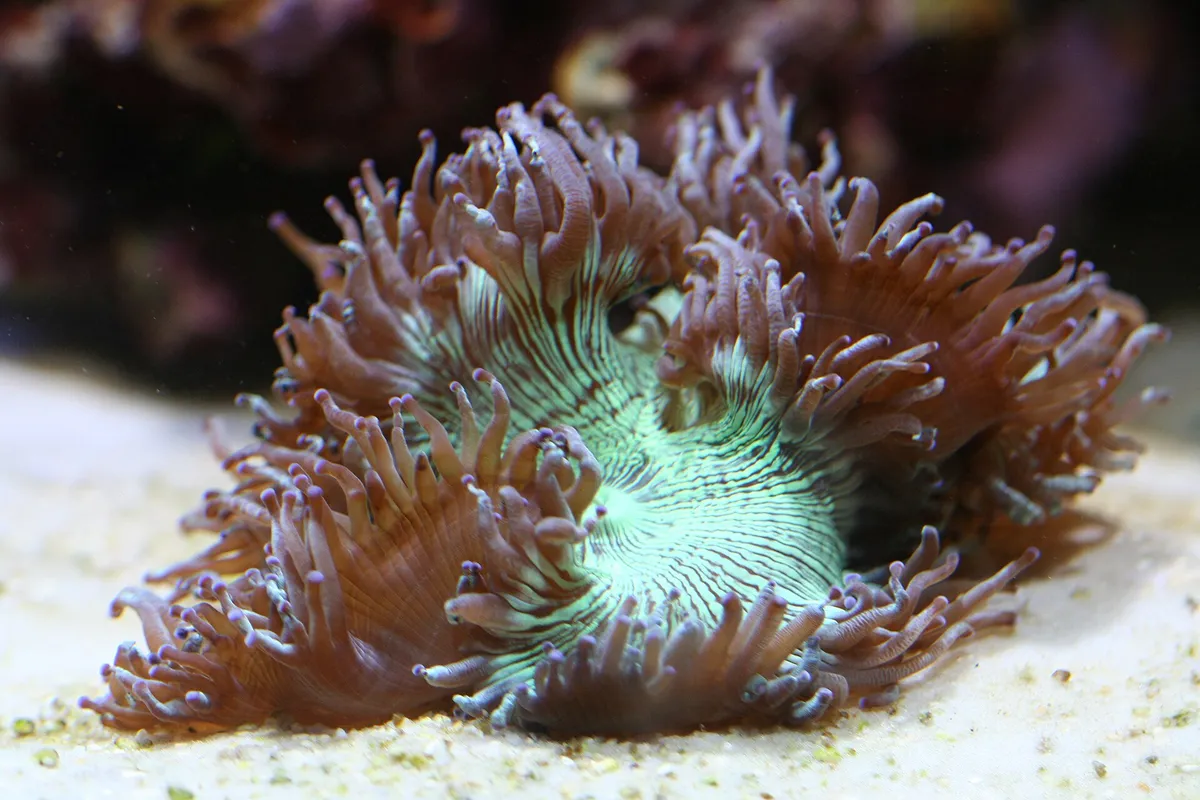
The elegance coral is one of the most beautiful large-polyp stony (LPS) corals in the hobby. A large, fleshy body spreads out from a cone-shaped skeleton, with a striped green or teal centre and long tentacles tipped in pink, purple or white. Catalaphyllia jardinei looks a lot like an anemone, and clownfish sometimes host in it.
It used to be considered easy, but wild elegance corals have had poor survival rates for years. Today, captive-grown elegance corals are much more reliable. Treat this as an intermediate coral that needs a stable, mature tank.
Where elegance coral comes from
Elegance coral comes from the Indo-Pacific, from Indonesia and the Philippines to northern Australia and the Solomon Islands. Unlike most corals, it lives on soft sand and mud in sheltered lagoons and bays, with its cone-shaped skeleton buried in the sediment.
Appearance and behaviour
When open, an elegance coral can spread to 20–30 cm or more. The oral disc has stripes of green, brown or teal, and the long tentacles have coloured tips. At night it may extend sweeper tentacles.
Elegance corals are aggressive. Their tentacles sting other corals and even some fish, so give them at least 15 cm of space from everything else.
Placement, lighting and flow
Place elegance coral on the sand bed, with the skeleton point down, as it would sit in nature. Avoid placing it on rock where it can be damaged. Give it moderate light, around 75–200 PAR, and gentle to moderate, indirect flow. Strong flow keeps it closed and can tear the tissue. Our guides to lighting and flow help.
Water parameters
Keep the temperature at 24–27°C, salinity at 1.025–1.026, alkalinity at 8–11 dKH, calcium at 400–450 mg/l and magnesium at 1250–1400 mg/l. Elegance corals like some nitrate and phosphate, so do not run an ultra-low nutrient system. See our guide to phosphates.
Feeding
Elegance coral is photosynthetic but grows best with feeding. Target feed it once or twice a week with mysis, chopped shrimp or coral pellets. Gently place food on the tentacles and let the coral pull it in.
Tank mates
Most reef fish are fine. Avoid coral-nipping angelfish and butterflyfish. Clownfish may host in it, which some corals tolerate and others do not. Keep it well away from other LPS and soft corals.
Common problems
Elegance coral syndrome is the best-known problem: the coral swells, the mouth gapes open and the tissue slowly wastes away. The cause is not fully understood, but it is far more common in wild-collected corals. Buy captive-grown elegance corals, quarantine them, and avoid placing them on rock. With good care they live and grow for many years.
Explore other topics
Dive into more aquarium guides across the site.