

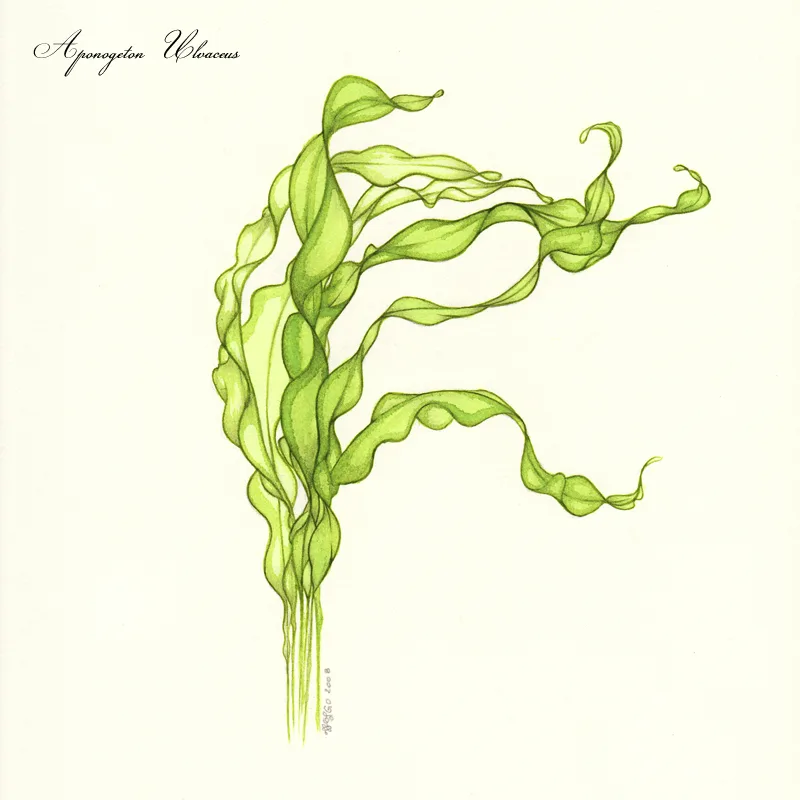
Aponogeton ulvaceus is a dramatic freshwater aquarium plant from Madagascar. It grows from a bulb-like tuber and produces long, translucent light-green leaves with strongly rippled edges. A healthy specimen can become a large architectural feature, so it is best treated as a focal plant rather than squeezed into a crowded foreground.
Natural Origin and Growth Habit
This species originates from Madagascar and belongs to the Aponogetonaceae family. In an aquarium, growth comes from a central tuber buried partly in the substrate. Mature plants can produce many long leaves, often reaching 30–60 cm, so they are most suitable for medium to large aquariums.
Where to Plant Aponogeton ulvaceus
Place the plant in the midground or background where its leaves can spread without shading everything around it. A single healthy plant can become wide and visually dominant. Avoid positioning it directly beneath a filter outlet that constantly bends the leaves.
When planting, do not completely bury the tuber. The roots should be in the substrate while part of the tuber remains exposed. This reduces the risk of rot. For more information about choosing a suitable base, see our aquarium substrate guide.
Lighting Requirements
Moderate aquarium lighting is usually sufficient. Very intense lighting is not essential, although stronger light combined with good nutrition can encourage faster growth. If leaves become excessively shaded by other plants, thin the surrounding growth rather than dramatically increasing light.
Water Conditions
Aponogeton ulvaceus is relatively adaptable and can grow in both softer and harder freshwater. A temperature around 22–28°C is suitable, with slightly acidic to moderately alkaline conditions generally tolerated. Consistency is more important than exact numbers.
Regular water changes help keep leaves clean and supply trace minerals. Stable water also reduces the chance of algae taking advantage of damaged or slow-growing leaves.
CO2 and Fertilization
Added carbon dioxide is not absolutely required, but CO2 can noticeably improve growth and leaf quality. In a low-tech aquarium, a nutrient-rich substrate and regular fertilization can still produce good results.
Because the plant feeds through its roots, root tabs are useful when the substrate has little nutritional value. A complete liquid fertilizer can supplement nutrients taken through the leaves. Our guide to CO2 in planted aquariums explains when added carbon dioxide may be worthwhile.

Pruning and Maintenance
Remove old, damaged or heavily algae-covered leaves by cutting them close to the base. Do not trim large leaves halfway across because the remaining section often deteriorates. Healthy new leaves should continue emerging from the centre.
Aponogeton species may occasionally slow down or enter a rest period after vigorous growth. Do not immediately discard a plant just because the leaves decline. If the tuber remains firm and healthy, new growth may return after a period of reduced activity.
Propagation
Mature plants can produce flower stalks that reach the water surface. Seed propagation is possible but less common in ordinary home aquariums. Some established specimens may also form additional growth from the tuber over time.
Fish Compatibility
The plant works well in peaceful community tanks. Small tetras, rasboras, rainbowfish and Corydoras generally leave it alone. Large herbivorous or destructive fish may damage leaves, especially when newly planted.
Ease of Care
This is an easy-to-moderate plant provided enough space and nutrients are available. Its biggest challenge is simply its mature size. It can overwhelm a small tank but makes an excellent centrepiece in a larger planted aquarium.
Species Variations
Aquarists may encounter several other Aponogeton species, including forms with broader, narrower or differently textured leaves. Aponogeton ulvaceus is especially recognisable by its light-green, wavy leaves. Albino forms are not a standard feature of aquarium plants in the way they are with fish.
Final Thoughts
If you want a plant with movement, height and a distinctive leaf shape, Aponogeton ulvaceus is an excellent choice. Give its tuber room to breathe, provide root nutrition and allow enough space for mature leaves to spread.

Explore other topics
Dive into more aquarium guides across the site.