

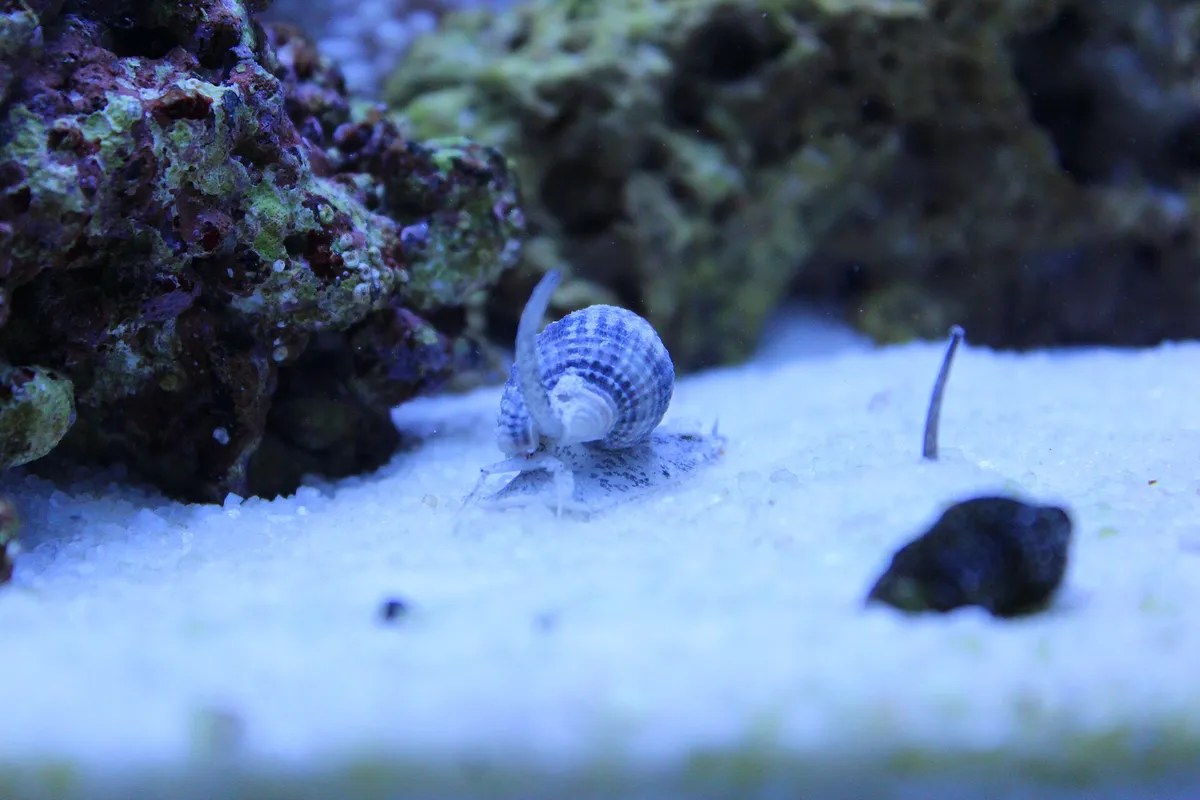
Nassarius snails spend most of their lives buried in the sand, with only a thin breathing tube, the siphon, poking out. The moment food lands nearby, they erupt from the sand and race towards it. They are among the most useful members of a reef clean-up crew, and one of the most entertaining to watch.
Several species of Nassarius are sold together as "nassarius snails", including Nassarius vibex from the Caribbean and Indo-Pacific species. They all need the same care.
Where nassarius snails come from
Nassarius snails live in sandy and muddy areas of shallow seas around the world, from tidal flats to lagoons. Many species are scavengers that track down dead animals by smell, using their long siphon to "sniff" the water.
Appearance and behaviour
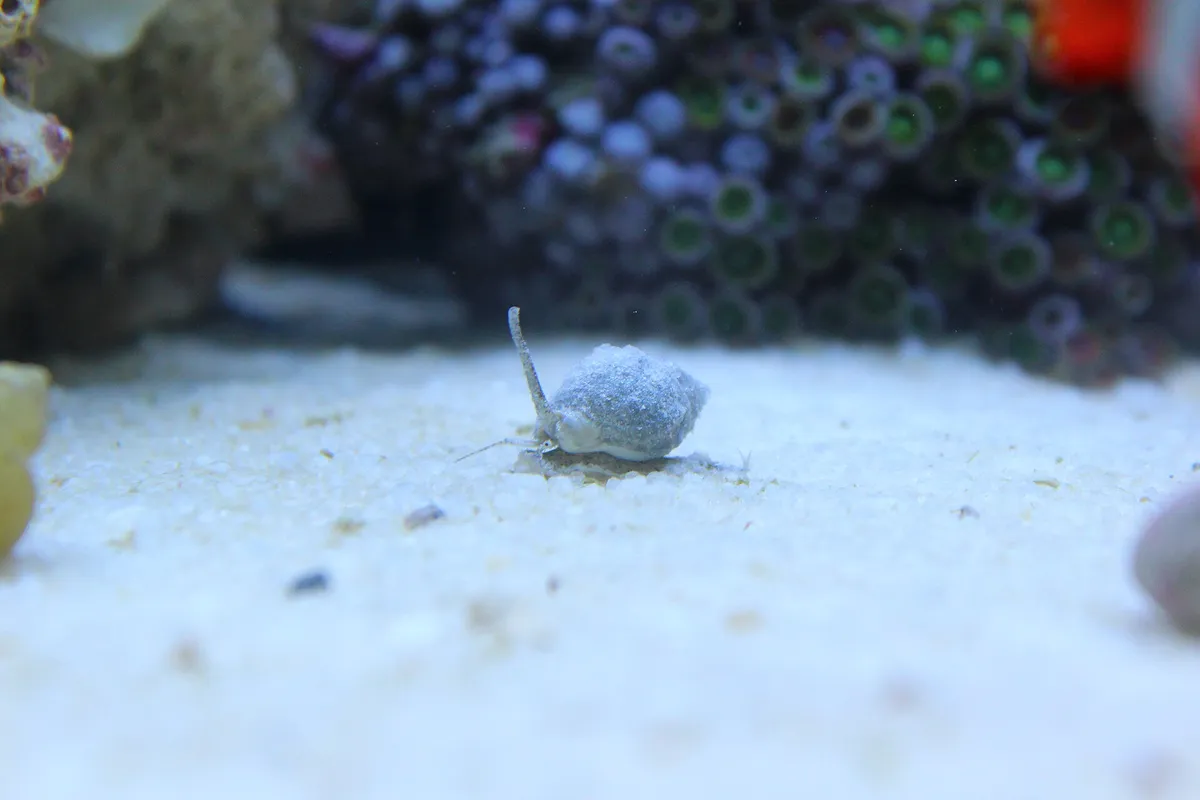
Most aquarium species are small, about 1–2 cm long, with a rounded, ridged shell. The foot is white or pale and quite large, and they have a long siphon and a pair of thin tentacles with eyes at the base.
They bury themselves during the day and come out to feed. If one is lying upside down on the sand, it may be resting, but if it doesn't move for a day, check whether it has died.
Tank setup
Nassarius snails need a sand bed, at least 2.5 cm deep, ideally of fine to medium sand. They are unhappy in bare-bottom tanks or on coarse gravel. A common rule is one snail per 4–8 litres of water, but in a tank that is fed lightly, fewer is better, as they need leftovers to survive.
Water parameters

Keep standard reef conditions: 23–27°C, specific gravity 1.023–1.026 and pH 8.1–8.4. Like other molluscs, they need good calcium and alkalinity for shell growth, and they are very sensitive to copper. Acclimate them slowly using drip acclimation.
Feeding
Nassarius snails are scavengers. They eat leftover fish food, dead animals and detritus. They do not eat algae. In a well-fed tank they find enough on their own, but in a lightly fed tank, drop a small sinking pellet or a piece of frozen food near the sand every few days.
Tank mates
They are safe with fish, corals and other invertebrates. Avoid fish and invertebrates that eat snails: puffers, triggerfish, some wrasses, larger hermit crabs, which kill snails for their shells, and starfish such as the chocolate chip starfish. They work well with other clean-up crew such as trochus snails, which eat algae on the rocks and glass.
Breeding
Nassarius snails often lay small egg capsules on rocks and glass in the aquarium. The larvae drift in the plankton and usually become food for corals and fish, so populations rarely grow at home.
Common problems and lifespan
Starvation in tanks with too many snails and too little food is the most common problem. Copper-based medicines are deadly to them, so never treat the display tank with copper. Read our guide to quarantine for safe treatment.
Nassarius snails can live several years in a reef tank.
Explore other topics
Dive into more aquarium guides across the site.