

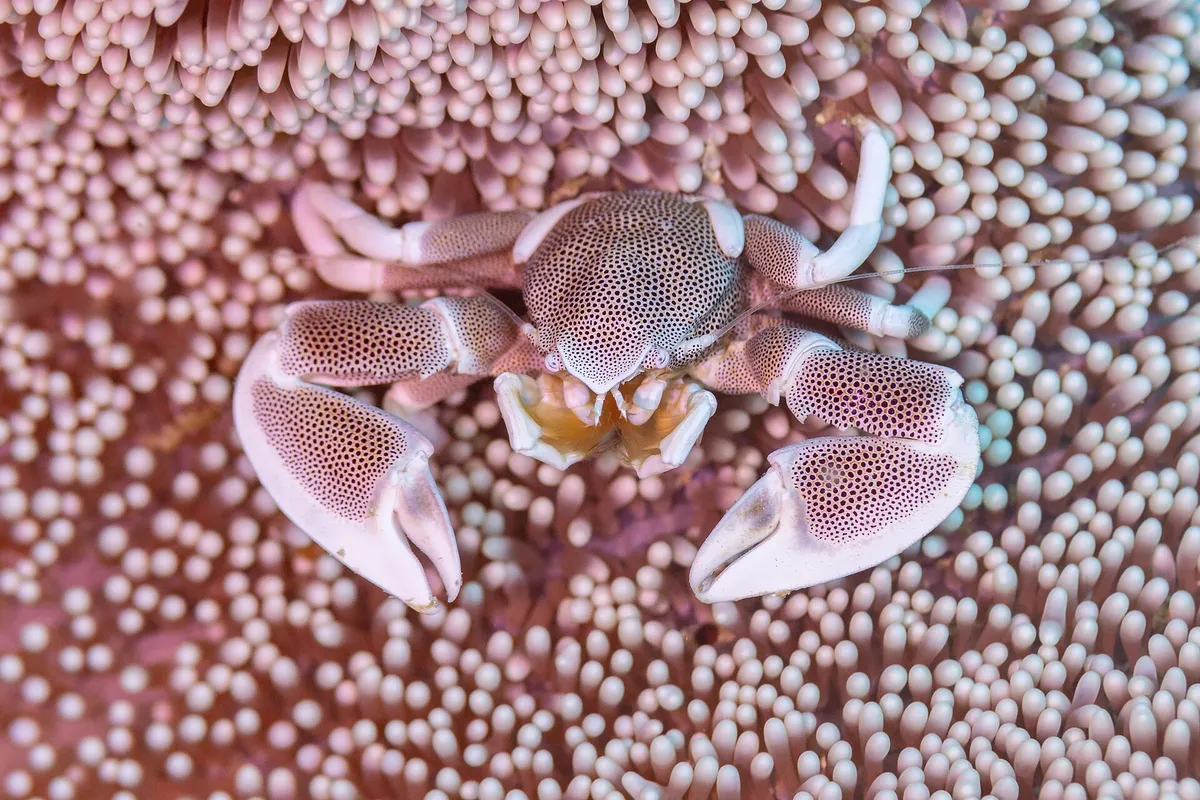
The spotted porcelain crab, often sold as the anemone crab, is a tiny, peaceful crab that lives inside sea anemones. Neopetrolisthes maculatus doesn't hunt or scavenge like most crabs. Instead, it sweeps the water with a pair of feathery fans on its mouthparts, catching plankton and fine particles. Watching it feed is one of the small pleasures of a reef tank.
Where porcelain crabs come from
The species is found across the Indo-West Pacific, from East Africa to the western Pacific. It lives in large sea anemones, especially carpet anemones and some others, often in pairs and sometimes sharing the host with clownfish.
Appearance and behaviour
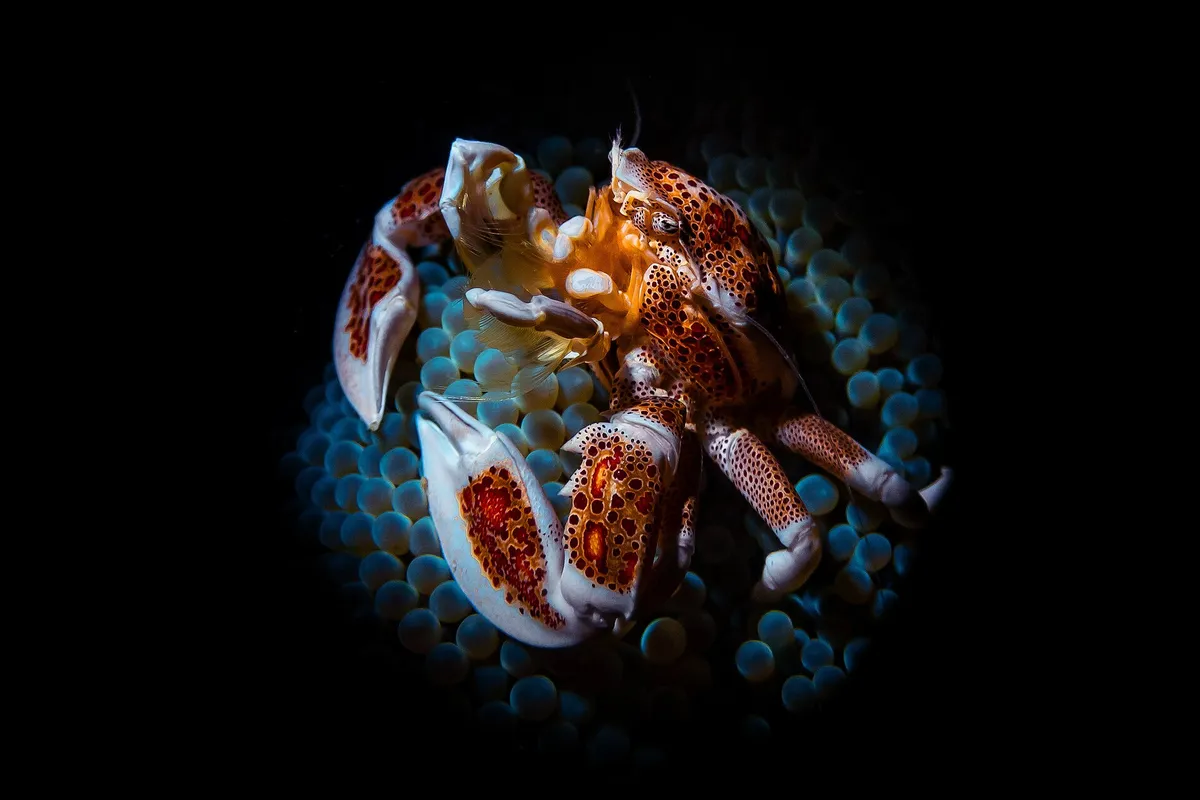
Porcelain crabs are small, with a body about 2–3 cm across. The shell and claws are white to cream with red-brown spots. The claws are large and flat, and are used mostly for display and defence, not feeding. Despite the name, porcelain crabs are more closely related to squat lobsters than to true crabs, and have only three pairs of walking legs visible.
They are peaceful and shy. They defend their anemone from other porcelain crabs, but leave fish and corals alone. If grabbed, they can drop a leg or claw to escape, and it regrows at the next moult.
Tank setup
A porcelain crab can live in a tank as small as 40 litres. It is happiest with a host anemone, such as a carpet or bubble-tip anemone. Without one, it will use a cave or crevice, or a large-polyp coral. Moderate water flow helps bring food to its fans.
Water parameters

Keep the temperature at 24–27°C, specific gravity at 1.023–1.026 and pH at 8.1–8.4. Calcium and alkalinity should stay at normal reef levels to support moulting. Read our guide to reef alkalinity.
Feeding
Porcelain crabs filter food from the water. In most reef tanks they find enough, but they do best with extra help: feed phytoplankton, rotifers, frozen cyclops or other fine foods a few times a week. You can also target-feed with a pipette, releasing food just upstream of the crab.
Tank mates
Porcelain crabs are safe with corals, invertebrates and peaceful fish. Avoid predators that eat small crabs, such as hawkfish, triggerfish, puffers, larger wrasses and dottybacks. They usually share an anemone peacefully with clownfish, such as the saddleback clownfish.
Breeding
Pairs often breed in aquariums, and females carry eggs under the tail. The larvae drift in the plankton and are rarely raised at home.
Common problems and lifespan
Being eaten by tank mates is the main cause of loss. Failed moults point to low calcium or iodine, or to stress. After moulting, the crab hides while its new shell hardens, and the old shell can look like a dead crab, so check before removing it.
Porcelain crabs live around two to three years.
Explore other topics
Dive into more aquarium guides across the site.