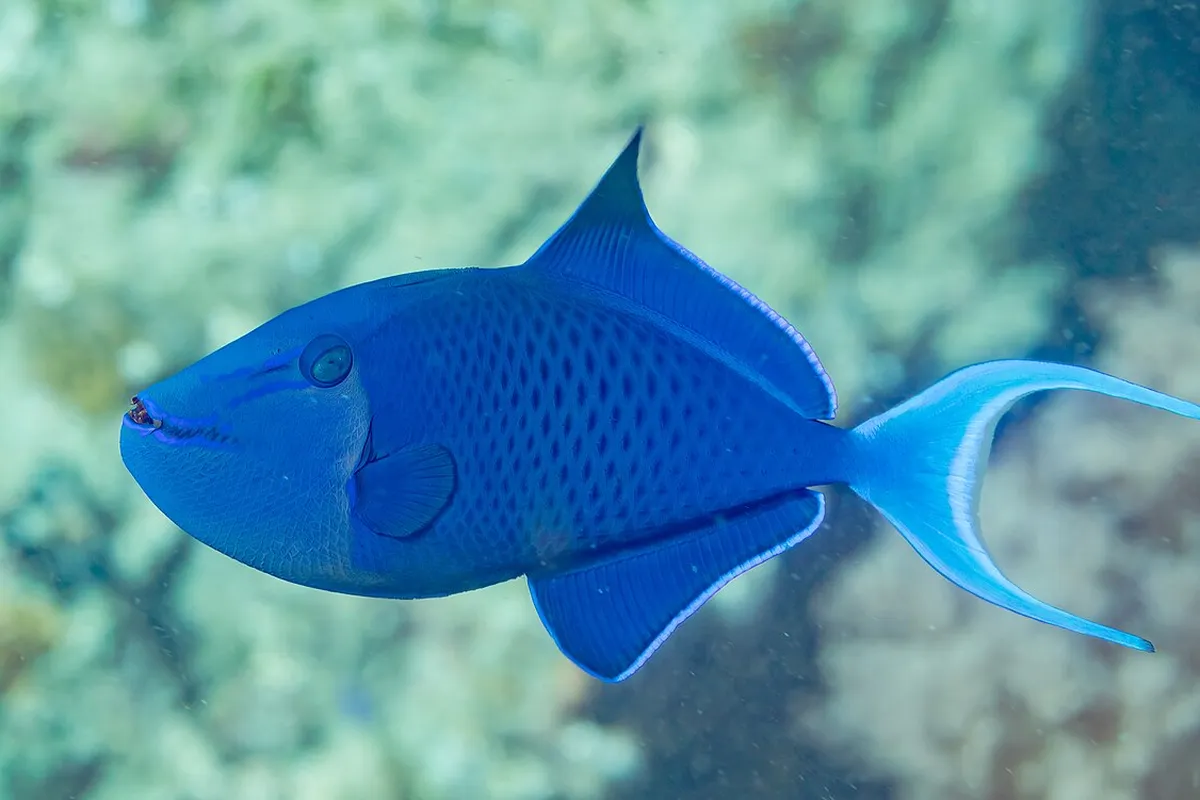
The niger triggerfish, also called the redtooth triggerfish, is a deep blue-purple fish with long streamers on its tail and bright red teeth. It reaches about 40 cm in the wild and 25–30 cm in aquariums.
Odonus niger is widely considered one of the more peaceful triggerfish. It still has the strong jaws and appetite of a trigger, so plan for a fish-only tank or a reef without crustaceans.
Where niger triggers come from
The species ranges across the Indo-Pacific, from the Red Sea to the Marquesas and Japan. Large groups feed on plankton above outer reef slopes and retreat to holes in the reef when threatened.
Appearance and behaviour
Colour shifts from green-blue to deep purple depending on mood and light. Like all triggers, it can lock its first dorsal spine upright to wedge itself into a crevice.
Niger triggers are usually calm with other fish, but individuals vary and some become aggressive with age. Keep one per tank.
Tank setup
An adult needs at least 500 litres, with plenty of swimming space and secure rockwork. Triggers move rocks, so build stable structures. Strong filtration and a skimmer handle their messy eating.


Water parameters
- Temperature: 24–27°C
- pH: 8.1–8.4
- Specific gravity: 1.020–1.025
Feeding
Feed a varied, meaty diet: krill, mysis, chopped squid, clam and prawn, and marine pellets, with some spirulina. Include hard-shelled foods such as whole shrimp to help wear down their teeth, which grow continuously.
Tank mates
Good companions include tangs, large angelfish such as the emperor angelfish, larger wrasses and puffers. Avoid small fish, crabs, shrimp, snails and urchins, which are all on the menu.
Breeding
Niger triggers nest in the sand in the wild, but they have not been bred in home aquariums.
Common problems and lifespan
They are hardy fish. The main problems are lost invertebrates and occasional aggression in older fish. They can live ten years or more.
Explore other topics
Dive into more aquarium guides across the site.