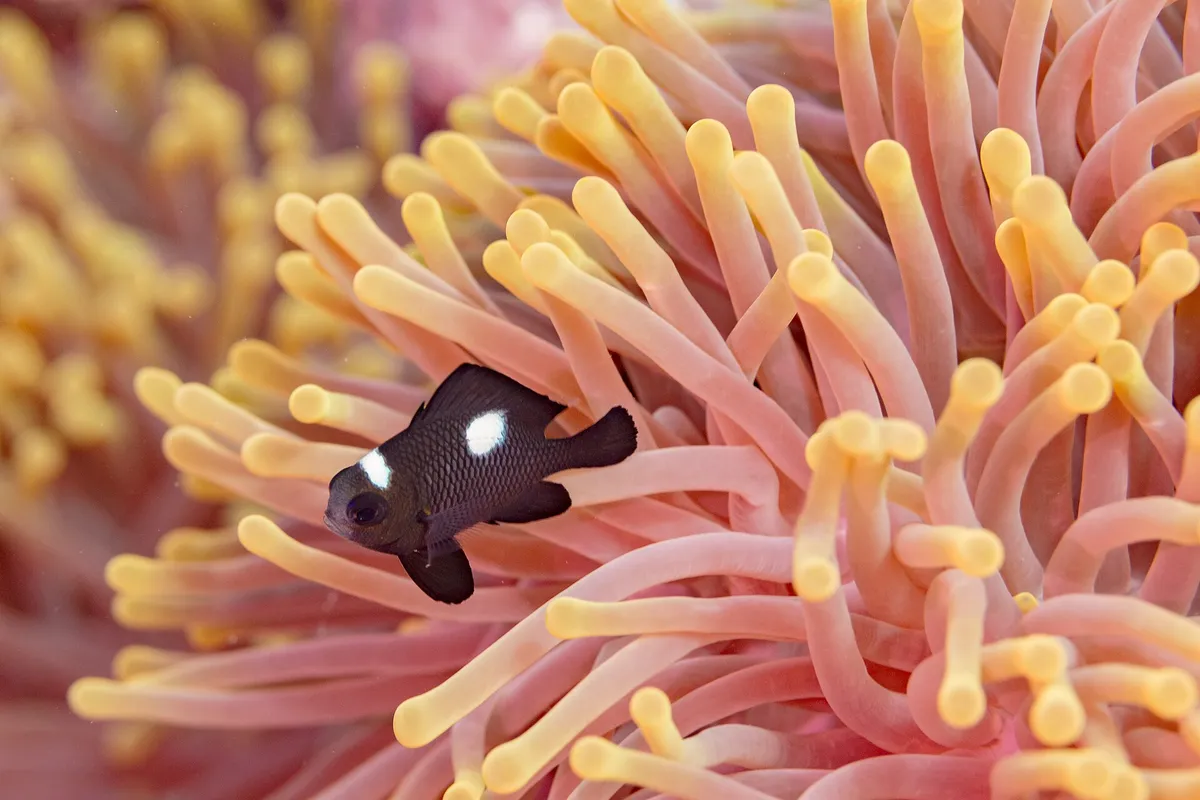
The domino damselfish, or three-spot damsel, looks like a domino tile: jet black with white spots. Dascyllus trimaculatus is one of the hardiest marine fish you can buy, and juveniles even share anemones with clownfish. That toughness comes with a temper, though, and adults can become the bully of the tank.
Where domino damselfish come from
The species is found throughout the Indo-Pacific and Red Sea, from East Africa to the central Pacific. Juveniles live in anemones, sea urchins and branching corals, often alongside clownfish. Adults move out onto the reef, where they form groups around coral heads.
Appearance and behaviour
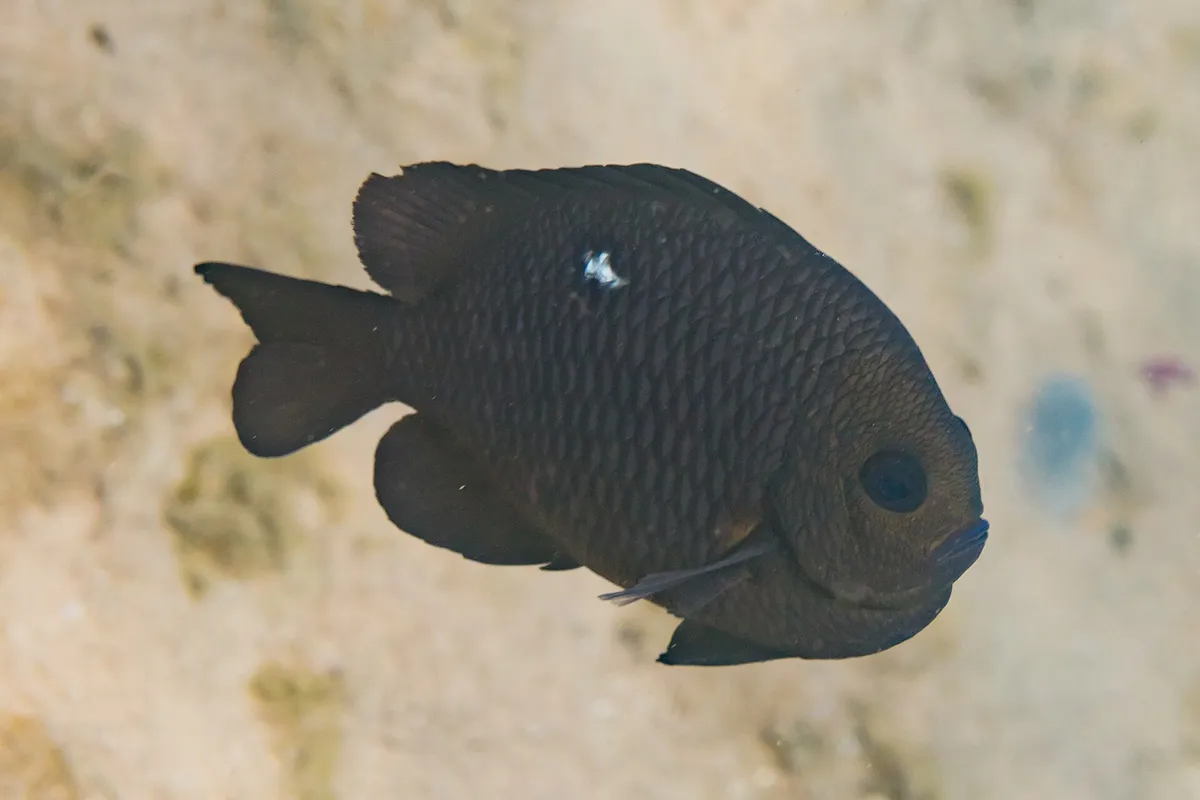
Juveniles are velvet black with a white spot on each side and one on the forehead. As they grow to their adult size of about 14 cm, the spots fade and the body turns grey-black. Adults are deep-bodied and strong.
Young dominos are fairly peaceful in groups, but adults become very territorial. They defend a patch of rock against fish much larger than themselves, and will nip at hands during tank maintenance.
Tank setup
A single adult needs at least 200 litres. Provide plenty of rockwork with caves and crevices, so it can claim a territory without dominating the whole tank. Domino damsels are often used to cycle tanks, but this is no longer recommended: fishless cycling is safer, and a damsel added first will claim the whole tank.
Water parameters

Keep the temperature at 24–28°C, specific gravity at 1.020–1.025 and pH at 8.1–8.4. Dominos tolerate a wide range of conditions and are among the hardiest marine fish, but stable water keeps them at their best.
Feeding
They are omnivores that pick plankton from the water. Feed marine flakes and pellets, frozen mysis, brine shrimp and some algae-based food, once or twice a day.
Tank mates
Choose tank mates that can stand up for themselves: tangs, larger wrasses, triggerfish, larger angelfish and hawkfish. Add the domino last, so the other fish already have territories. Avoid gentle fish such as gobies, firefish, cardinals and royal grammas in smaller tanks. Juveniles can share a large anemone with clownfish, but adults usually push clownfish out.
Breeding
Males prepare a nest site on rock and court females with a fast up-and-down swimming display. The male guards the eggs until they hatch, usually after a few days. Raising the tiny larvae requires rotifers and is rarely attempted at home.
Common problems and lifespan
Aggression is the main problem, and once a domino has taken over a tank, the only fix is to remove it, which often means taking out the rockwork. Disease is rare. For gentler damsels, see our blue-green chromis and yellowtail blue damsel guides.
Domino damselfish can live 10 years or more.
Explore other topics
Dive into more aquarium guides across the site.