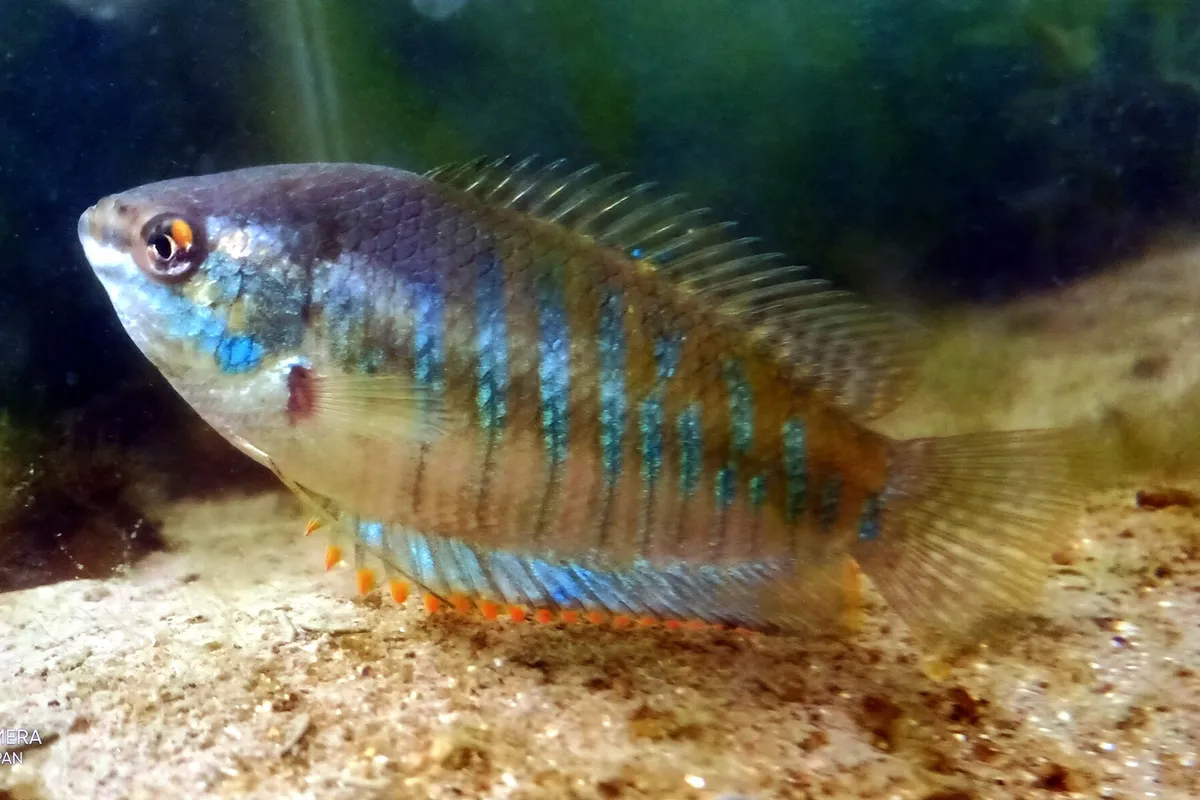
The banded gourami, sometimes called the striped or giant gourami, is the larger cousin of the familiar dwarf and honey gouramis. Trichogaster fasciata grows to about 10 cm and has a row of turquoise and orange bars down its sides. It is calmer and hardier than many gouramis in the trade, and makes an excellent centrepiece in a planted community tank.
Where banded gouramis come from
The species is found across northern India, Bangladesh, Nepal and Myanmar. It lives in slow rivers, ponds, ditches, rice paddies and lakes, usually where plants are thick and the water is warm and still. It is a common fish in the region and is also caught for food.
Appearance and behaviour
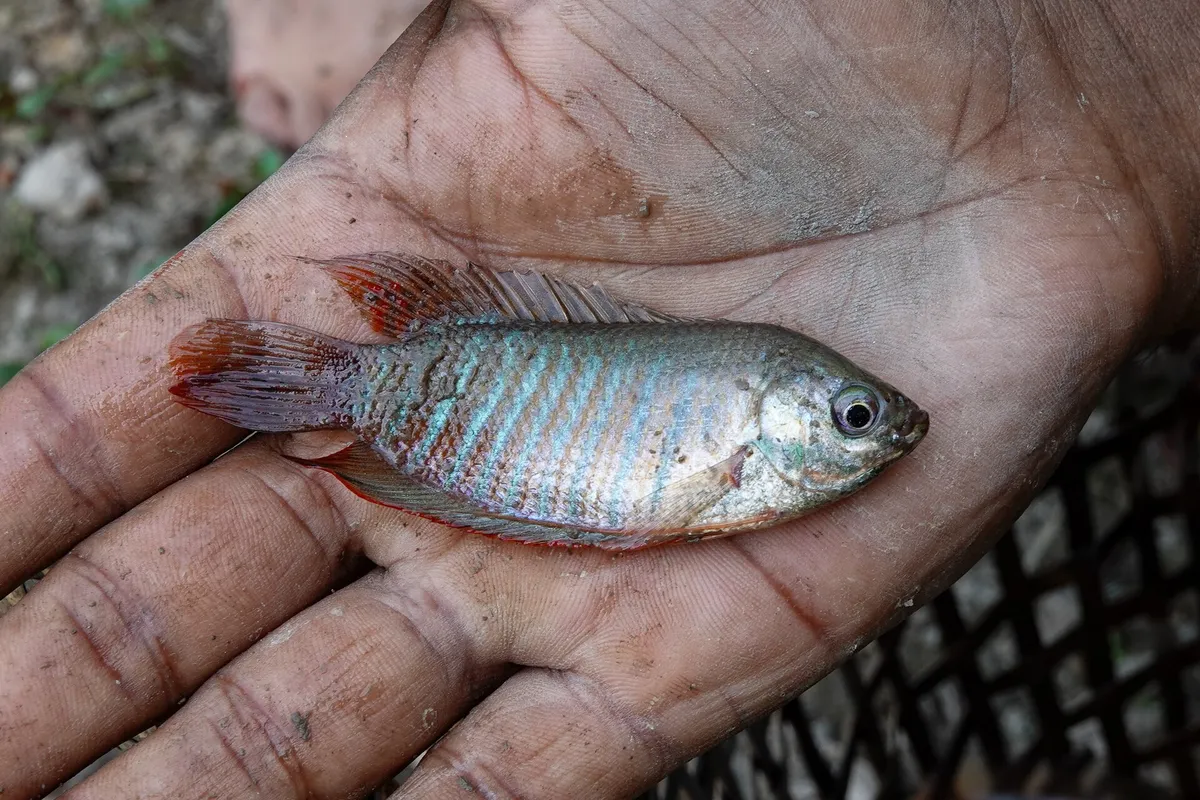
Males show blue-green and orange vertical bars, a red-edged anal fin and, in breeding colour, a darker throat. Females are paler and silvery, with fainter bars. Both have the long, thread-like pelvic fins that gouramis use to touch and explore. Like all labyrinth fish, they breathe air from the surface.
Banded gouramis are peaceful and a little shy. Males can be territorial with each other, especially when breeding, so keep one male with one or two females in smaller tanks.
Tank setup
A pair needs at least 80 litres. Give them a planted tank with tall stems and floating plants, some driftwood and gentle flow. They prefer calm water and dim to moderate light. A lid keeps the air above the water warm and humid, which protects their labyrinth organ.
Water parameters

Keep the temperature at 22–28°C, pH at 6.0–7.5 and water soft to moderately hard. Banded gouramis are adaptable, but they colour up best in slightly soft water with plants and floating cover. Change 25% of the water weekly.
Feeding
They are omnivores. Feed a good flake or small pellet as the base, plus frozen or live bloodworms, daphnia and brine shrimp, and some vegetable foods. They eat from the surface and mid-water, so make sure faster fish do not take everything first.
Tank mates
Good companions are peaceful fish of similar size: rasboras, larger tetras, peaceful barbs such as cherry barbs, loaches, corydoras and plecos. Avoid fin-nippers such as tiger barbs, which target the long pelvic fins. Do not keep them with dwarf gouramis or bettas in small tanks, as males may fight.
Breeding
Males build a bubble nest at the surface, often mixed with bits of plant. When the female is ready, the pair spawns under the nest, and the male gathers the eggs into it and guards them. Remove the female after spawning, and remove the male once the fry are free-swimming. Feed the fry infusoria first, then baby brine shrimp. Lower the water level and keep the air above the tank warm while the fry develop their labyrinth organ.
Common problems and lifespan
Banded gouramis are hardy. Most problems come from fin-nipping tank mates, cold drafts over the surface and poor water quality. For other gouramis, see our honey gourami and dwarf gourami guides.
Banded gouramis live about four to six years.
Explore other topics
Dive into more aquarium guides across the site.