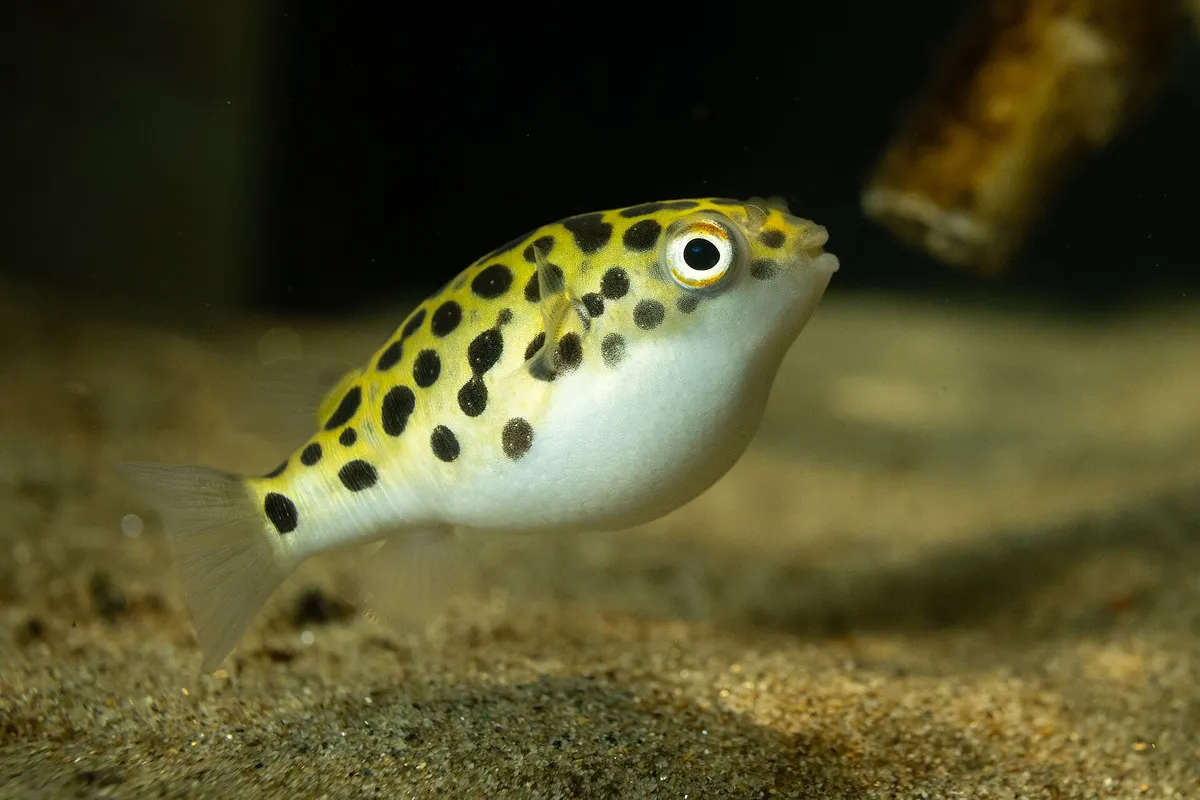
The green spotted puffer is one of the most personable fish you can keep. It watches you, follows your finger across the glass and begs at feeding time. Dichotomyctere nigroviridis (formerly Tetraodon nigroviridis) is often sold in the freshwater section as a cute community fish. It is neither a freshwater fish nor a community fish.
Adults reach about 15 cm, need brackish to marine water and have teeth that keep growing. Get those three things right and a GSP can live for over a decade.
Where green spotted puffers come from
The species is found across South and Southeast Asia, from India and Sri Lanka to Indonesia and the Philippines. It lives in estuaries, mangroves and the lower reaches of rivers. Juveniles may be found in fresher water, but adults move into brackish and coastal water.
Appearance and behaviour
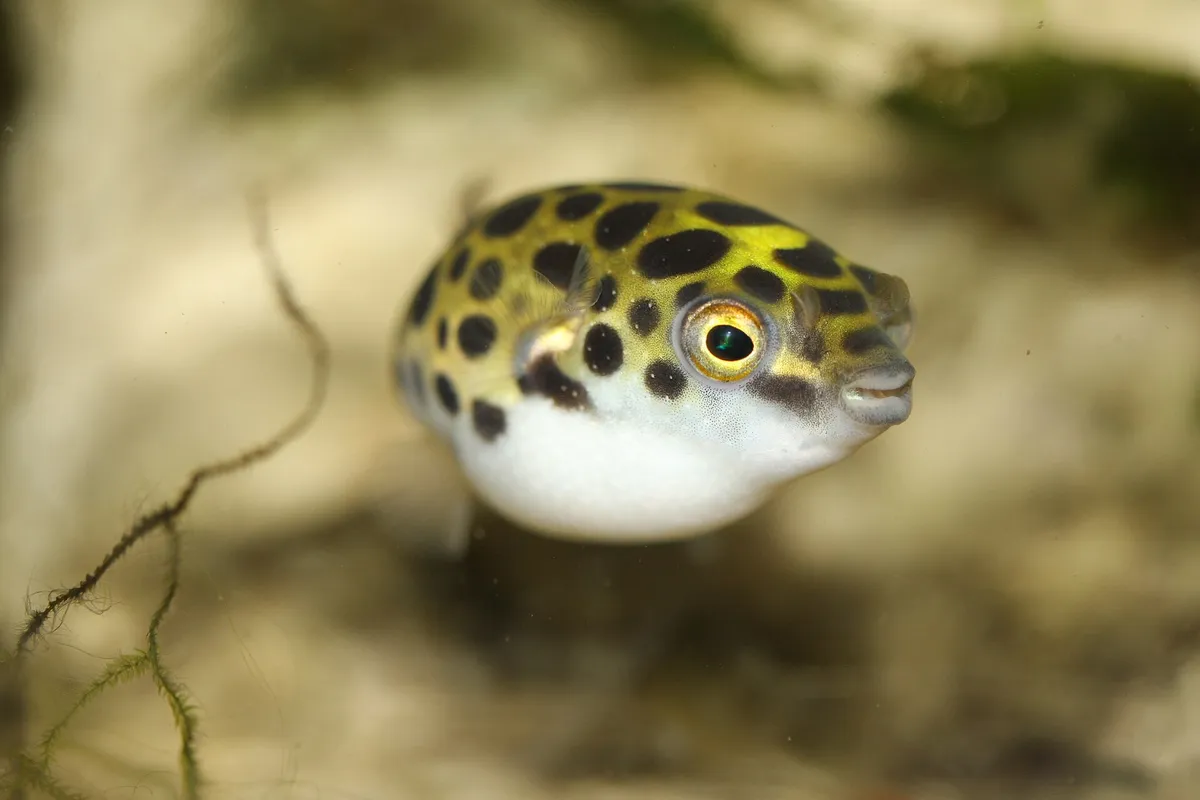
The back is bright yellow-green with bold black spots, and the belly is white. Puffers inflate with water when stressed, which should never be encouraged, as it harms them. They are active, curious and very aggressive feeders.
GSPs are fin-nippers and will attack most tank mates. Some can be kept in groups in a large tank, but many are best kept alone.
Tank setup
A single adult needs at least 120 litres, and more is better. Use sand or crushed coral, rocks and driftwood to break up sight lines, and an oversized filter, as puffers are very messy eaters. Hardy plants such as Java fern work in low brackish water, but will die as you raise the salinity.
Salinity and water parameters

Juveniles can be kept in low brackish water, at a specific gravity of 1.005–1.008. As they grow, raise it slowly to 1.010–1.018, and many keepers move adults to full marine water. Change salinity by no more than 0.002 per week and measure it with a refractometer. Keep the temperature at 24–28°C and pH at 7.5–8.5, and change 30–50% of the water weekly.
Feeding and teeth
Puffers have four fused teeth that form a beak, and that beak keeps growing. Hard-shelled food is what wears it down. Feed snails, clams and mussels in the shell, cockles, crab legs and shrimp with the shell on, plus frozen bloodworms and krill. Without hard foods, the beak overgrows and the puffer can no longer eat, and it will need to be trimmed under sedation.
Tank mates
A species tank is the safest choice. Some keepers have success with fast brackish fish such as monos and spotted scats in very large tanks, but even these can be bitten. Never keep them with slow, long-finned or small fish, or with shrimp and snails you want to keep.
Breeding
Green spotted puffers have rarely been bred in captivity. In the wild they are thought to spawn on hard surfaces in brackish or marine water, with the male guarding the eggs. Aquarium fish are wild caught.
Common problems and lifespan
Long-term freshwater keeping, overgrown teeth and poor water quality cause most problems. Puffers are scaleless and very sensitive to copper and many medications. For a smaller freshwater puffer, see our pea puffer guide.
With good care, green spotted puffers live 10–15 years.
Explore other topics
Dive into more aquarium guides across the site.