

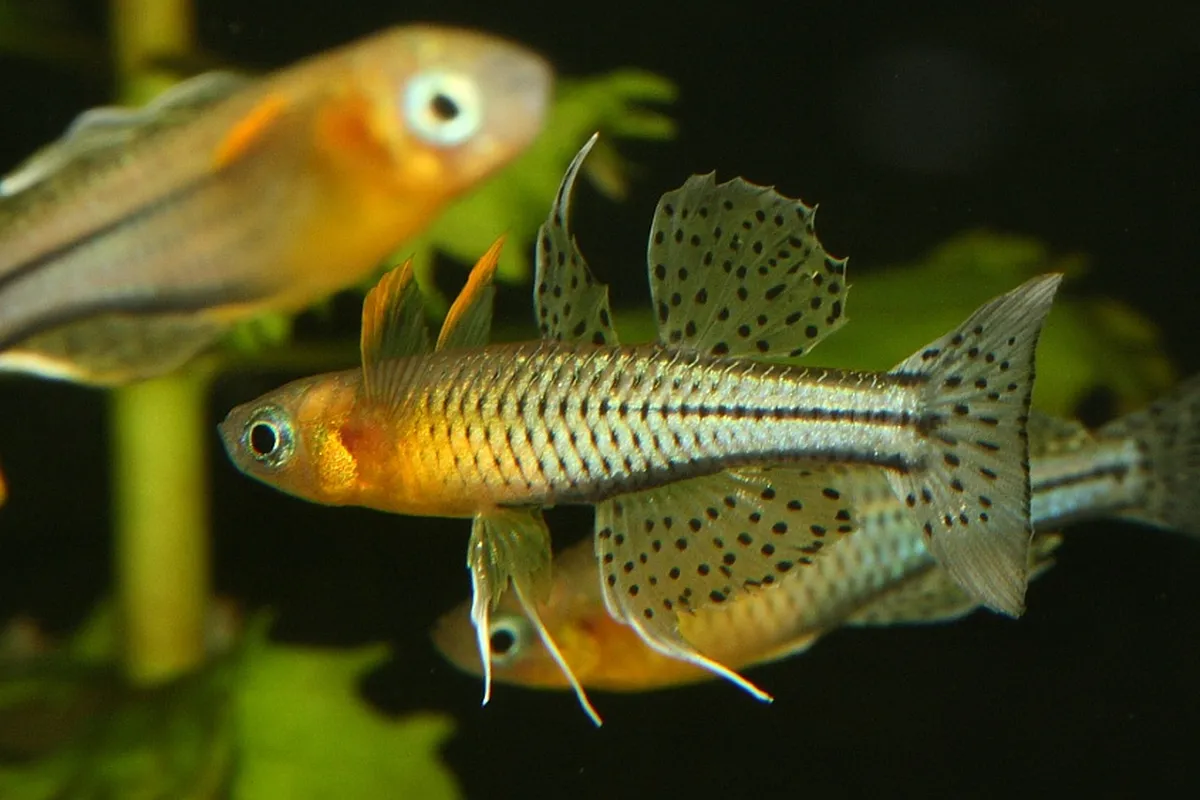
The spotted blue-eye is one of the smallest rainbowfish in the hobby, and one of the prettiest. Males have pale blue eyes, a yellow body and large, black-speckled fins that they flare constantly at each other. Pseudomugil gertrudae rarely tops 3.5 cm, so a small group fits comfortably in a planted nano tank.
It is a peaceful, active fish that suits a calm community or a species tank. The main things it needs are clean, soft to medium water, plenty of plants and very small food.
Where spotted blue-eyes come from
The species lives in northern Australia, southern New Guinea and the Aru Islands. It is found in slow, clear streams, swamps and lily-covered lagoons, usually among dense vegetation. Several regional forms are sold, named after their collection sites, such as Aru II or Wapoga. Keep forms separate if you want to maintain them true.
Appearance and behaviour
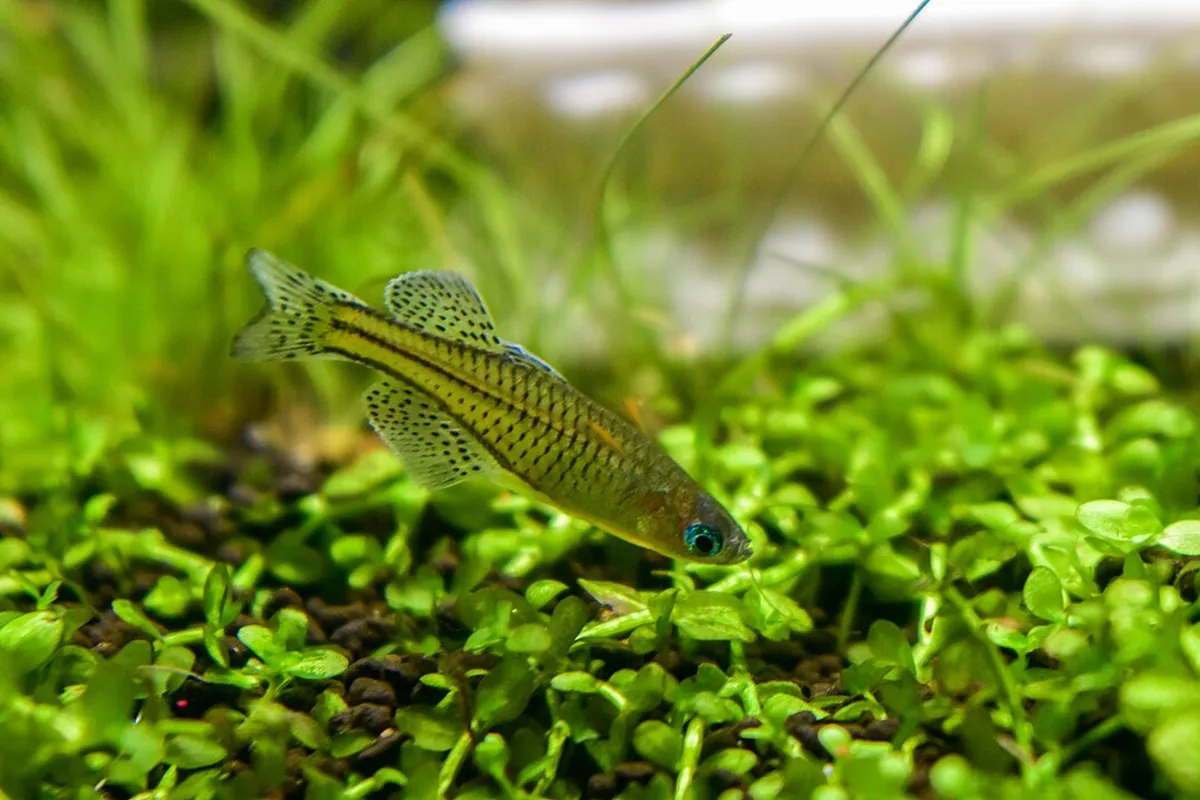
Males are the showpieces, with long first dorsal fins and dark-spotted second dorsal, anal and tail fins. Females are plainer, with clear fins and a light yellow body. Males display to each other for hours, spreading every fin, but they rarely cause real damage.
Keep at least six fish, ideally with more females than males. In a group they spread out and display; kept alone or in pairs, they hide and lose colour.
Tank setup
A 40–60 litre tank suits a group of six to ten. Use plenty of fine-leaved plants and floating cover, and leave an open swimming area near the front. A gentle filter, such as a sponge filter, is ideal, as these fish struggle in strong flow. A tight lid matters because they jump.
Water parameters

- Temperature: 24–28°C
- pH: 6.0–7.5
- Hardness: 2–12 dGH
They are sensitive to nitrate build-up, so change 20–30% of the water weekly. Stable, clean water matters more than hitting exact numbers.
Feeding
Their mouths are tiny. Offer crushed flakes, micro pellets, baby brine shrimp, daphnia and other live foods in small amounts twice a day. They feed mostly at the surface and in midwater and rarely pick food from the bottom.
Tank mates
Choose fish of similar size and temperament: small rasboras, ember tetras, pygmy corydoras, small gobies and dwarf shrimp. Other blue-eyes, such as the forktail blue-eye, work well in larger tanks. Avoid fin-nippers and anything big enough to eat them.
Breeding
Spotted blue-eyes spawn almost daily, scattering a few large eggs among fine plants or a spawning mop. The parents eat eggs and fry, so move the mop to a separate container every few days. Eggs hatch in 10–14 days, and the fry can take infusoria and then baby brine shrimp. Our guide to first foods for fry covers the early weeks.
Common problems and lifespan
Most losses come from poor water quality, starvation in a busy tank, or jumping. They are short-lived, usually one to two years, so keeping a breeding group going is the best way to keep them long term.
Explore other topics
Dive into more aquarium guides across the site.