

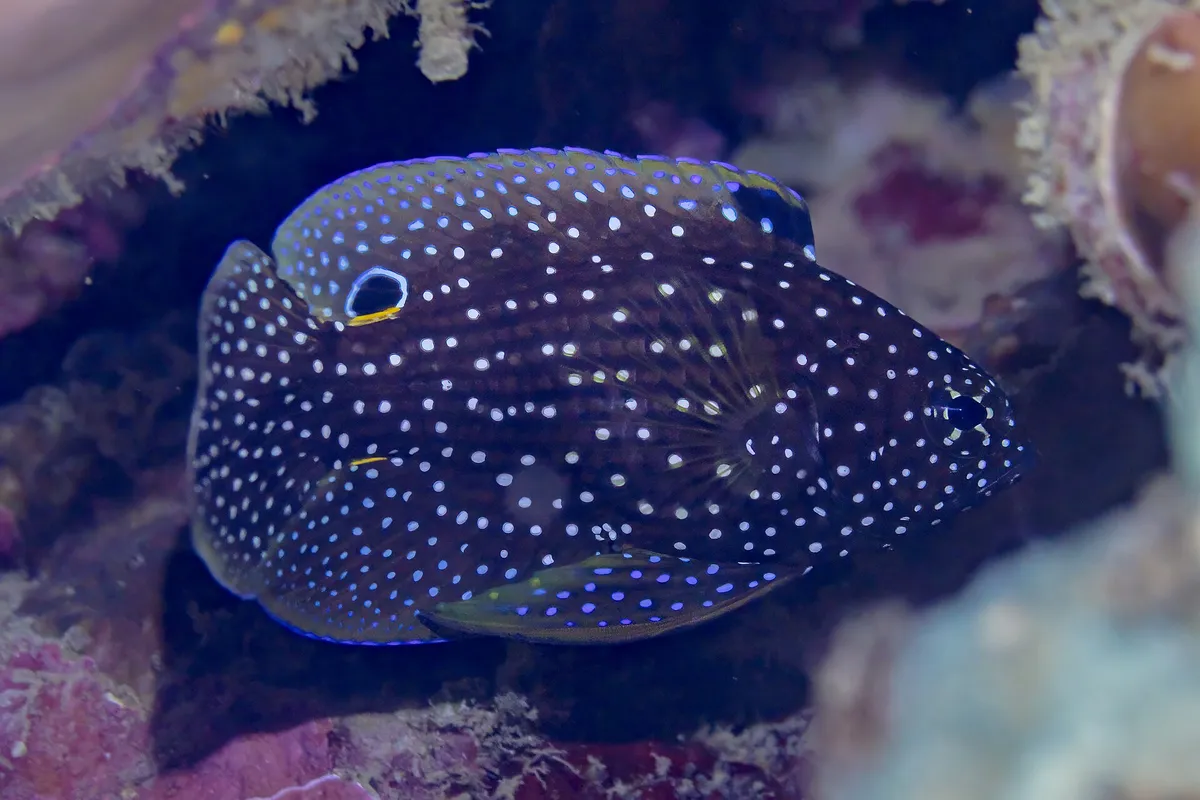
The marine betta, also called the comet, is one of the most elegant fish you can keep in a marine tank. Its dark body and huge fins are covered in tiny white spots, and a gold-ringed eye-spot sits at the back of the dorsal fin. When threatened it pokes its head into a cave so the tail end looks like the head of a moray eel.
Calloplesiops altivelis is hardy and mostly reef safe, but it is shy, slow to feed at first, and will eat small fish and shrimp. Here is how to keep one well.
Where marine bettas come from
Marine bettas live across the Indo-Pacific, from the Red Sea and East Africa to the central Pacific. They hide in caves and crevices on reef slopes, usually at 3–45 m, and come out mostly at dusk to hunt.
Appearance and behaviour
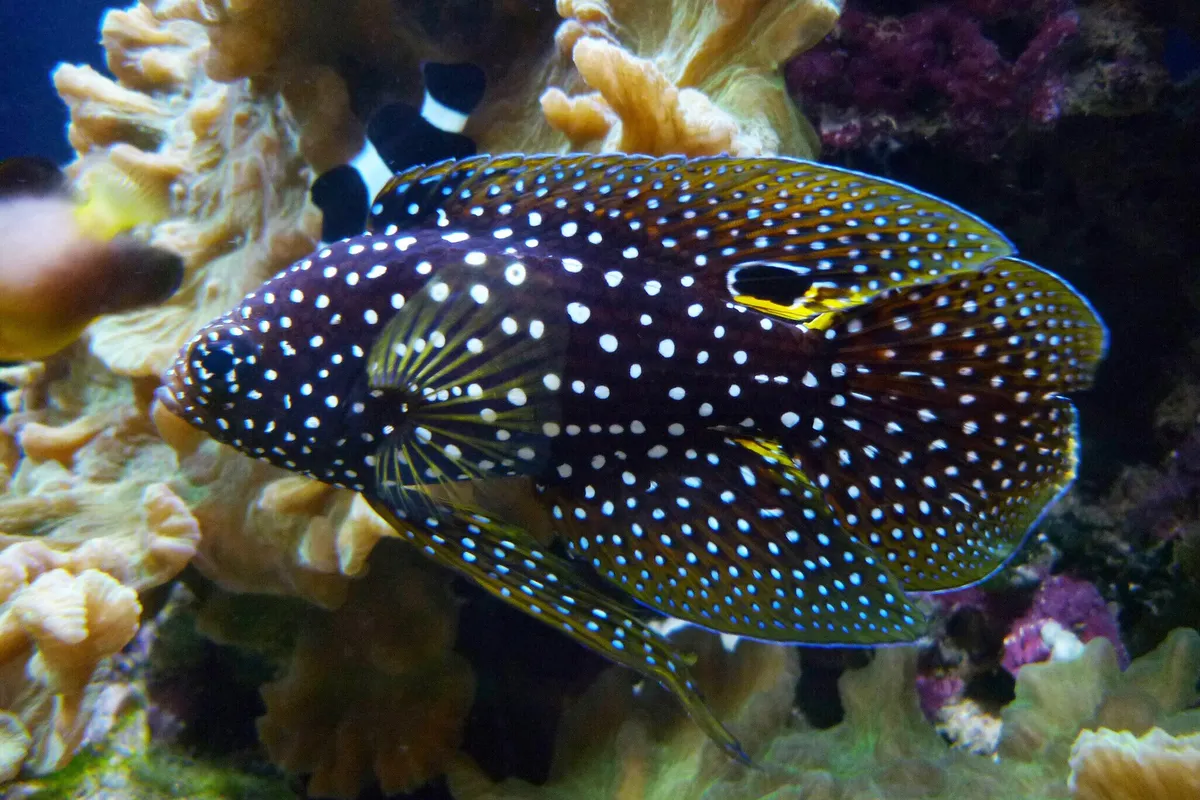
Adults reach 15–20 cm. The body is dark brown to black with dense white to blue spots, and the dorsal, anal and pelvic fins are large and rounded. The eye-spot near the tail, together with the fin shape, mimics the head of the white-mouth moray eel.
Marine bettas are calm and slow-moving. They spend much of the day in or near a cave, hanging still in the water. They are peaceful towards fish too large to swallow but may fight with their own kind, so keep one per tank.
Tank setup
One marine betta needs at least 200 litres, with plenty of rockwork forming caves and overhangs. Moderate flow and subdued lighting in part of the tank help it feel secure. Use a lid: although calm, marine bettas can jump when startled.

Water parameters
Keep the temperature at 24–27°C, salinity at 1.023–1.025, pH 8.1–8.4 and nitrate below 20 mg/l. Marine bettas are hardy and tolerate a range of conditions, but stable water keeps them active. See our guide to marine parameters to test.
Feeding
Marine bettas are carnivores that prefer live food when first imported. Start with live mysis or ghost shrimp, then wean them on to frozen mysis, krill, chopped squid and silversides. Feed once a day or every other day, at dusk if possible, near their cave.
Tank mates
Choose calm fish that are not too aggressive and are too big to eat: clownfish, larger cardinalfish, tangs, rabbitfish and peaceful wrasses. Avoid small gobies, firefish, chromis and small shrimp, which can be eaten. Very boisterous fish will stop the betta coming out to feed. Corals and larger invertebrates are safe.
Breeding
Pairs have spawned in aquariums, laying a ball of eggs in a cave that the male guards. Raising the larvae is difficult, but captive-bred marine bettas are now available and are usually easier to feed.
Common problems and lifespan
Not feeding after import is the main issue. Give new fish a quiet quarantine tank with a cave and live food. Once settled, marine bettas are tough and can live 10–15 years.
Explore other topics
Dive into more aquarium guides across the site.
