

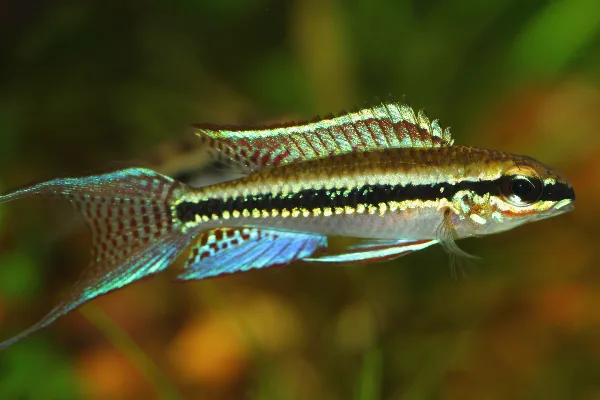
Checkerboard cichlid is a polite name for a demanding fish. Dicrossus filamentosus (often still sold as Crenicara filamentosa in old books) is a slender dwarf from Rio Negro and Orinoco blackwaters, 6–8 cm, painted with a grid of dark squares on a pale body, males growing filamentous fin extensions. It lives in water that would make a livebearer curl up: very soft, very acidic, stained dark, low conductivity. It is more of a blackwater specialist than a typical farmed cockatoo apisto. It is not an apisto. It is not a Julie. It is not a community “dwarf cichlid” for a tank that also holds a pearl cichlid.
If you cannot mix RO and keep pH in the fives, do not buy this species. Buy a flag acara or a steindachneri instead. The checkerboard is the one you keep when the water already looks like tea and the TDS meter already looks like a mistake.
Rio Negro tea, Orinoco tea, almost no minerals
Wild fish come from extremely soft blackwaters of the Rio Negro and Orinoco systems. The water is warm, 24–28°C, pH often 4.5–6.0 in nature, conductivity so low that “tap water” is a foreign language. The habitat is shaded, with leaf litter, fine sand, roots, and almost no hardness. Cardinal tetras actually do share this chemical world — which is why a cardinal tetra article is a relevant chemistry cousin here, and why it was a disastrous related-reading link on a Tanganyika post. Dicrossus still is not a tetra. It is a cichlid that hunts in the same stained water, holds a small territory, and spawns as a pair on leaves or fine substrate in that tea.
Copy the tea. Copy the emptiness of minerals. Do not copy a Tanganyika salt mix. Do not copy a Geophagus sand river at pH 7.2 and 350 litres of hardness.
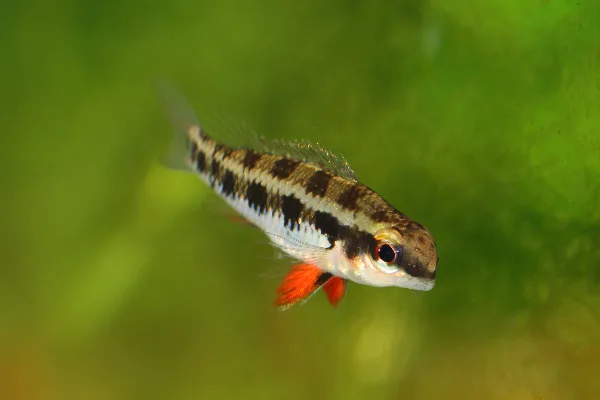
A grid, a needle body, filaments on the male
The checkerboard is the field mark: rows of dark squares along a pale, slightly yellowish or pearly body. Males develop longer, filamentous dorsal and caudal extensions and look almost like a different fish from the rounder female. They are slimmer than a ram, slimmer than a flag acara, more elongate than most apistos. The pattern can fade to almost nothing in poor water — a washed checkerboard is a water report.
Do not confuse them with flag cichlids (Mesonauta), which are larger, deeper, and not this grid. Do not confuse them with Marlier’s Julie, which is a Tanganyika checker of a completely different construction.
Eighty litres of stained, still, empty conductivity
A pair belongs in 80 litres, planted or littered, dim, with fine sand and leaves. Gentle sponge filtration. No crushed coral, no limestone, no shells. A few caves or broad leaves as spawn sites. This scape looks closer to a panduro tank than to any Tanganyika tank, and the water is even softer than many apisto tanks. It is not a 25 litre Boraras swamp only — Dicrossus still needs a pair territory — but the chemistry is in the same family as peat rasboras, not in the family of ocellatus.
Lid: they can jump when startled, though they are not scissortails. Light: low. Flow: almost none.
The pH number that scares shops
Temperature 24–28°C. pH 4.5–6.5, with breeding often needing the lower half. Hardness as low as you can stably manage. RO water, botanicals, maybe a commercial blackwater mix, measured so you do not crash to pH 3.5 by accident. Ammonia in soft acidic water is still lethal; cycle with the understanding that tests and biology behave differently at low pH — do not add these fish to a new tank. Chemistry basics matter more here than in a pearl cichlid article. Cycling still comes first.

If your tap is pH 8 and 20 dGH, this is an RO project or it is a different species. There is no “they will adapt” that keeps the checkerboard looking like a checkerboard.
Tiny foods in tea-coloured water
Live foods are the honest staple: baby brine, microworms, grindal, daphnia, mosquito larvae if clean. Frozen cyclops. Then the smallest pellets. They have small mouths and a shy feeding style. They will not compete with danios. They will not sift like altifrons. They will not graze zucchini like Uaru. If you cannot feed live or frozen regularly, this is a hard species.
Males show filaments when well fed in good water. Females fill for spawn. Thin fish in a tea tank are still starving; tannins do not replace calories.
A pair, maybe cardinals, never a Julie
The classic companion conversation is other Rio Negro fishes: cardinal tetras, some small pencilfish, Nannostomus, perhaps a gentle suckermouth that tolerates the pH. That cardinal tetra pairing is habitat-true. A Tanganyika pairing is habitat-false. Apistos can overlap in a large blackwater tank if you like two territorial systems; in 80 litres, pick one genus. Flag acaras want similar softness but are a different, rounder, more plant-spawning fish. Shell-dwellers would die here.
Shrimp: possible with adults, incompatible with fry, and the pH must suit the shrimp — many commercial shrimp will not like pH 5.
A pair on a leaf in water you can barely buffer
They form a pair (not an apisto harem as the default). Eggs go on a leaf, wood, or stone. Both parents may tend. Soft water is required for egg development; this is why people fail. Fry are minute and need infusoria-grade foods. This is closer to a ram/flag acara spawn than to a cave apisto, and nothing like a mouthbrooding eartheater or a shell-dweller.
If the pair eats the eggs, check water, diet, and whether you keep walking up to the glass. They are shy spawners in tea.
Invisible pattern, sudden deaths
The pattern goes first. Then you find them on the sand. Hard water, copper (from pipes or meds), and temperature shocks are classic. Quarantine in the same blackwater, with leaves, not in a hard-water hospital that “cured ich for cichlids.” Ich treatments that raise salt are a poor match. Prevention is the RO system you already committed to.
Relevant reading: cardinal tetra for the same chemical neighbourhood (not as a care clone — tetras school, Dicrossus pairs), A. agassizii if you wanted a slightly more typical dwarf, flag acara if you wanted a gentler, less extreme soft-water pair. Do not follow a fairy cichlid link as if it were related care. It is not.
Explore other topics
Dive into more aquarium guides across the site.