

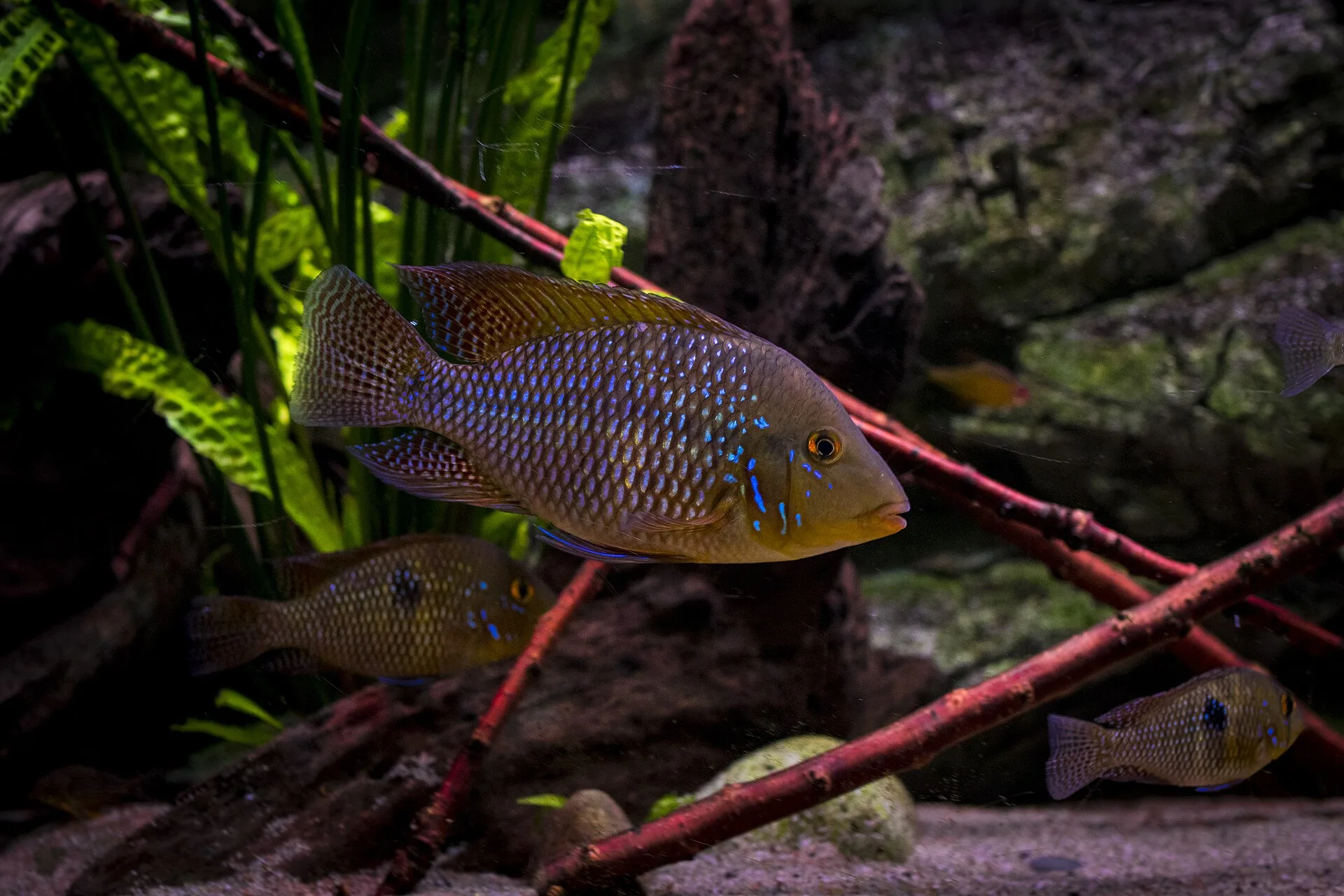
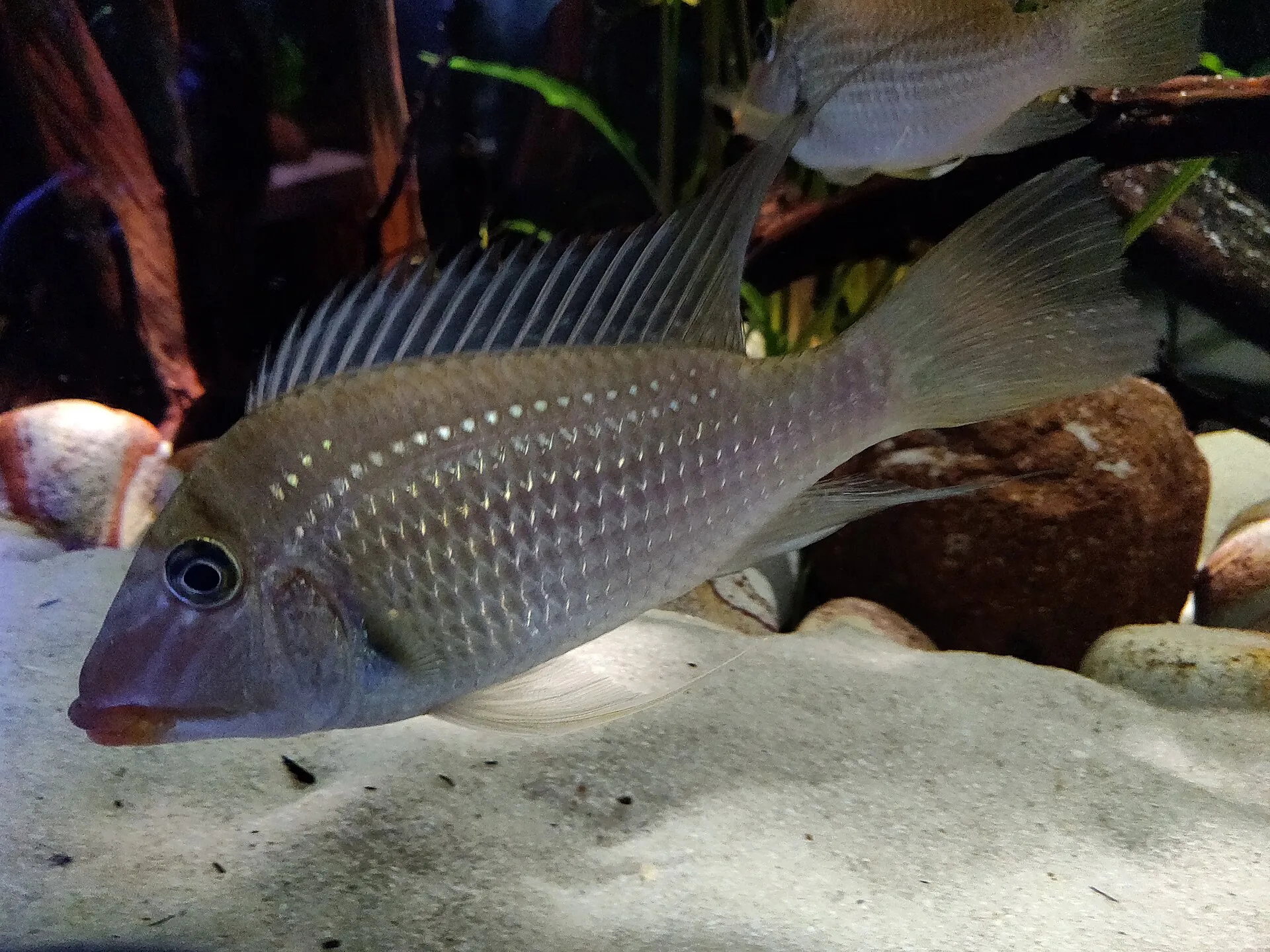
The pearl cichlid is the geophagine that does not read the Amazon eartheater script. Geophagus brasiliensis (the brasiliensis complex in the trade is messy, but the fish you are sold as pearl cichlid is this idea) comes from coastal drainages of southeastern Brazil, grows 20–30 cm, and wears a spangling of iridescent pearls on a body that can flush teal, olive, and rust. It sifts sand, it digs pits, and it is often more territorial and more chemically flexible than G. altifrons or Satanoperca jurupari. People buy one for a “pretty South American” community and meet a fish that will rearrange the tank and the stocking list.
It is still not a mbuna. It is still not a Tanganyika shell-dweller. It is a big, coastal, sand-working cichlid that can live in water many Amazon giants would find too hard and too cool.
Coastal Brazil, not a blackwater tributary
Southeastern Brazilian coastal drainages: habitats that can include lagoons, slower rivers, and water that is not locked to pH 5. Temperature 22–28°C covers them; they do not demand discus heat. pH 6.5–8.0 appears in hobby ranges because this species is adaptable — that is a warning, not a dare to throw it in a Malawi tank. They still want freshwater, sand, and space. They still sift. They are not a rift-lake fish if you add a heater and call it Africa.
The coastal story is why they show up in outdoor ponds in warm climates and in tanks that would be marginal for a Uaru. It is also why they can become invasive where dumped. Do not dump them.
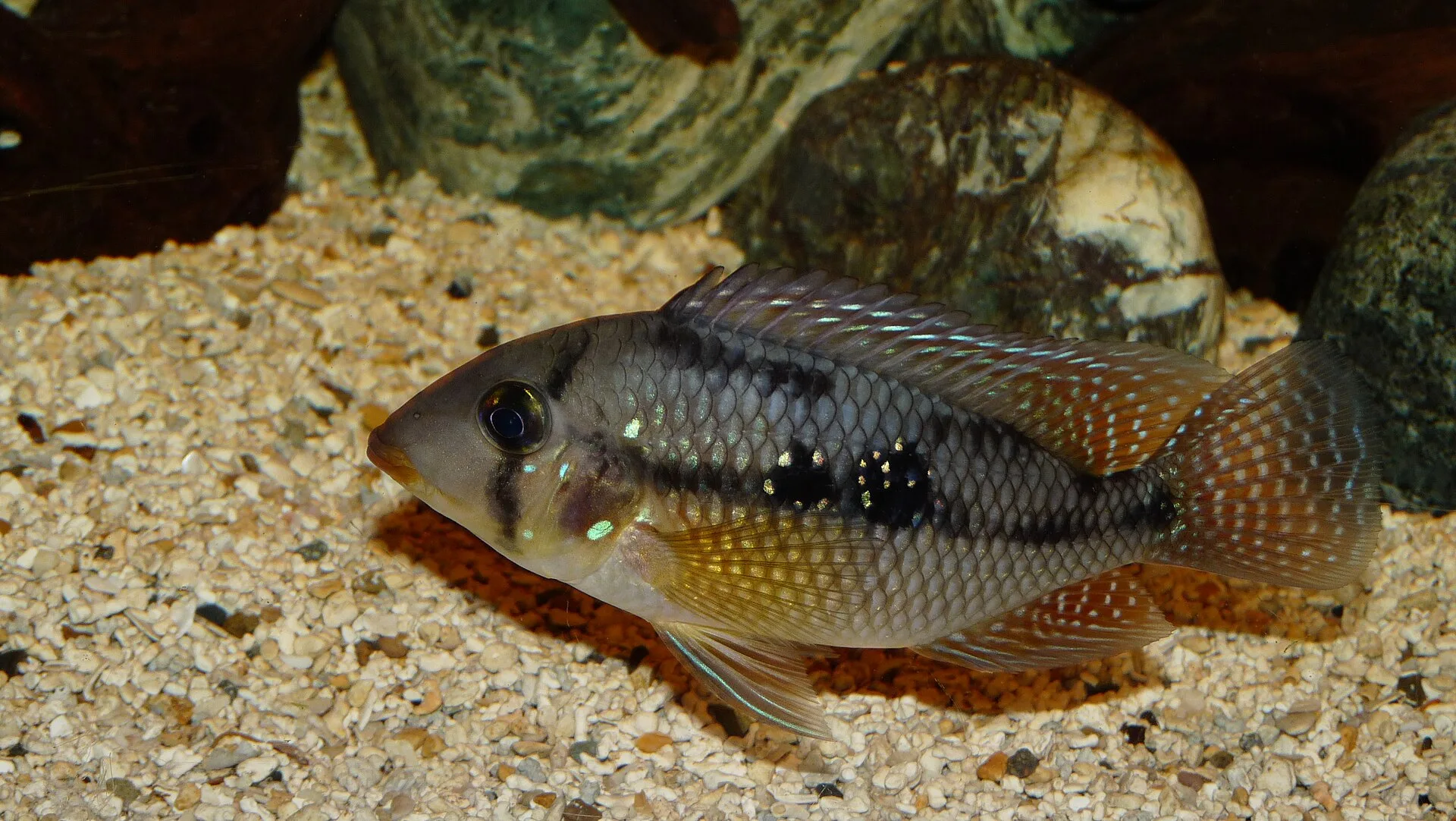
Pearls, a spade tail, a mood ring
The common name is fair: a mature, well-kept fish looks dusted with pearls, especially on the flanks and fins. There is often a dark mid-spot. Colour saturates when they dominate and fades when they hide. Males in breeding dress are the postcard; beaten fish look like generic brown cichlids. They are deeper-bodied than jurupari, less ‘Uaru triangle’ than Uaru, and usually more aggressive than altifrons in a comparable tank.
Sexing: males often larger with more pointed fins; behaviour at a pit nest is clearer. A pair will own a crater in the sand. That crater is not a Julie slit and not an apisto coconut.
Three hundred litres of sand they will re-landscape
Three hundred litres is the honest minimum. Fine sand, deep enough to dig. Wood and rock as borders, knowing they will undermine décor — build so it cannot crush them. Plants are a gamble; they will uproot. This is a sifter tank with more attitude than a jurupari layout. Filtration must handle sand and a dirty, digging 30 cm fish. Cooler end of tropical is fine; you do not need 30°C.
A 150 litre tank is a cruelty. A planted Dutch scape is a donation to the fish. A Tanganyika rock wall is the wrong furniture and, if you use rift salts, the wrong water.
The wide pH is not a personality
Temperature 22–28°C. pH 6.5–8.0 in captive fish. They may live in harder water than a Dicrossus could imagine. They still need a cycle, oxygen, and nitrate control. They still suffer in filthy water. Adaptable is not invincible. Chemistry, cycling.

Do not keep them with apistos because the pH might overlap at 7.0. The pearl will plough the cave and eat the apisto. Do not keep them with ocellatus because pH 8 might overlap. The lake fish wants minerals and shells; the pearl wants to dig a crater through the shell field.
Omnivore that still sifts
Pellets, frozen foods, some vegetable matter, food they can find in sand. They will eat small fish. They will eat shrimp. They will eat leftover plants. They are not a Uaru that requires a salad as identity, and they are not a specialist snail-hunter compressiceps. Feed sinking foods. Expect the sand to move after every meal.
Tankmates must be large and unimpressed
Other similarly sized, robust cichlids in a huge tank, large catfish, big characins. Not dwarfs. Not rasboras. Not Corydoras (they will be blasted by digging). Not Tanganyika fish. Not discus. A silver dollar school in a giant tank is a more honest neighbour than a ‘community tetra mix.’
Two pearls in 300 litres can be a pair or a war. Have a divider plan.
A crater, eggs, two angry parents
They typically spawn on a pit or a stone they have cleared, then guard ferociously. Some geophagines mouthbrood; brasiliensis-type pearls are usually open/substrate guarders rather than Satanoperca-style delayed mouthbrooders — treat the pair as pit spawners unless your specific fish prove otherwise. The practical point: you will know they spawned because they own a third of the tank. This is not a cave apisto spawn. This is not a shell colony.
Shredded tankmates and ‘hardy’ neglect
Hardy species attract neglected tanks. Pearls in cold, dirty, overcrowded boxes get ich, holes in the head, and a reputation they do not deserve. Quarantine a large cichlid in a large box with sand. Watch it sift. A pearl that never sifts is a pearl on gravel, in fear, or in illness.
Amazon sifters for contrast: G. altifrons, S. jurupari. Vegetable giant: Uaru. The pearl is the coastal, pearl-spangled, crater-digging one. Keep it that way.
Ponds, dumping, and the coastal fish that does too well
Because pearls take cooler, harder water than Amazon giants, they get treated like goldfish with attitudes. They are not goldfish. They grow, they dig, they breed in pits, and in warm climates they survive outdoors. That adaptability is why they should never be released. If you cannot house 30 cm, do not buy the 6 cm “pretty pearl.” Rehome through people who already run large cichlid tanks, not through a creek.
In the aquarium, use the adaptability for stable tap that is on the hard side, not for skipping water changes. A dirty pearl tank is a hole-in-the-head tank. They will live through neglect longer than a Dicrossus; living through neglect is not the same as looking pearled.
Explore other topics
Dive into more aquarium guides across the site.