

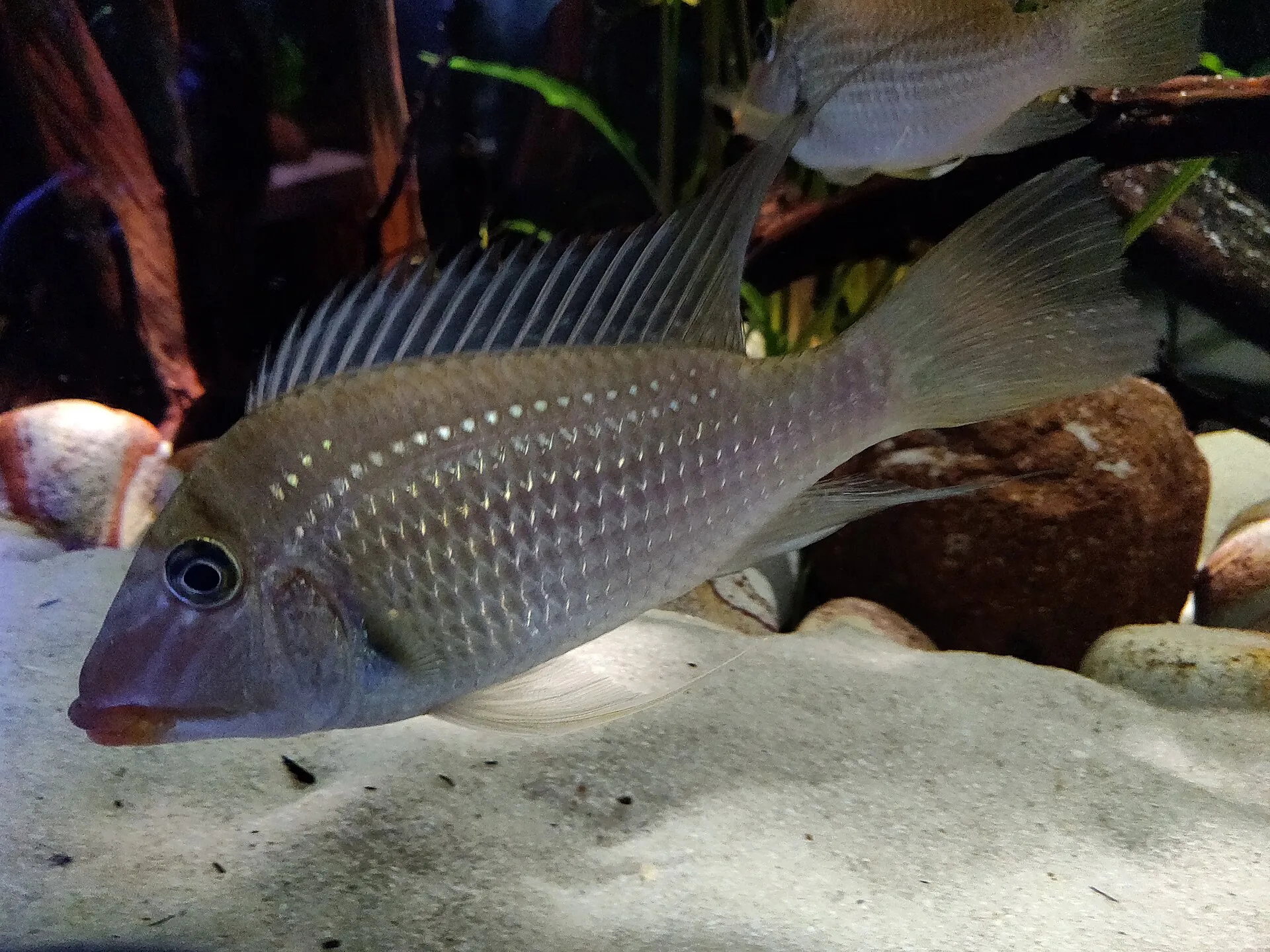
The demon eartheater is badly named and correctly described by the second half of the name. Satanoperca jurupari is a sand-sifting geophagine from the Amazon and Guianas, 20–25 cm, that feeds by taking a mouthful of sand, sorting food, and blowing the rest out of the gills. It is typically a delayed mouthbrooder: eggs on the sand, then picked up. It is a large, mostly peaceful (for a cichlid) South American. It is not a demon. It is not a Uaru. It is not a pearl cichlid (different genus history, different temperament, different coastal water story). It is not a Tanganyika anything.
If you do not want a cloud of sand in the water every hour, you do not want this fish. If you want a plant scape, you do not want this fish. If you want a 90 litre apisto tank, you are reading the wrong file.
Sandy rivers, not leaf-cup apisto creeks
Native to the Amazon and Guianas, in sandy rivers and lagoons. The fish lives on and in the first centimetres of sand. Water is typically warm, soft to moderately soft, 24–28°C, pH 5.5–7.5. Structure is wood and a little rock as landmarks, not a maze of Julie slits and not a field of snail shells. Current can exist; they still work the bottom.
The habitat photograph is a pale sand bed and a long-faced cichlid blowing a puff. That puff is the species.
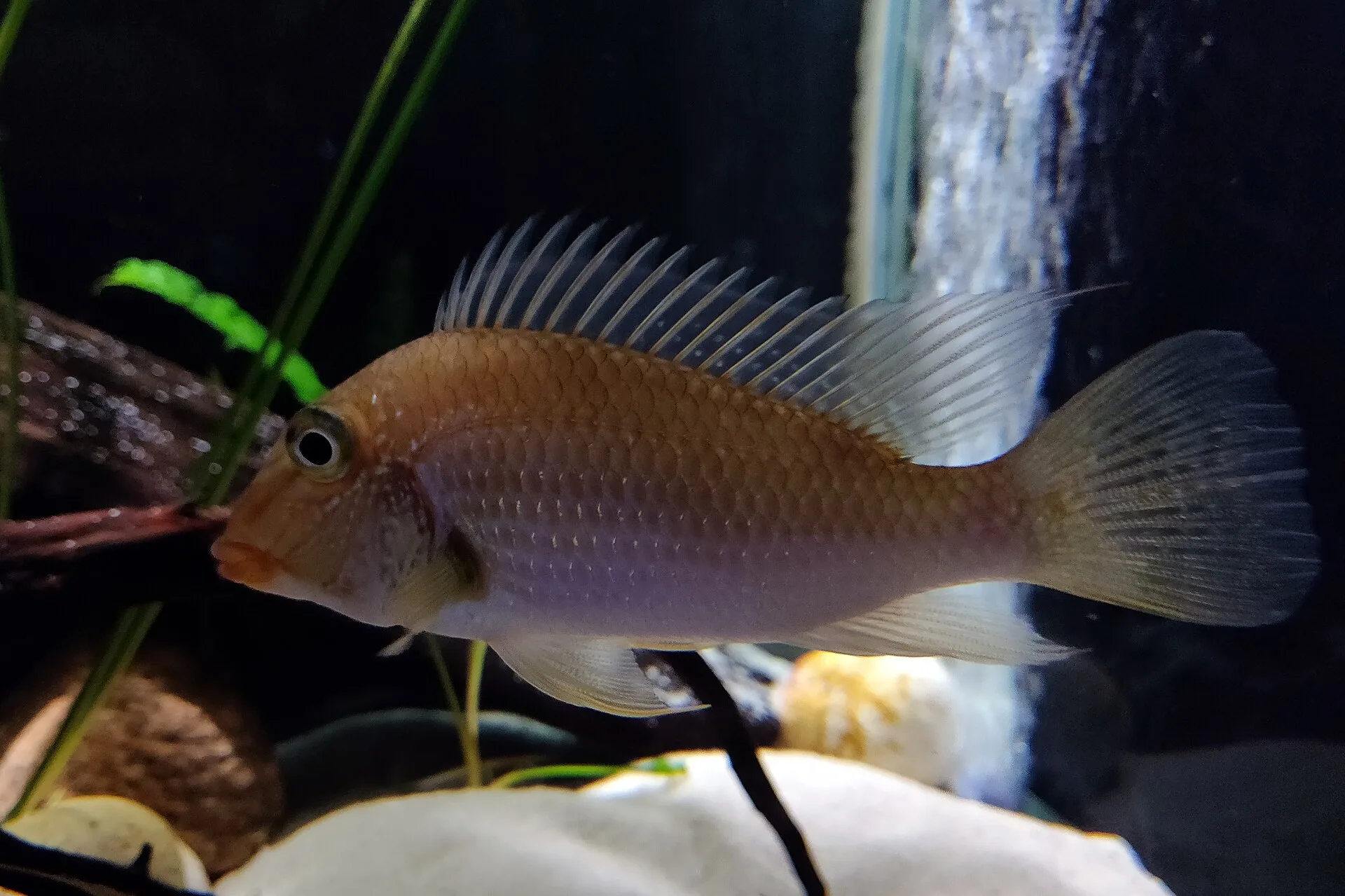
A long face built to sift
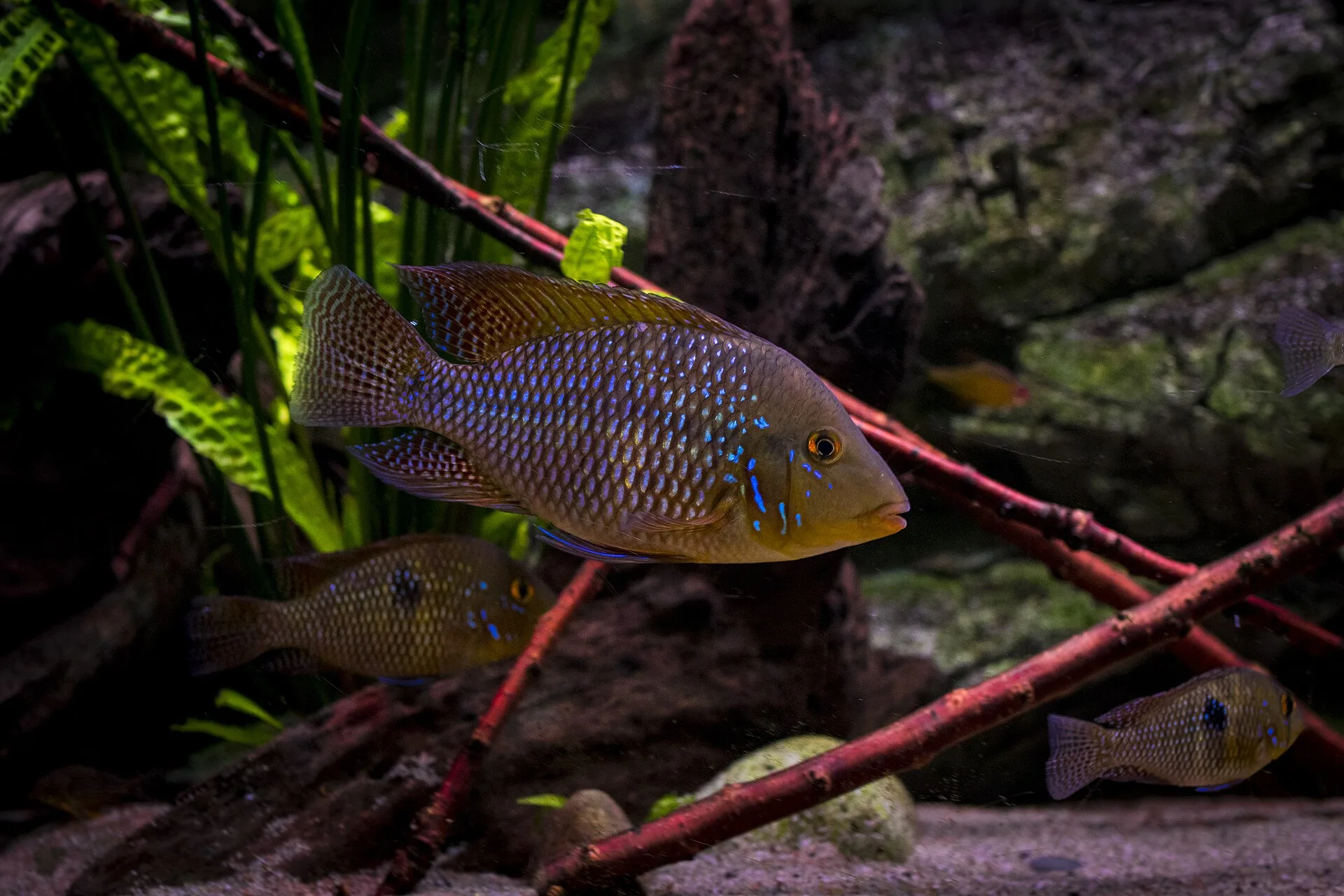
Jurupari has the eartheater profile: eyes high, snout for sand, a pattern of spots along the flank that can look like a row of small demons if you squint at the common name. Colour is beige to gold with dark marks; it is not a neon. Sexing is easier at spawning. They look more elongated than a high-bodied Geophagus altifrons and less discus-like than Uaru. They will not graze zucchini as a lifestyle. They will sift.
Juveniles in shops look harmless and small. They grow into 25 cm sifters that need a bed of sand, not a dusting.
Three hundred litres, sand you can measure with a ruler
The honest tank is 300 litres with a deep, fine, rounded sand bed — several centimetres at least, finer than play gravel, never sharp. Wood as cover. Open sand as the feeding floor. Filter that can handle suspended sand (pre-filter sponges, intakes raised or guarded). No nutrient plant substrate they will mix into the water. No delicate carpets. This is the opposite of a planted African butterfly tank and the opposite of a Tanganyika shell lawn (those shells would fill with sand and the chemistry would be wrong anyway).
A group of four or more juveniles settling into a pair or two is nicer than a single lonely sifter, if the tank is huge. They can be shy. Dither fish of appropriate size in the same water help. Dither fish from Lake Tanganyika do not.
Soft river water, cool relative to Uaru
Temperature 24–28°C — they do not require the 30°C Uaru/discus heat, and they often look better a degree cooler than a discus vat. pH 5.5–7.5. Soft to moderate. Cycle. They are messy because they sift detritus into the water column; water changes are not optional. Chemistry, cycling.

Hard alkaline water is a rift recipe. Coastal Brazilian pearl cichlids may take harder water; jurupari is the Amazon/Guiana sifter, not the coastal pearl.
Food in the sand, not on the surface
Sinking pellets, frozen bloodworm and mysis mixed into the sand or placed so they fall, live foods they can sift for. Surface flakes for rasboras will be missed. A vegetable disc is a side, not the Uaru staple. They will eat small fish that sleep on the sand. They will uproot plants looking for food. Feed enough that they do not vacuum every invertebrate you wanted to keep, not so much that the sand bed becomes a compost heap.
Watch the gill puff. That is how you know they are living correctly.
Peaceful is relative when you are 25 cm
Good neighbours: other large, non-nasty Amazonians, peaceful catfish, bigger characins. Bad: dwarfs, shrimp, anything that needs intact plants, anything from Tanganyika, mbuna. Pearl cichlids can be more aggressive; mixing two large geophagine types is a big-tank decision. Uaru overlap in water but fight over food style and warmth.
Corydoras in a jurupari tank will be sifted around and stressed; skip them. This is not a Corydoras sand tip recycled from a catfish article. This sand exists for a cichlid’s mouth.
Eggs on sand, then in the mouth
Typical Satanoperca breeding: a nest on the sand, then delayed mouthbrooding — parents pick up eggs or wrigglers. This is not an apisto cave. This is not a Julie slit. This is not ocellatus in a snail. If you vacuum the nest, you vacuum the spawn. If you have no sand, you have no nest. Raising fry is a specialist job; leaving the pair in a huge, calm tank is the behavioural goal for most keepers.
Cloudy water and hidden fish
Cloudy water is often sand in suspension plus waste — check mechanical filtration, do not assume a bacterial bloom every time. Hidden fish: not enough group, too much traffic in the room, or a tankmate hunting them. Quarantine in a tank with sand, or they will not eat normally. Thin fish that will not sift are sick or in the wrong substrate.
Compare G. altifrons (higher body, Amazon sift, often warmer) and G. brasiliensis (coastal, tougher, more attitude). Compare Uaru if you wanted greens and a discus-shaped giant instead of a sand blower. No cardinal tetra care model. No shell-dweller care model.
Pre-filtering the puff
Every gill-full of sand that goes into the water can go into a filter impeller. Sponge on the intake is not optional décor. Raise the intake slightly off the sand. Rinse sponges in old tank water often. If you hear grinding, you waited too long. This is the maintenance that is unique to sifters; a cylindricus cave tank does not throw the substrate at the filter in the same way. Plan your hardware for jurupari, not for a generic “cichlid kit.”
Explore other topics
Dive into more aquarium guides across the site.