

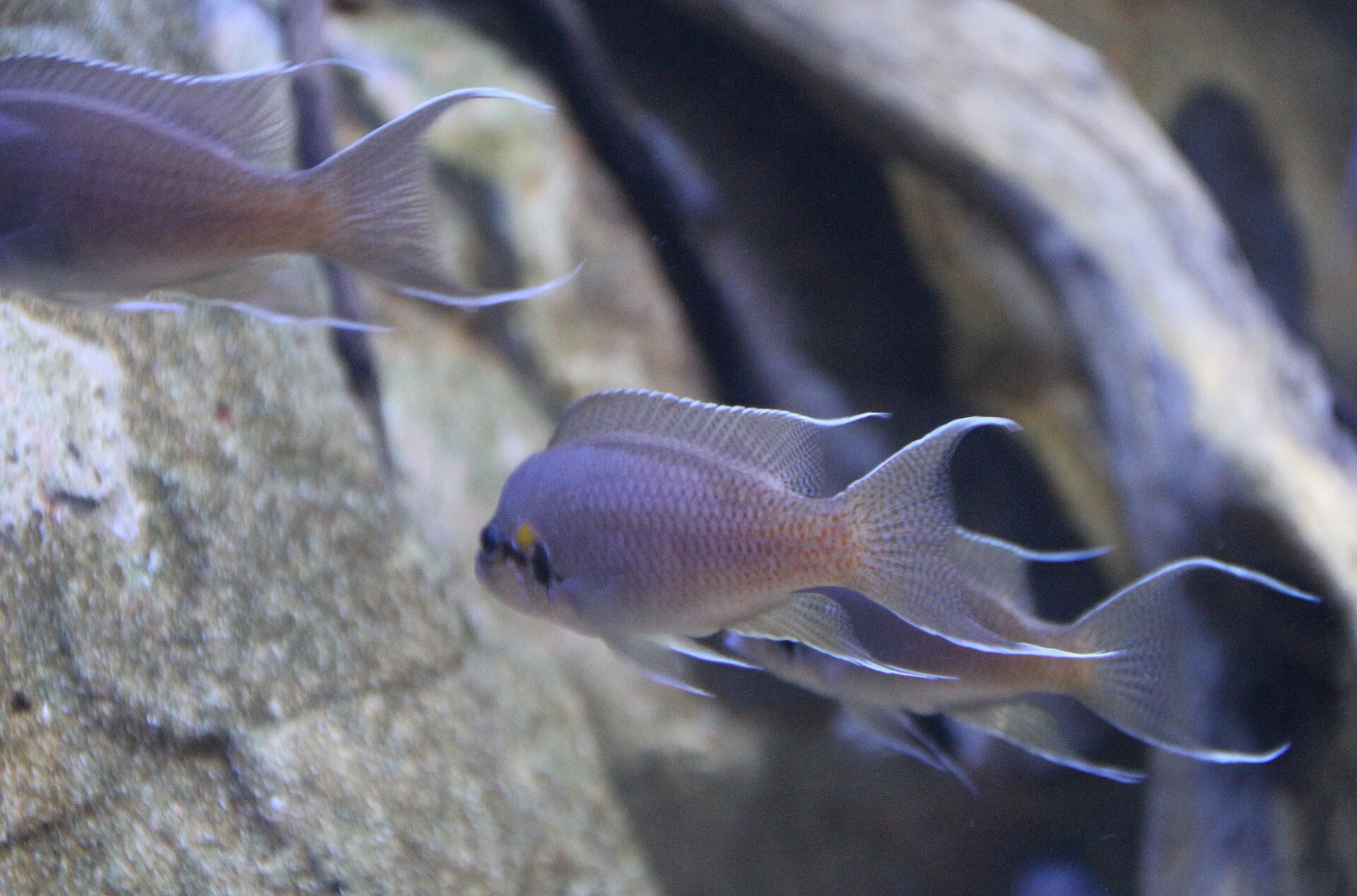
Fairy cichlids run a palace. Neolamprologus brichardi, the Princess of Burundi, is a Tanganyikan rock cichlid that breeds in a castle of helpers: older offspring stay and help guard the next brood. That is unusual among aquarium fishes and it is the whole reason a “pretty lyretail” becomes a political problem in a mixed tank. A pair does not stay a pair. A pair becomes a clan. The clan occupies a rock pile, then the rock pile next to it, then they decide the open sand is an insult. People buy two because the fins are filamentous and the body is a pale, elegant beige with a dark eye stripe. They wake up six months later owning a government.
It is close to Neolamprologus pulcher (the daffodil); some scientists have argued about splitting and lumping. The fish you buy as brichardi is a pale, lyretail, colonial Neolamprologus from Lake Tanganyika’s rocky shores. Care is alkaline, mineral, cave-oriented, and social in a way that does not mean “community-friendly.” It means “friendly to its own dynasty.”
Filaments, a mask, and 10 cm of court politics
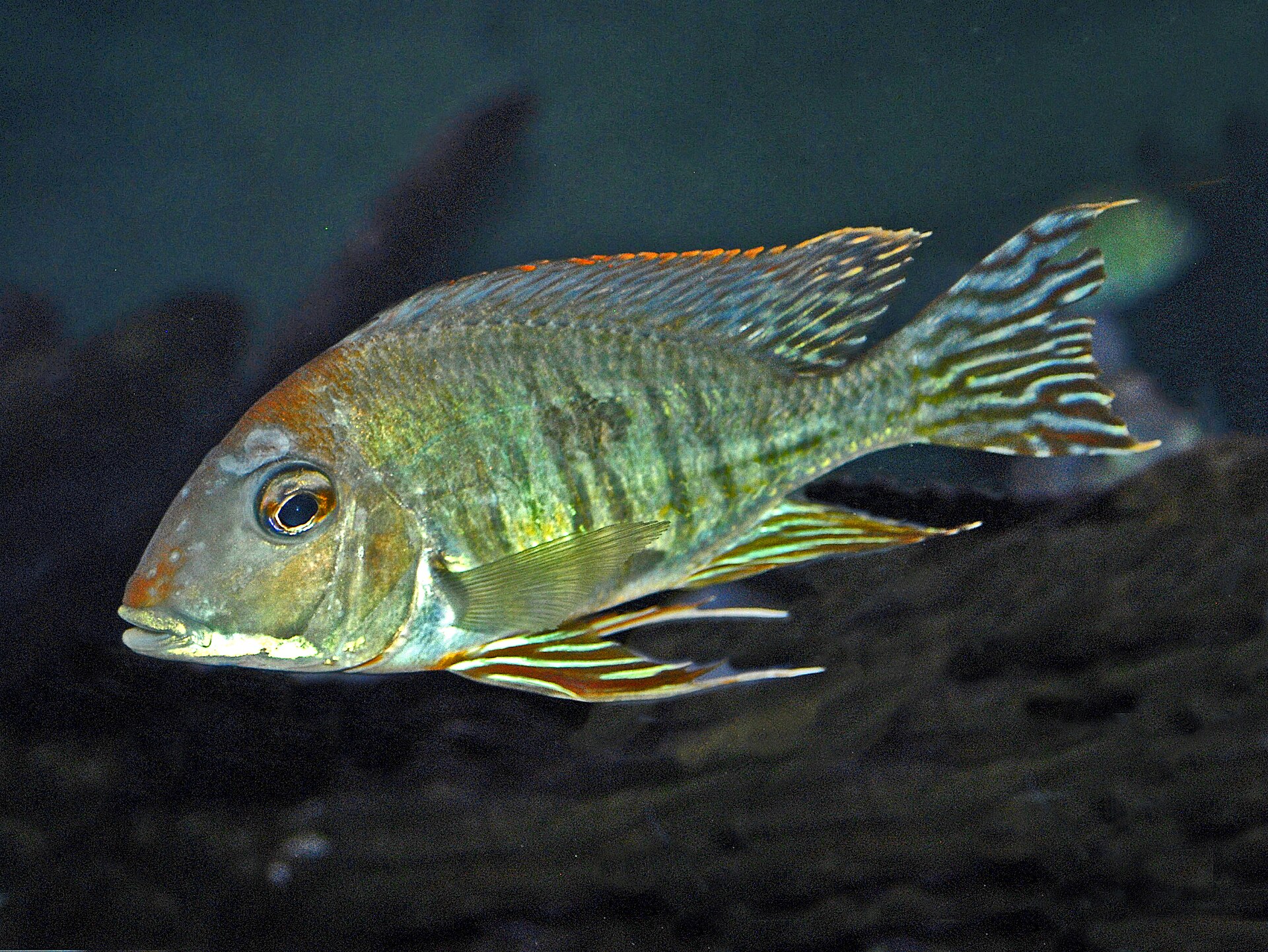
Adults reach 8 to 10 cm, not counting the tail streamers. The body is cream to grey-beige, the fins long, the eye crossed by a dark bar that gives the princess her face. Sexing is awkward. Males may have longer fins. A breeding pair is identified when they take a cave and the rest of the group starts acting like staff. Juveniles look like smaller, shorter-finned versions. The lyretail is the adult costume.
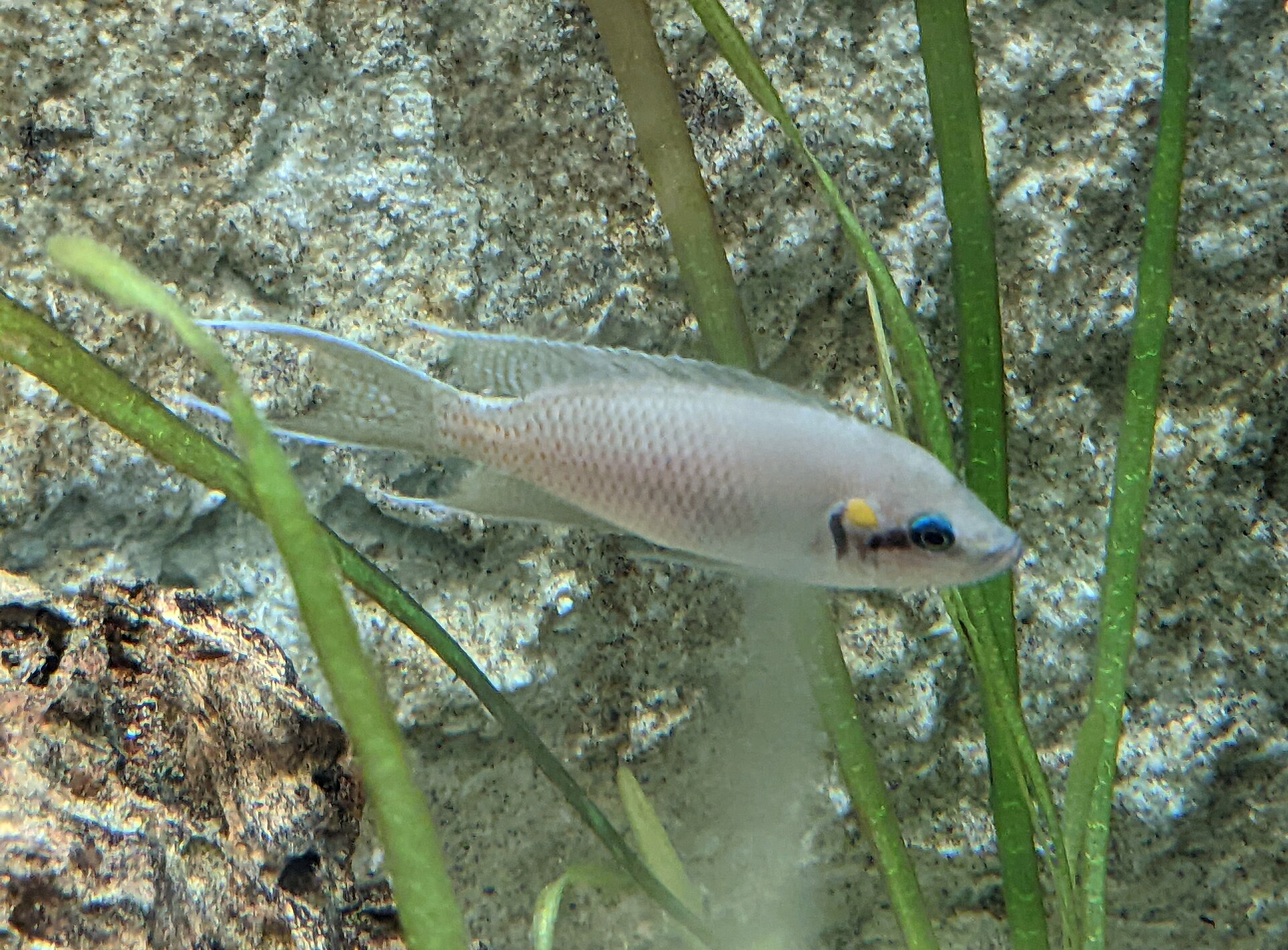 Neolamprologus brichardi. Photo: FakirNL / Wikimedia Commons (CC BY-SA 4.0)
Give the dynasty a castle, or it will annex yours
One hundred and fifty litres can start a colony; 200 litres and up is more realistic if you want any other Tanganyikans to keep a suburb. Rock piles with multiple caves. Sand in front. The colony will use vertical structure. Height is useful. Temperature 24 to 27°C, pH 8.0 to 9.0, high KH. Strong filtration, high oxygen, Tanganyika-clear water. They are not as chemically precious as Tropheus, but they are not a fish for a peat swamp. They will jump when chasing. Lid.
If you want a pair only, you will be removing helpers forever, which is fighting the species. If you want the species, you accept the clan and you build for it. Half-measures produce a pair that spawns, helpers that grow, and a sudden eviction of every other fish you liked.
A diet for a court that still hunts
They pick small invertebrates off rock and take food in the water column. Quality pellets, frozen mysis, brine shrimp, cyclops, and a little vegetable matter cover it. They are not aufwuchs specialists first. They are also not sharks. Feed the colony so that helpers eat, not only the breeding pair at the royal cave. A skinny helper is a political failure and a health problem.

They will eat fry of other species. They will eat shrimp. They will not usually eat adult tank-mates of similar size unless those tank-mates enter the nursery, at which point “eat” may be replaced by “harass until they leave or die.”
The helper system, without romance
Eggs are laid in a cave. Both parents and a stack of juveniles from previous spawns guard. This is cooperative breeding, documented in the lake and reliably repeated in aquaria. It is fascinating. It is also why a brichardi colony is a bad roommate for shell dwellers, for timid julies, and for anything that needs the same caves. Open-water cyprichromis in a large tank can work because they do not apply for cave permits. Other Neolamprologus of similar look will hybridise and war. Malawi fishes are the wrong chemistry and the wrong manners.
If the colony grows past what the tank can hold, you remove fish. You do not wait for nature. Nature in a box is a monopoly.
When the princess is not peaceful
The reputation for peace comes from the pale colour and the fairy-tale name. Watch a colony on a nest. The filaments go up, the pair charges, the helpers flank. It is war on a small scale. Outside of breeding they are still territorial around the home rock. A single brichardi in a Malawi tank is a confused, often shredded tourist. A colony in a Tanganyikan rock tank is the native government. Pick which story you are telling.
Ich, bacterial issues after a nest-defence injury, and hole-in-the-head in dirty tanks all appear. Quarantine new stock; introducing one fish to a clan is difficult. Introduce several juveniles, or be ready to house the newcomer separately until you have a plan. Rearranging rock to reset territories will also destroy the current palace map and can stall breeding. Sometimes that is what you want. Sometimes it is how you lose a functioning helper system for months.
Why keep a government in a box
Because the lyretail in a group, hovering over a castle, with three sizes of young in the same territory, is one of the few aquarium sights that is actually about society rather than about pigment. Neolamprologus brichardi is a pale fish that made itself interesting with politics. If you give it Tanganyika water, a rock pile, and no naive community plans, the palace works. If you wanted two pretty fish to sit still in a community, the princess will still recruit a court, and you will learn the common name was never about fragility. It was about a title. Titles come with land. Build the land to fit the title, or do not buy the crown.
Farmed brichardi are widely available and usually the ethical source. Wild collection of Tanganyikan rock cichlids is a separate, heavier topic. Either way, the animal you take home is a colonial breeder. Feed it, house it, and edit the census when the government gets too large. That is fairy cichlid keeping. The filaments are just the flag on the palace.
One last practical note that belongs to this species and not to cave hunters in general: count mouths at feeding time. A helper that never reaches the pellet will still guard the cave, then fade, then vanish into the rockwork where you find a body a week later. Spread food along the palace wall, not only at the royal door. A working dynasty is a well-fed dynasty. The lyretail looks like ornament. It is also a weather vane: clamped streamers mean the court is under pressure, from chemistry, from a new fish, or from a tank that finally ran out of unclaimed stone.

Explore other topics
Dive into more aquarium guides across the site.