

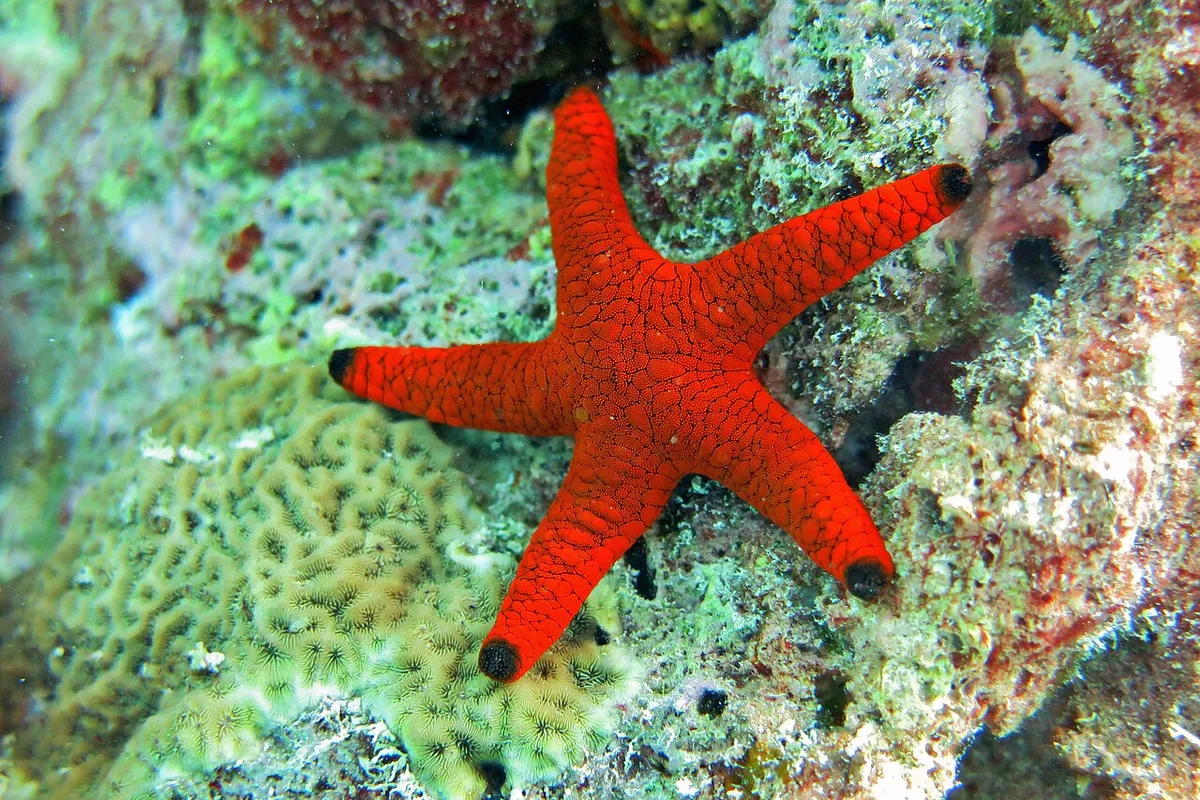
The red marble starfish, also called the Indian sea star, is a small, bright red to orange starfish with dark tips on its arms and a finely textured surface. It reaches about 10 cm across.
Fromia indica is fully reef safe and grazes biofilm and tiny organisms on the rock. It is one of the better small starfish for a reef, but it needs a mature tank and careful acclimation.
Where red marble starfish come from
The species lives across the Indian Ocean and western Pacific, from the Maldives to Indonesia and northern Australia, on reef flats and slopes.
Appearance and behaviour
Red marble stars move slowly over rock and glass, feeding with their stomachs on the film that grows there. They are completely peaceful.
Tank setup
Add one only to a tank that has been running for at least six months, with plenty of live rock and natural biofilm. A tank of 100 litres or more provides enough grazing for one star.
Water parameters

- Temperature: 24–27°C
- pH: 8.1–8.4
- Specific gravity: 1.023–1.026
Starfish are very sensitive to salinity changes. Drip acclimate over at least an hour and never expose them to air. They do not tolerate copper.
Feeding
They feed on biofilm and microorganisms. In a mature tank they rarely need extra food, but you can place a small piece of shrimp or a sinking pellet under the star once a week.
Tank mates
Red marble stars are safe with corals, fish and invertebrates. Avoid harlequin shrimp, which eat starfish, and puffers or triggerfish that pick at them.
Breeding
They are not bred in home aquariums.
Common problems and lifespan
Losses usually come from poor acclimation or starvation in new tanks. Related sea stars include the blue linckia. Healthy red marble stars can live several years.
Explore other topics
Dive into more aquarium guides across the site.