

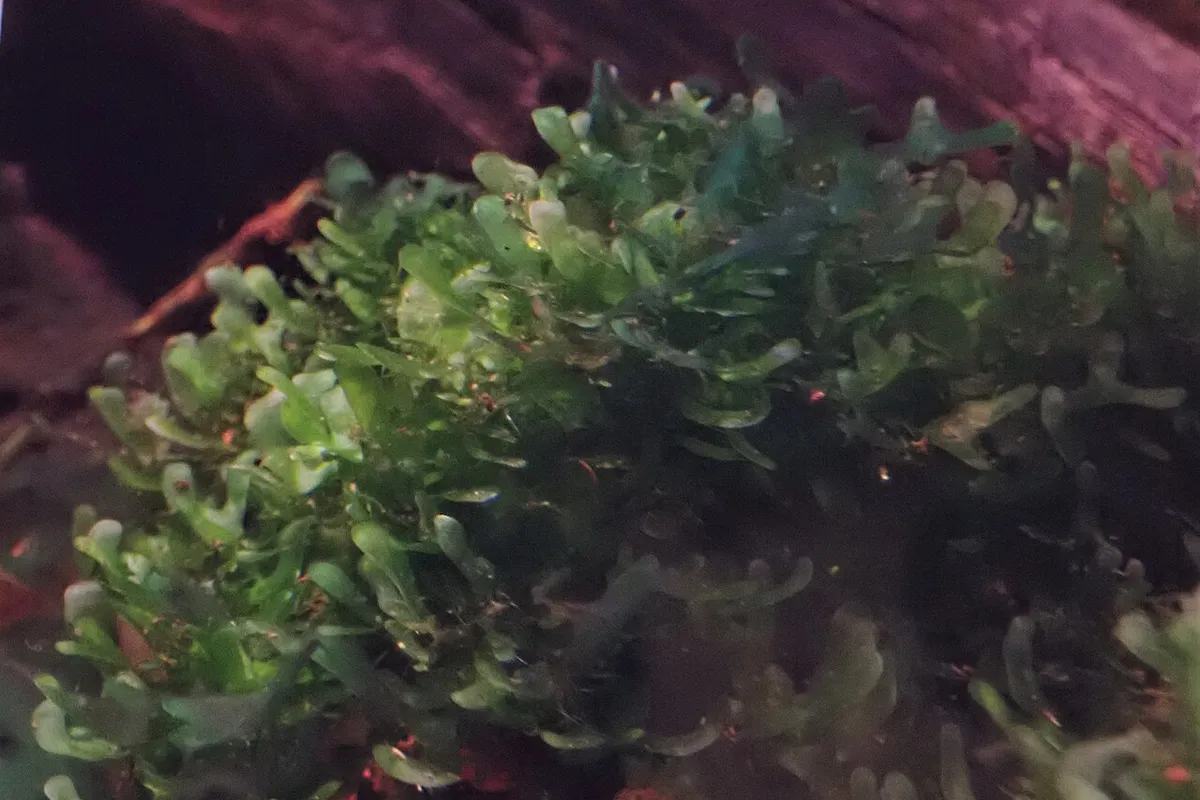
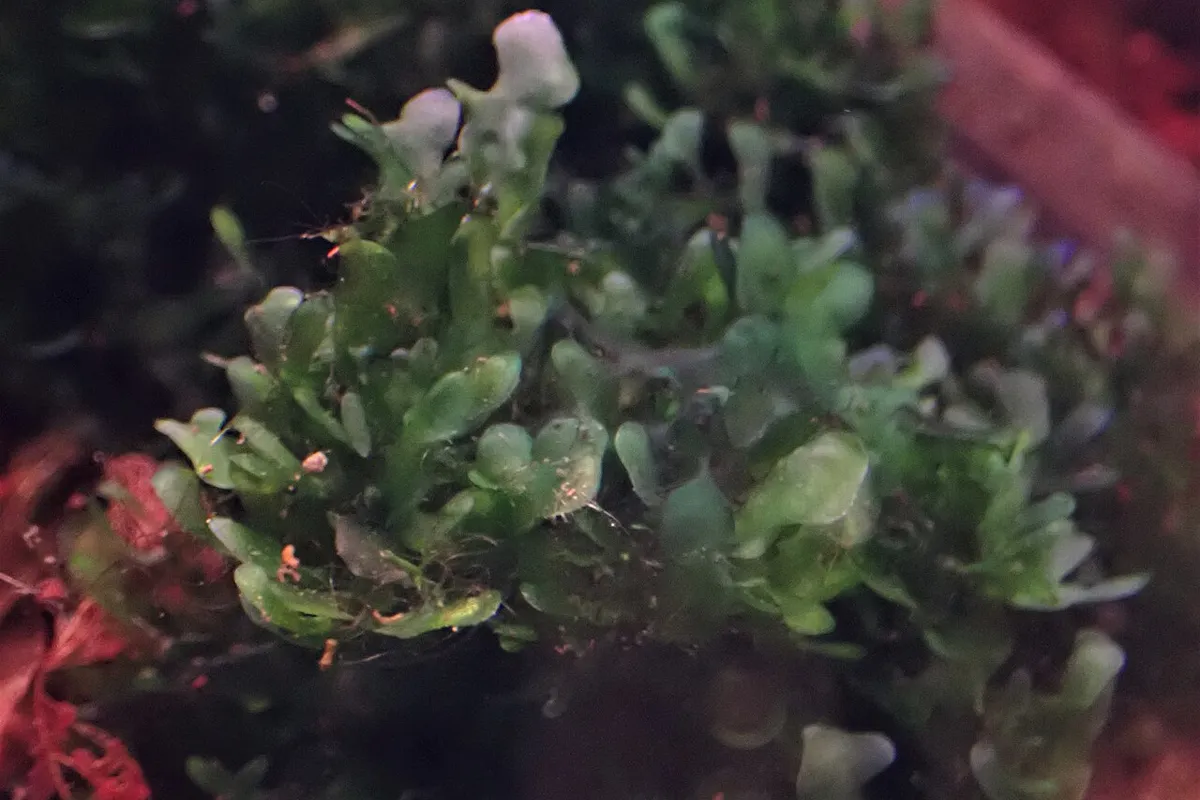
Pellia is a liverwort, a relative of the mosses, that grows as flat, branching, bright green ribbons. Over time it builds into soft, dense cushions on wood and rock. It is popular in nano tanks, aquascapes and shrimp tanks.
The plant sold as pellia is Monosolenium tenerum. A different plant, the young stage of the fern Lomariopsis, is also sold as "pellia" or "Lomariopsis moss" and looks similar.
Origin
Monosolenium tenerum grows on damp soil and rocks along streams in East and South Asia, including India, China, Taiwan and Japan.
Appearance and growth
Unlike true mosses, pellia has no roots or rhizoids that grip strongly. It grows slowly and does not float away easily once established, but it needs to be tied or trapped in place at first.
Placement
Attach thin layers to driftwood or stone with fine cotton thread, mesh or a small amount of plant-safe glue. It also works on the substrate, held under small stones.
Light, CO2 and nutrients

Low to medium light. CO2 speeds growth and makes the cushion denser. A light dose of liquid fertiliser is enough.
Water conditions
- Temperature: 18–26°C
- pH: 6.0–7.5
- Hardness: 2–12 dGH
It prefers cooler water and grows poorly above 27°C.
Propagation and maintenance
Break off pieces and attach them elsewhere. Trim the top of thick cushions now and then, as the bottom layers can die off and come loose.
Compatibility
Excellent for shrimp, which graze biofilm from it, and for small fish and fry that hide in it. Pair it with other mosses such as Christmas moss or Java moss.
Common problems
Algae can grow into slow-growing cushions. Browning usually means water that is too warm or lacking in nutrients.
Explore other topics
Dive into more aquarium guides across the site.