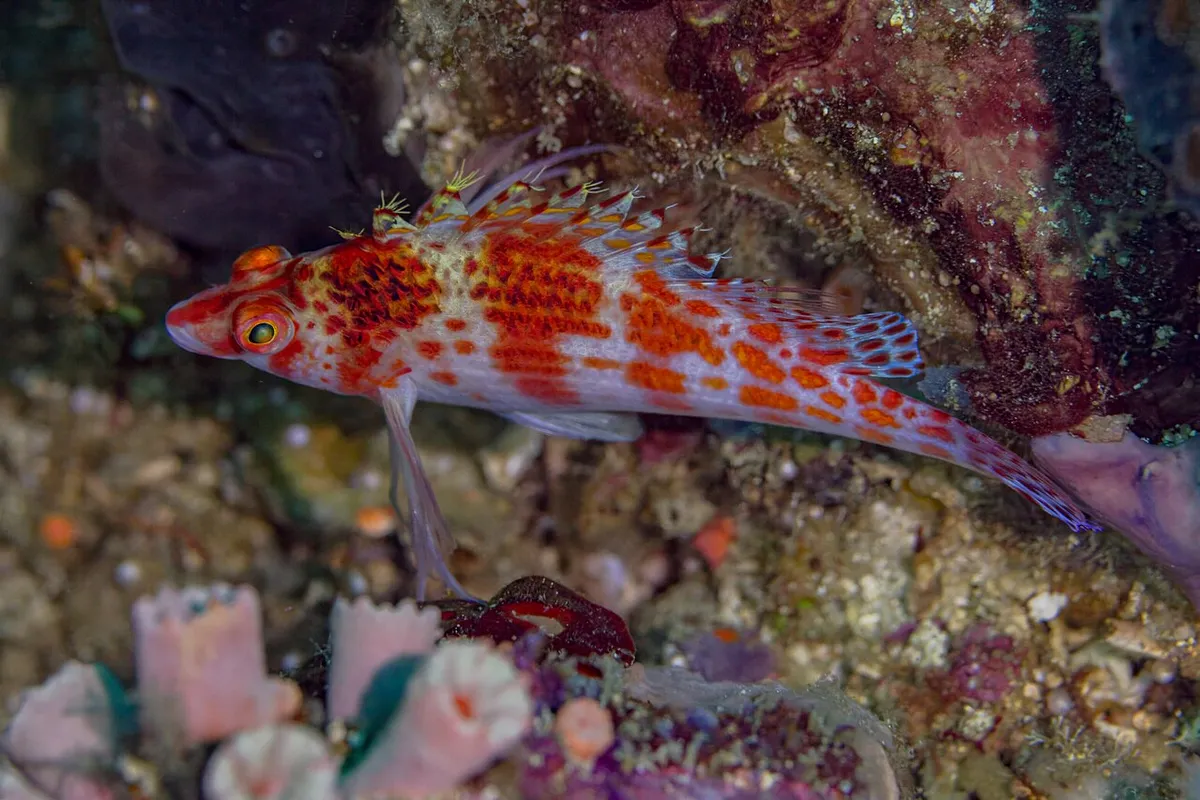
The falco hawkfish, or dwarf hawkfish, is a small white fish covered in red-brown blotches, with tiny tufts called cirri on the tips of its dorsal spines. At about 7 cm, it is one of the smallest hawkfish and a good fit for a medium-sized reef.
Cirrhitichthys falco spends its day perched on rock or coral, watching for food. It is hardy and full of personality, but it eats small shrimp.
Where falco hawkfish come from
The species ranges across the Indo-Pacific, from the Maldives to Samoa and north to Japan. It lives on coral and rock reefs, sitting at the base of coral heads.
Appearance and behaviour
Hawkfish have no swim bladder, so they hop from perch to perch rather than swimming continuously. They rest on their thick pectoral fins and quickly learn to watch their owner at feeding time.
Keep one per tank. They become territorial towards other hawkfish and bottom-dwelling fish of similar shape.
Tank setup
A single falco needs at least 110 litres with plenty of rock ledges and coral heads to perch on. A tight lid is wise, as they can jump when startled.


Water parameters
- Temperature: 24–27°C
- pH: 8.1–8.4
- Specific gravity: 1.020–1.025
Feeding
Falcos are carnivores. Feed frozen mysis, brine shrimp, chopped seafood and marine pellets once or twice a day. They snatch food as it drifts past their perch.
Tank mates
Good companions are fish that do not perch on the bottom: tangs, chromis, anthias, dwarf angelfish and clownfish. Avoid small gobies, blennies and other hawkfish such as the flame hawkfish. Small ornamental shrimp, such as sexy shrimp, are likely to be eaten.
Breeding
Falcos form harems in the wild and spawn at dusk. Captive breeding is rare.
Common problems and lifespan
They are hardy and safe with corals. The main issue is shrimp disappearing. With good care they live five to seven years.
Explore other topics
Dive into more aquarium guides across the site.