

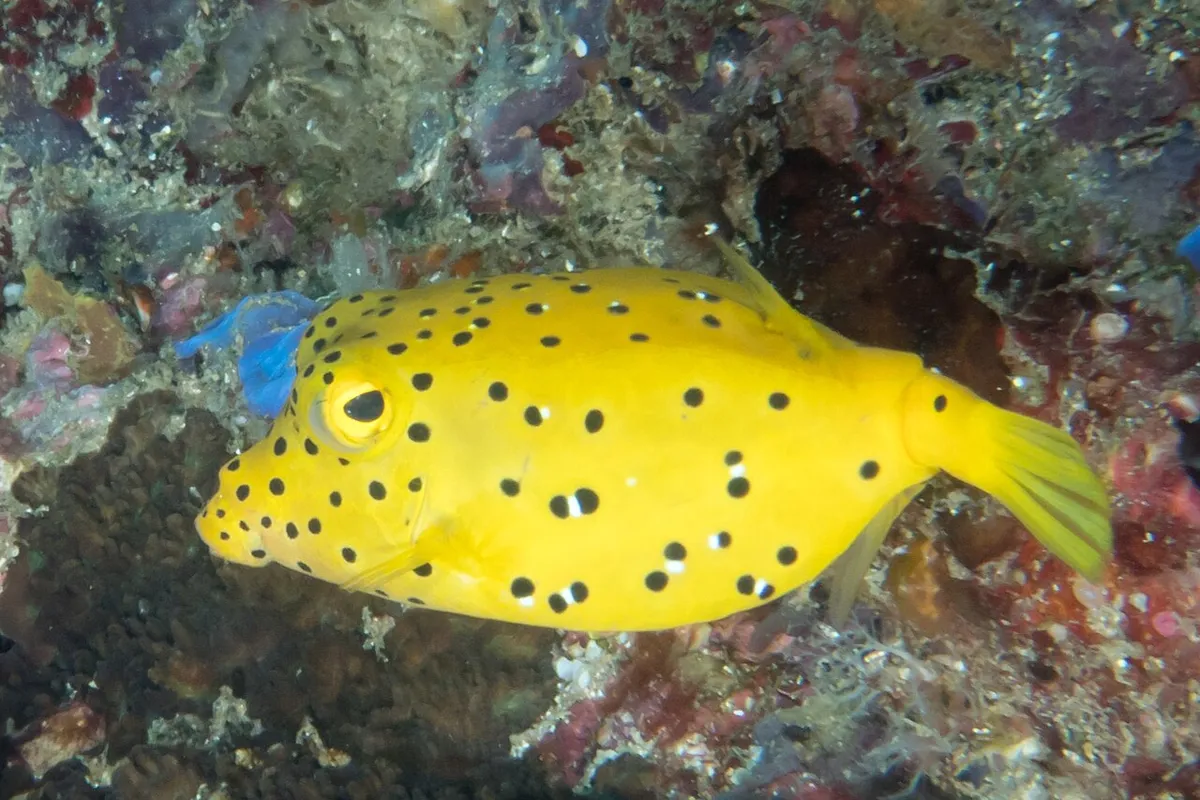
Juvenile yellow boxfish are among the cutest fish in the marine trade: a bright yellow cube, covered in black spots, that hovers and swims with tiny fins. They do not stay small. Adults reach 30–45 cm, turn dull blue-brown and develop a bony bump on the snout.
Ostracion cubicus also secretes a skin toxin, ostracitoxin, when stressed or dying. In a closed aquarium it can kill every fish in the tank. This is a fish for experienced keepers with large, dedicated systems.
Where yellow boxfish come from
The species ranges across the Indo-Pacific, from the Red Sea and East Africa to Hawaii. Juveniles shelter among branching coral; adults roam lagoons and reef flats.
Appearance and behaviour
The body is encased in a rigid box of fused bony plates, with gaps only for the eyes, mouth, gills and fins. Boxfish are slow, peaceful and curious, and often learn to beg for food at the front glass.
Tank setup
A juvenile can start in 400 litres, but an adult needs 1,000 litres or more. Use a large protein skimmer, keep activated carbon in the system to absorb toxin if it is released, and avoid powerful pumps without guards, which can trap a slow swimmer.

Water parameters

- Temperature: 24–27°C
- pH: 8.1–8.4
- Specific gravity: 1.020–1.025
Feeding
Boxfish are omnivores. Feed frozen mysis, brine shrimp, chopped clam and squid, with spirulina and nori. Juveniles need three small feedings a day; thin juveniles rarely recover.
Tank mates
Choose calm, non-nippy fish that will not stress the boxfish, such as tangs and peaceful angelfish. Avoid triggerfish, puffers that nip, and aggressive damsels. Boxfish may nibble on invertebrates, clams and some corals, so a fish-only tank is safest.
Breeding
Yellow boxfish spawn in open water in the wild and have not been bred in home aquariums.
Common problems and lifespan
Toxin release during shipping, illness or bullying is the biggest risk. Quarantine new fish alone and never add a boxfish to a tank with fish you cannot afford to lose. They live ten years or more.
Explore other topics
Dive into more aquarium guides across the site.