

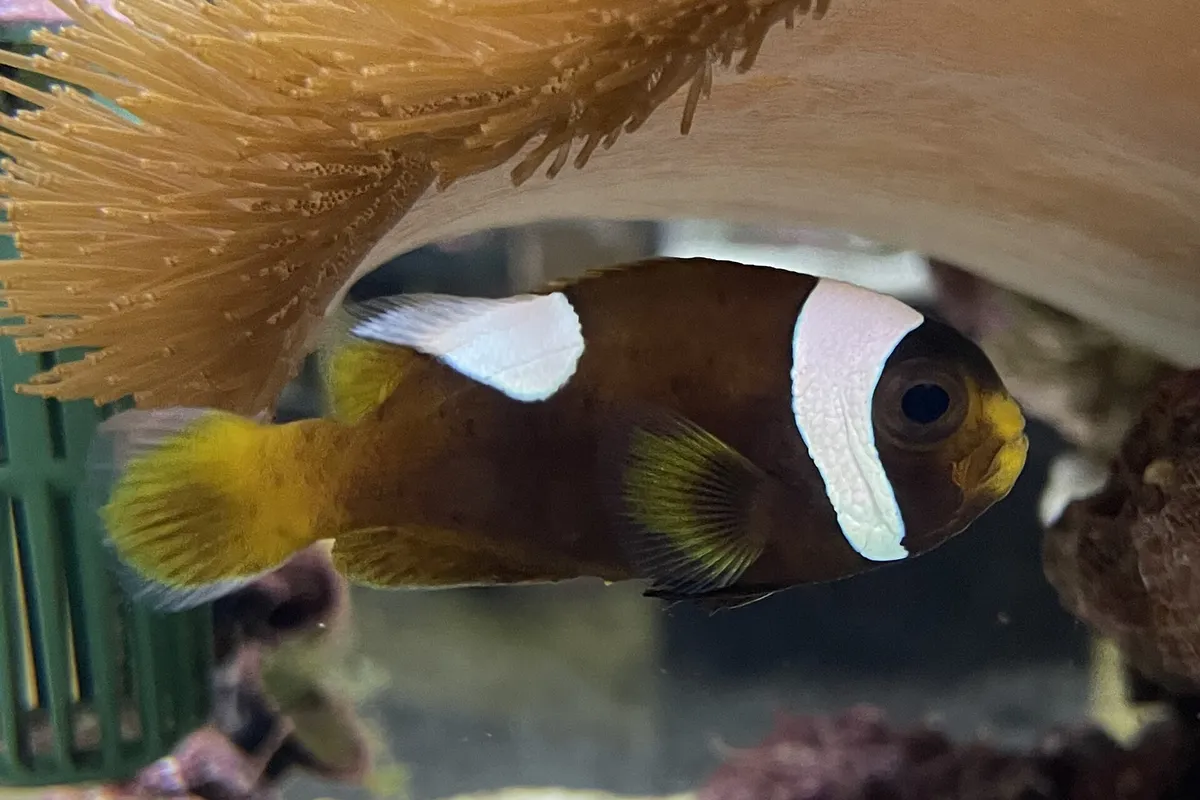
The saddleback clownfish is named for the white saddle that crosses its back and runs up into the dorsal fin. Amphiprion polymnus is darker and less common than the familiar orange clownfish, and in the wild it lives in anemones on open sand instead of on the reef. It is a rewarding fish for keepers who want something a little different.
Where saddleback clownfish come from
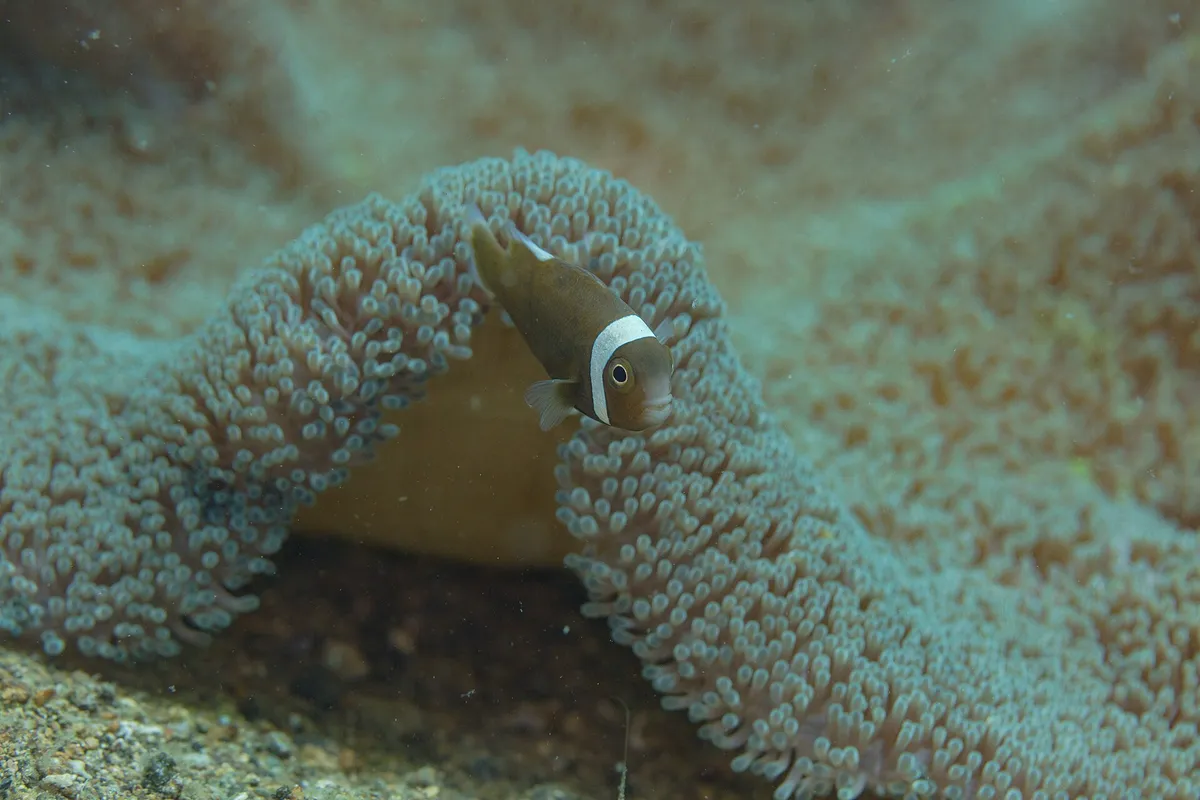
The species is found in the western Pacific, from the Philippines and Indonesia north to Japan and east to the Solomon Islands. It lives on sand and mud flats and in sheltered bays, in carpet anemones (Stichodactyla haddoni) and long-tentacle anemones (Macrodactyla doreensis), often far from any reef.
Appearance and behaviour
Saddlebacks grow to about 12 cm. The body ranges from orange-brown to nearly black, with a white bar behind the eye and a white saddle on the back. Many fish have a yellow or orange face and tail edge. Like all clownfish, they live in pairs, with the larger fish being the female.
They are more territorial than ocellaris clowns, especially once they host an anemone, and will defend it against fish and even the keeper's hands.
Tank setup
A pair needs at least 110 litres, or 200 litres or more with a host anemone. Give them a deep, open sand bed and some rockwork. If you add an anemone, choose a carpet anemone, which is their main natural host, and set the tank up for its needs first. Our carpet anemone guide covers lighting, feeding and safety. Saddlebacks can live without an anemone, but they are calmer and more natural with one.
Water parameters

Keep the temperature at 24–27°C, specific gravity at 1.023–1.026 and pH at 8.1–8.4. Wild-caught saddlebacks are more sensitive than other clowns to poor water, so keep nitrate low with regular water changes.
Feeding
Saddlebacks are omnivores. Feed quality marine pellets and flakes, frozen mysis, brine shrimp and finely chopped seafood, plus some algae-based food. Feed small portions two or three times a day. Clownfish often carry food to their anemone, which helps feed it.
Tank mates
Good companions are peaceful reef fish that will not compete for the anemone: gobies, cardinalfish, small wrasses, chromis and blennies such as the bicolor blenny. Keep only one pair of clownfish in most tanks, and do not mix clownfish species.
Breeding
Saddlebacks are now bred in captivity, and tank-bred fish are hardier and better adapted than wild ones. Pairs lay eggs on a flat surface next to their anemone and guard them for about a week. The larvae need rotifers and then baby brine shrimp, as with other clownfish. Captive-bred fish are worth seeking out.
Common problems and lifespan
Wild-caught fish are prone to Brooklynella and marine ich, so always quarantine new arrivals. Aggression around the anemone is normal. For an easier clownfish, see our orange clownfish guide.
With good care, saddleback clownfish can live 10–15 years or more.
Explore other topics
Dive into more aquarium guides across the site.