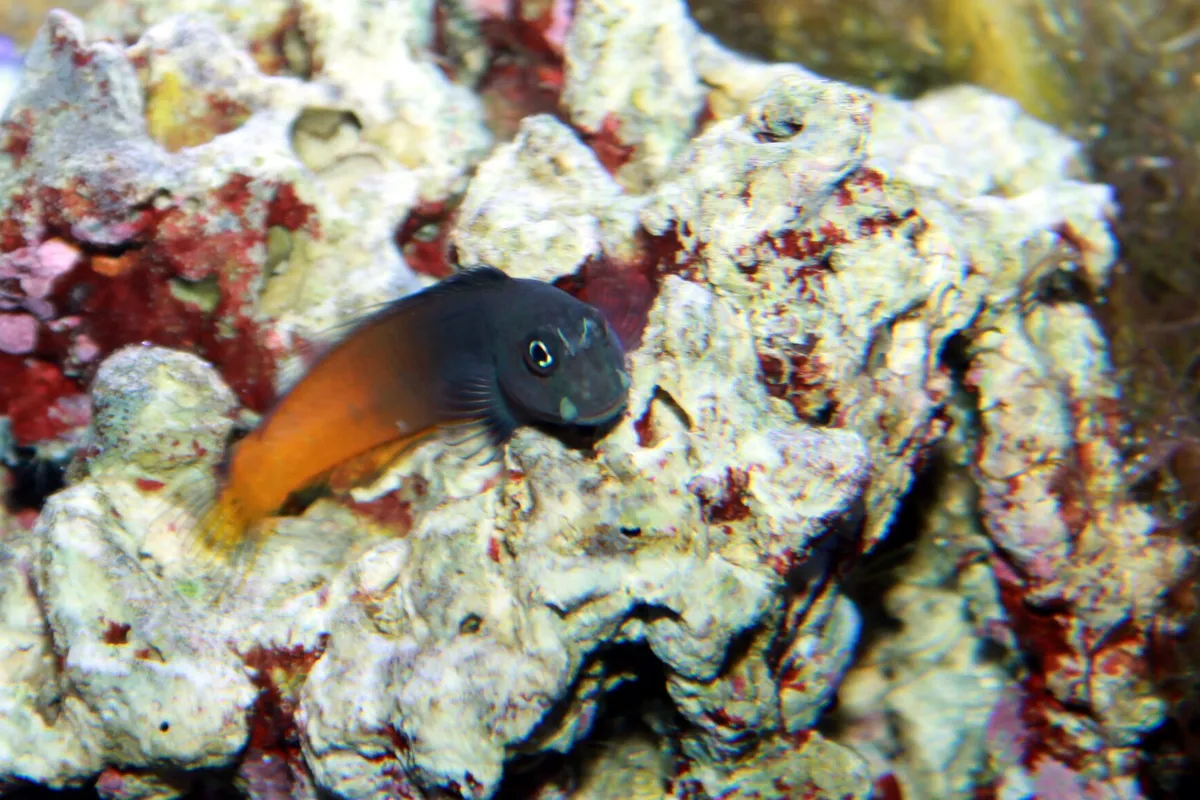
The bicolor blenny is a small fish with a big personality. Ecsenius bicolor spends its day perched on rocks, looking around with its large eyes, darting into holes when startled and popping back out a moment later. It grazes algae, ignores corals and suits most reef tanks.
Where bicolor blennies come from
The species is found across the Indo-Pacific, from the Maldives through Indonesia and the Philippines to Micronesia and the Great Barrier Reef. It lives on shallow reefs and lagoons, where it shelters in empty worm tubes and holes in the rock.
Appearance and behaviour
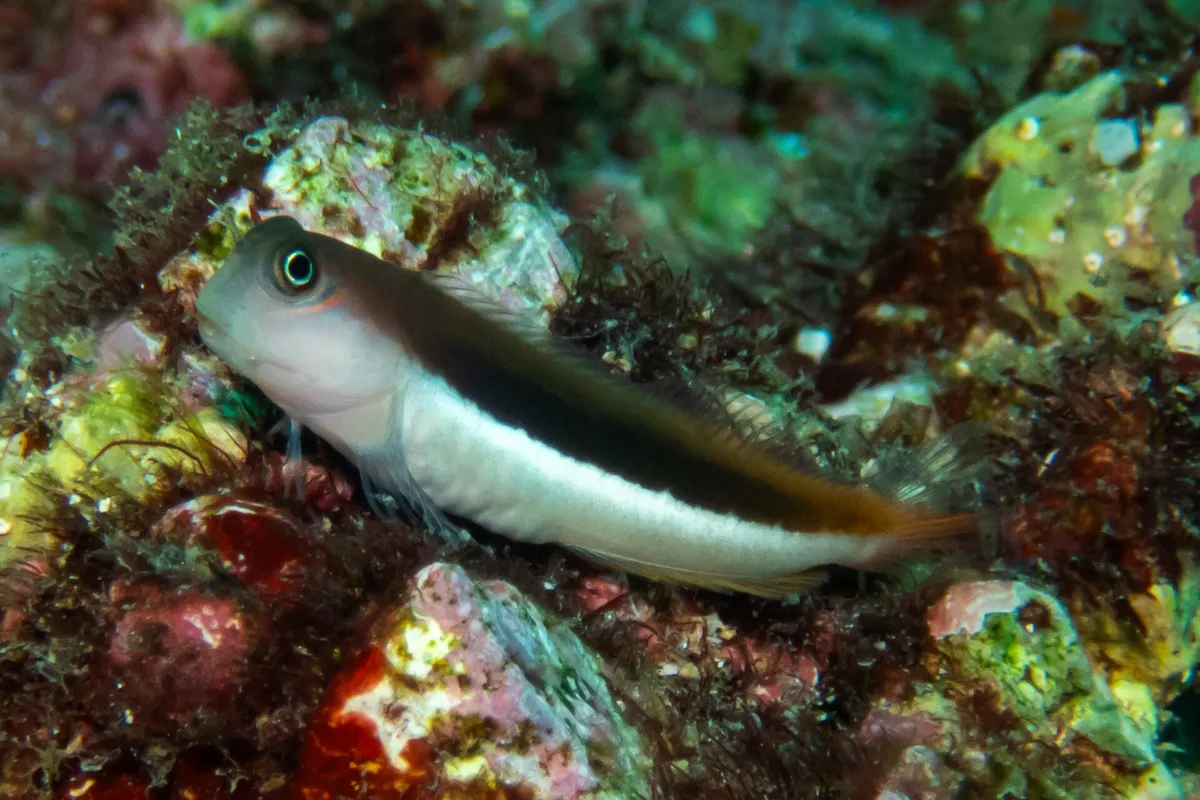
Bicolor blennies grow to about 10 cm. The most common colour form has a dark blue-brown front half and an orange to yellow rear half, which gives the fish its name. Other forms are dark with white bands or mostly brown. Males guarding eggs can turn reddish with pale bars. They have small tentacles, called cirri, above the eyes.
They are peaceful with most fish, but territorial with other blennies, especially ones with a similar shape or colour. Keep one per tank unless the tank is very large.
Tank setup
A single bicolor blenny needs at least 110 litres. Plenty of live rock with holes and crevices is essential, as this is where it lives, sleeps and feeds. Give it a few perches with a view. Blennies are good jumpers, so use a lid or mesh cover.
Water parameters

Keep standard reef conditions: 24–27°C, specific gravity 1.023–1.026, pH 8.1–8.4, and low nitrate and phosphate. Check salinity regularly with a refractometer. See our guide to the key parameters to test in a marine aquarium.
Feeding
Bicolor blennies graze film algae on rocks, but rarely find enough in a clean tank. Supplement with nori seaweed, spirulina flakes and pellets, and frozen herbivore foods, plus mysis and brine shrimp. Feed small amounts two or three times a day. A thin fish needs more food.
Tank mates
Good companions are peaceful reef fish: clownfish, gobies, cardinalfish, small wrasses and chromis. Avoid other blennies of similar shape, and large, aggressive fish such as big dottybacks and triggerfish. Bicolor blennies are generally safe with corals and invertebrates, though a few individuals nip at clam mantles or large-polyp stony corals. For another algae-eating blenny, see our lawnmower blenny guide.
Breeding
Pairs spawn in a hole or tube, where the male guards the eggs until they hatch. The larvae are tiny and drift in the plankton, so raising them requires rotifer and copepod cultures. Most bicolor blennies in the trade are wild caught.
Common problems and lifespan
Slow starvation in tanks without enough algae is the main cause of loss. Jumping and fights with other blennies come next. Quarantine new fish to prevent parasites such as marine ich, using our quarantine protocol.
With good care, bicolor blennies live four to five years or more.
Explore other topics
Dive into more aquarium guides across the site.