
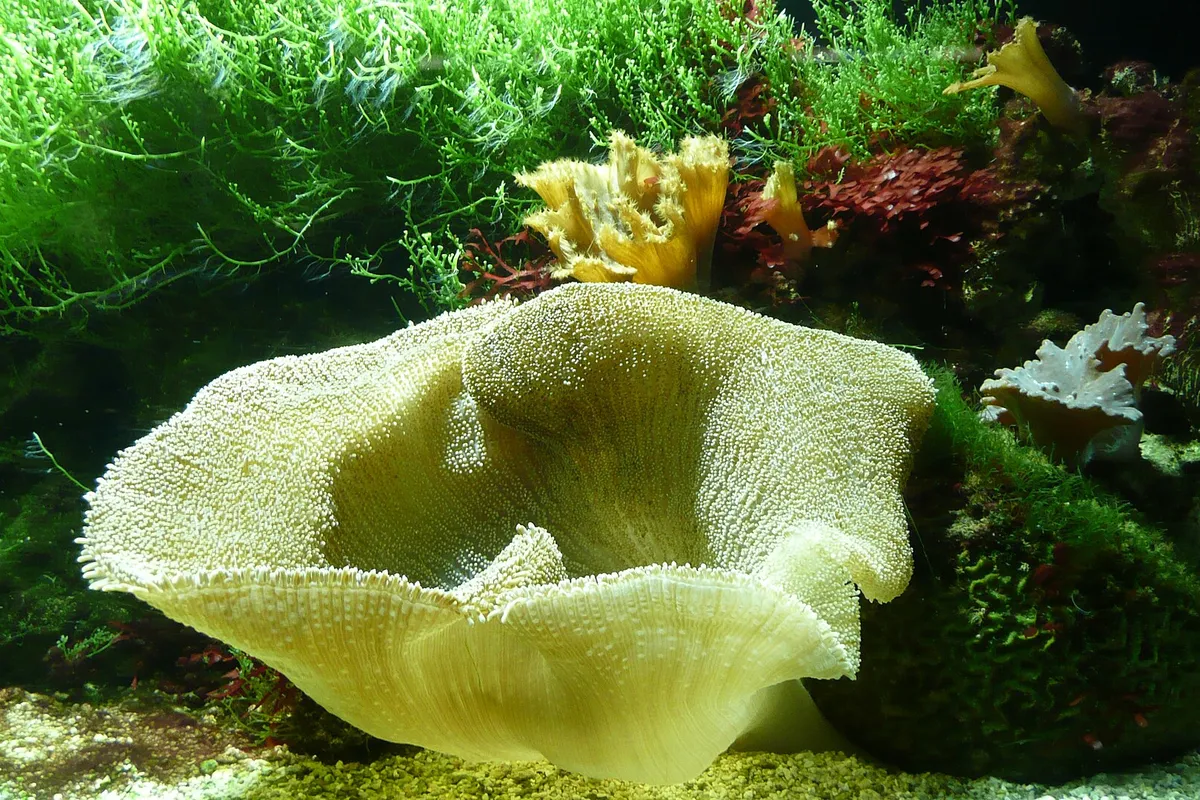
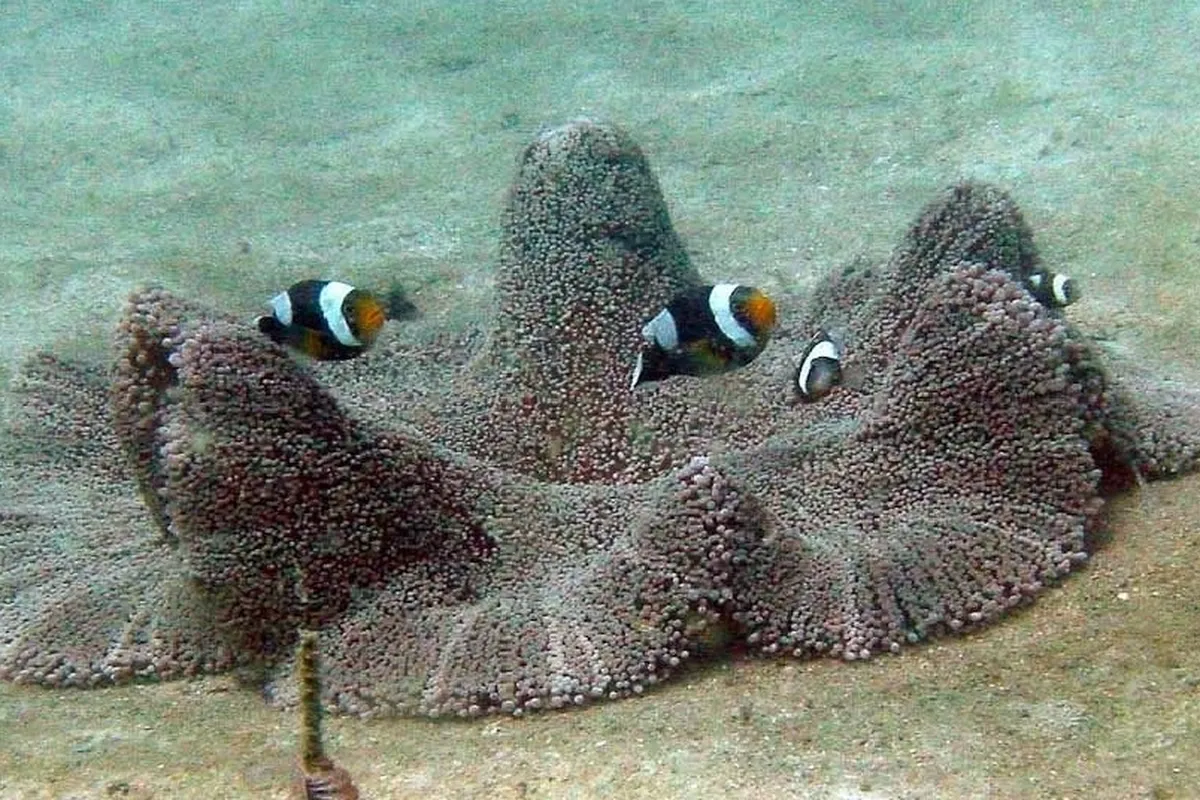
The carpet anemone, also called Haddon's or saddle carpet anemone, is one of the largest and most impressive anemones in the hobby. Stichodactyla haddoni spreads into a wide, wavy disc covered in short, sticky tentacles, often in green, tan, pink or blue. A clownfish wriggling in its folds is a classic reef sight.
It is also one of the most dangerous animals in a reef tank. Its sting is strong enough to catch and eat fish, it can grow to 80 cm, and it needs a large, mature, stable tank.
Where carpet anemones come from
Haddoni carpet anemones live across the Indo-Pacific, from the Red Sea and East Africa to Australia and the western Pacific. They are found on sand and seagrass beds in shallow lagoons, with their foot buried deep in the sand and the disc flat on the surface.
Appearance and behaviour
The disc is usually 30–50 cm across in aquariums and up to 80 cm in the wild, folded at the edges like a saddle. The tentacles are short, dense and very sticky. If it sticks to your fingers, that is the sting working.
Carpet anemones host several clownfish species, especially Clark's, saddleback, maroon and tomato clownfish. Ocellaris clownfish may also host. They tend to stay in one spot on the sand once settled, but may move if unhappy.
Tank setup
A carpet anemone needs at least 300 litres, a deep sand bed of 10 cm or more, and strong, stable lighting, around 200–350 PAR. Moderate, indirect flow is best. Cover every pump intake and overflow; a wandering carpet anemone can be shredded by a pump. Add it only to a tank that has been running stably for at least six months. Our lighting guide explains PAR and placement.

Water parameters
Keep the temperature at 24–27°C, salinity at 1.024–1.026, pH 8.1–8.4 and stable alkalinity. Nitrate should be low but not zero. Our guide to marine parameters to test covers the essentials.
Feeding
Carpet anemones are photosynthetic but also need regular feeding. Target feed two or three times a week with chunks of fish, shrimp, mussel or silversides, placing food on the disc. A healthy carpet grabs food immediately and folds it towards the mouth.
Tank mates
Choose larger, fast fish that are less likely to be caught, and add a host clownfish species. Avoid small fish, slow fish, fish that sleep on the sand, and shrimp, crabs and snails that can wander into it. Keep it well away from corals, which it will sting. Many keepers give carpet anemones a dedicated tank.
Breeding
Carpet anemones do not split in aquariums, and they are rarely bred. Aquacultured carpets are sometimes available and are the better choice.
Common problems
Wandering into pumps, shrinking from poor light, bleaching (turning white) and a gaping mouth are the main warning signs. A dying anemone can poison a whole tank, so remove it fast if it starts to fall apart. Quarantine new anemones. With good care carpet anemones can live for decades.
Explore other topics
Dive into more aquarium guides across the site.