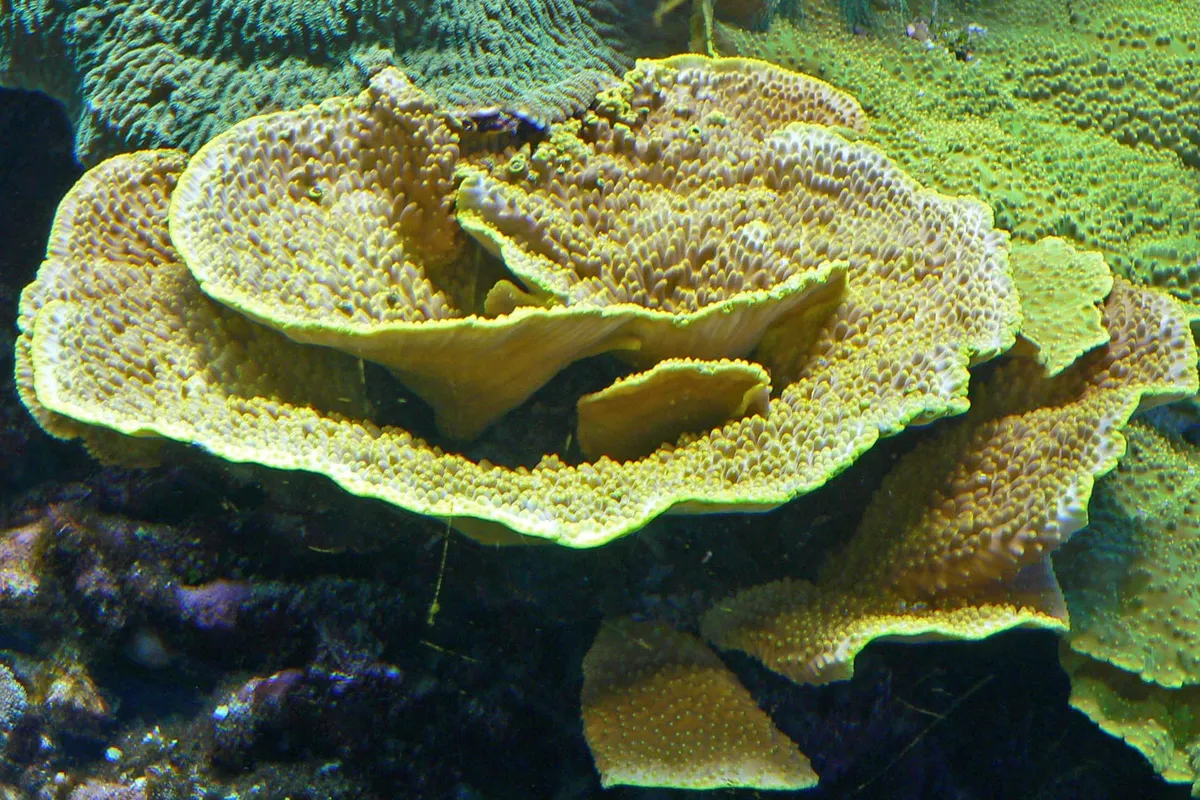
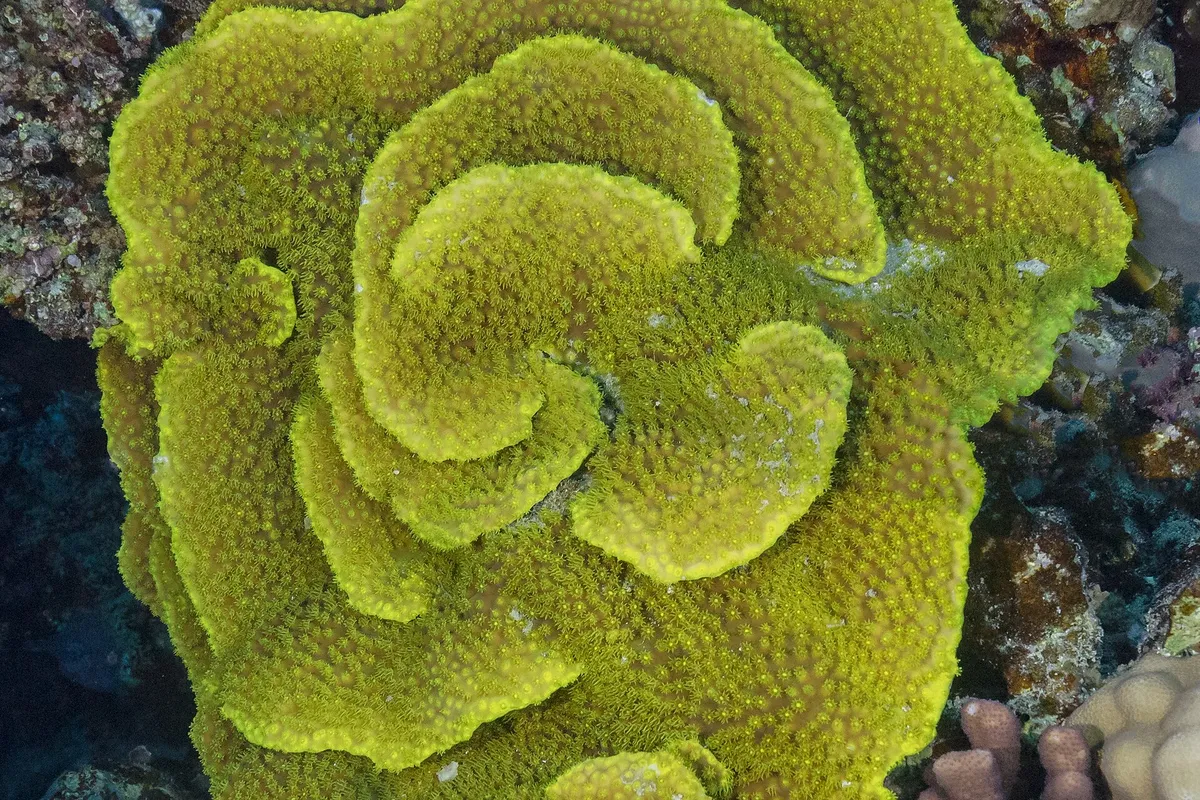
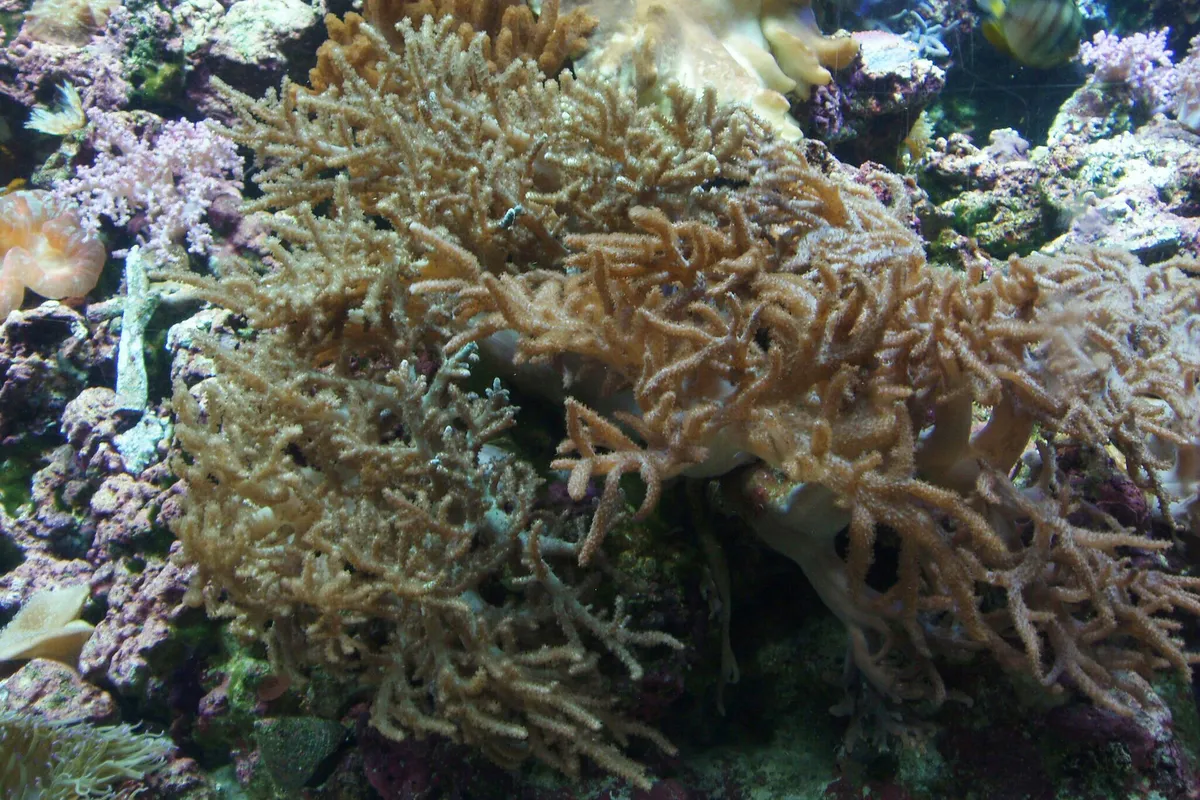
Scroll coral, also called yellow scroll or cup coral, grows into broad, swirling plates that look like rolled-up paper. Turbinaria reniformis is usually bright yellow to yellow-green, with small polyps that extend as a soft fuzz over the surface. It is one of the hardiest stony corals you can buy.
Its main need is space. A small frag can become a plate half a metre wide over a few years, shading anything below it.
Where scroll coral comes from
Scroll coral is found across the Indo-Pacific, from the Red Sea and East Africa to Australia and the central Pacific. It grows on reef slopes and in lagoons, often in murky water at 2–15 m, forming large plates and scrolls.
Appearance and behaviour
The plates are thin, flat and curved, with a smooth edge that keeps growing outward. The surface is covered in small corallites with tiny polyps that open during the day. Colours range from bright lemon yellow to green and brown, often with a pale growth edge.
Scroll coral is not aggressive and has very short tentacles, so it is easy to place near other corals, as long as its plates will not shade them as they grow.
Placement, lighting and flow
Place scroll coral low to mid-height under moderate light, around 100–250 PAR. It tolerates lower light but colours best with more. Give it moderate flow across the surface so detritus does not settle on the plates. Our guides to lighting and flow cover the basics.

Water parameters
Keep the temperature at 24–27°C, salinity at 1.025–1.026, alkalinity at 8–11 dKH, calcium at 400–450 mg/l and magnesium at 1250–1400 mg/l. Scroll coral tolerates higher nutrients than most stony corals and is a good indicator: if it starts to fade or lose tissue, check alkalinity first. See our alkalinity guide.
Feeding
Scroll coral is photosynthetic and filter feeds on fine particles. Broadcast feeding with phytoplankton, rotifers or fine coral foods a couple of times a week helps it grow. It does not need target feeding with large foods.
Fragging
Cut pieces from the plate edge with a saw or bone cutters and glue them to plugs. The cut edges heal fast and grow out into new plates. Our fragging guide has the steps.
Tank mates
Scroll coral suits almost all reef fish and invertebrates. Some angelfish nip the polyps, and urchins may graze the edges, but damage is usually minor.
Common problems
Detritus settling on the plates, shading by other corals, and alkalinity swings are the main problems. A plate that bleaches in the middle may need more flow or light. Quarantine and dip new corals to avoid pests. Scroll corals can live and grow for decades.
Explore other topics
Dive into more aquarium guides across the site.