

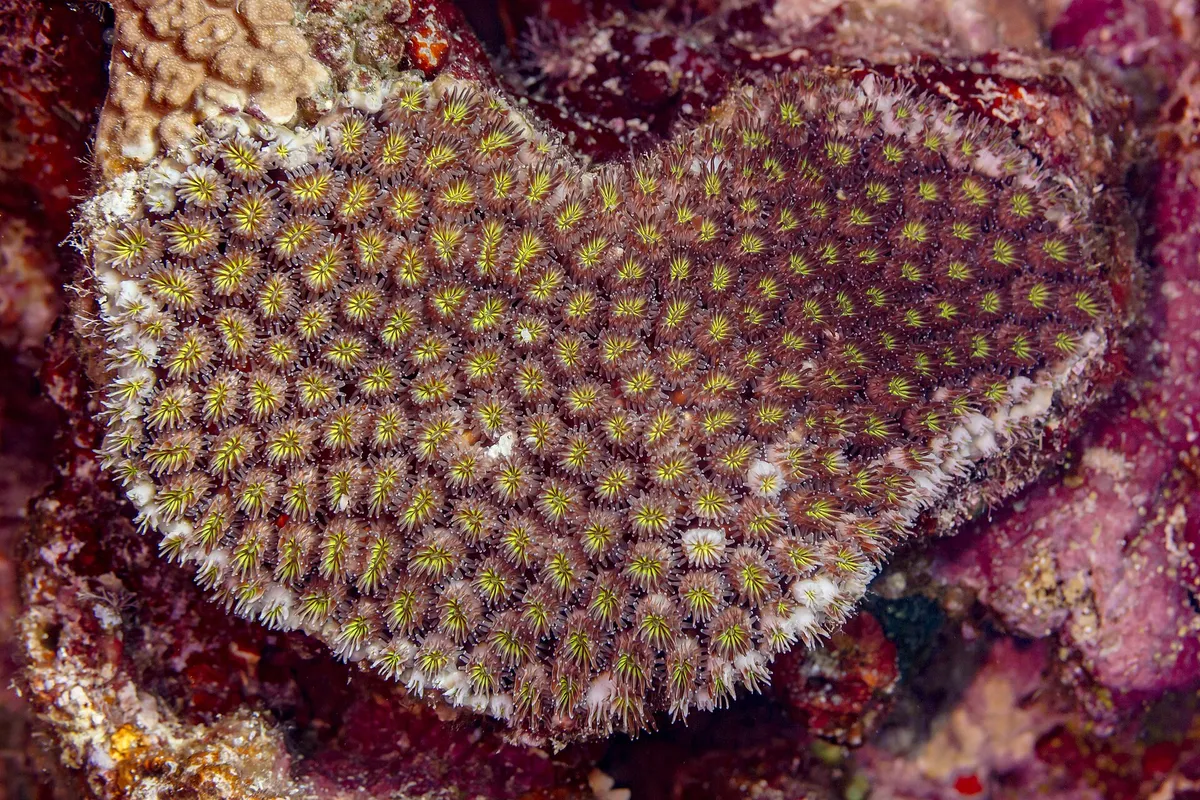
Galaxea coral, also called galaxy or tooth coral, is made of hundreds of small, star-shaped polyps packed together. Each polyp has a ring of sharp skeletal ridges and a small crown of tentacles, often with green, white or brown tips. Galaxea fascicularis grows quickly and is very forgiving of beginner mistakes.
It also has a dark side. Galaxea sends out sweeper tentacles that can reach 15 cm or more and kill almost any coral they touch. It is a great coral if you plan its place in the tank carefully.
Where galaxea coral comes from
Galaxea is common across the Indo-Pacific and Red Sea, on reef flats, slopes and lagoons at 1–20 m. It grows in many forms, from flat encrusting plates to large mounds.
Appearance and behaviour
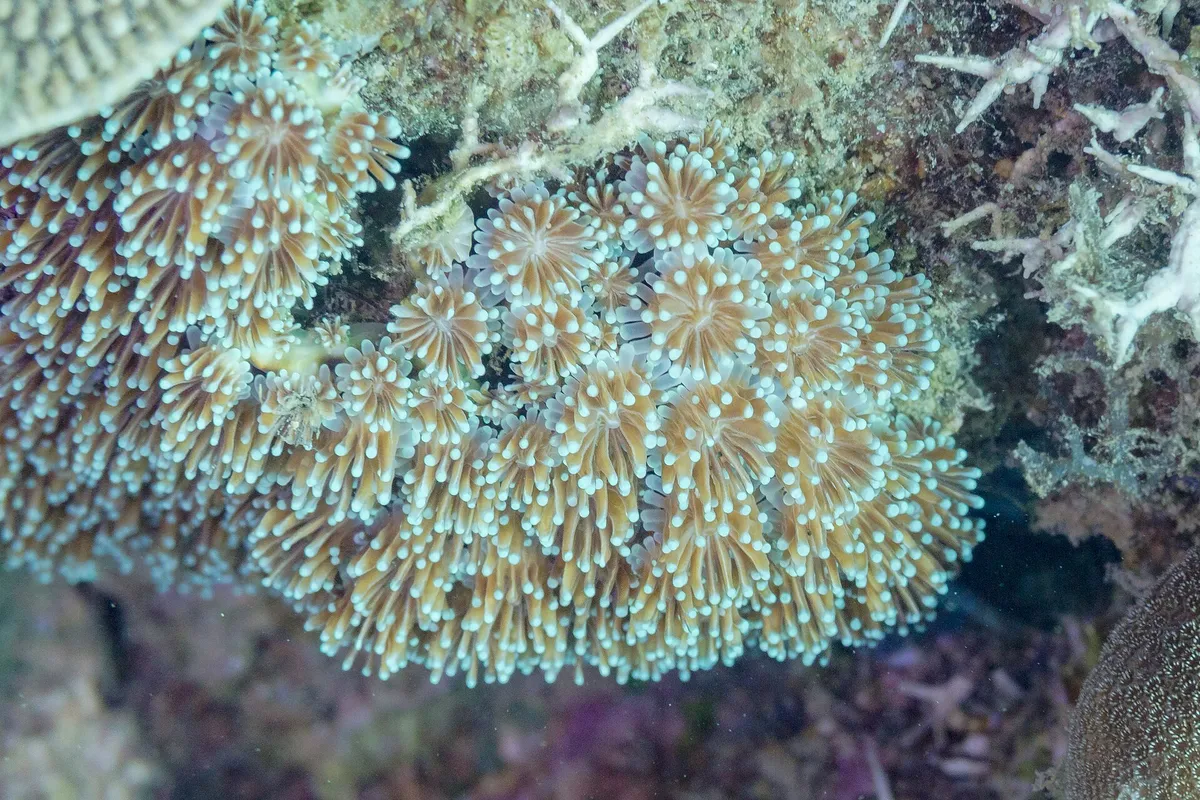
Each polyp is 5–10 mm across, with sharp, pointed septa that look like tiny teeth. The tentacles are short during the day, often with white or green tips. Colours range from brown and green to cream with bright green centres.
At night, and sometimes during the day, galaxea extends long, thin sweeper tentacles with powerful stings. These are some of the most aggressive in the reef, so keep galaxea 15–20 cm from other corals, or on its own island of rock.
Placement, lighting and flow
Galaxea does well under moderate light, around 100–250 PAR, placed mid-height in the tank. Moderate flow keeps detritus off it. Choose a spot downstream from other corals, so the flow carries its sweepers away from neighbours, and place it lower in the tank than coral you want to protect. Our guides to lighting and flow can help.

Water parameters
Keep the temperature at 24–27°C, salinity at 1.025–1.026, alkalinity at 8–11 dKH, calcium at 400–450 mg/l and magnesium at 1250–1400 mg/l. Galaxea tolerates a wide range, but steady alkalinity gives steady growth.
Feeding
Galaxea is photosynthetic and also catches small food. Target feeding once or twice a week with fine foods such as rotifers, small mysis or coral powders speeds up growth. Well-fed galaxea also tends to send out fewer sweepers.
Fragging
Galaxea is easy to frag with a saw or bone cutters. Cut through the skeleton, glue the pieces to plugs and they heal quickly. Our fragging guide explains how. Wear gloves: the skeleton is sharp.
Tank mates
Galaxea is fine with most reef fish and invertebrates. The main risk is to other corals, not to fish.
Common problems
Most problems are with neighbours, not the galaxea itself. Watch for bleached patches on corals near it at night. Galaxea is prone to bleaching if moved suddenly to strong light, so adjust it slowly. Quarantine and dip new corals. Kept well, galaxea colonies live and grow for many years.
Explore other topics
Dive into more aquarium guides across the site.
