

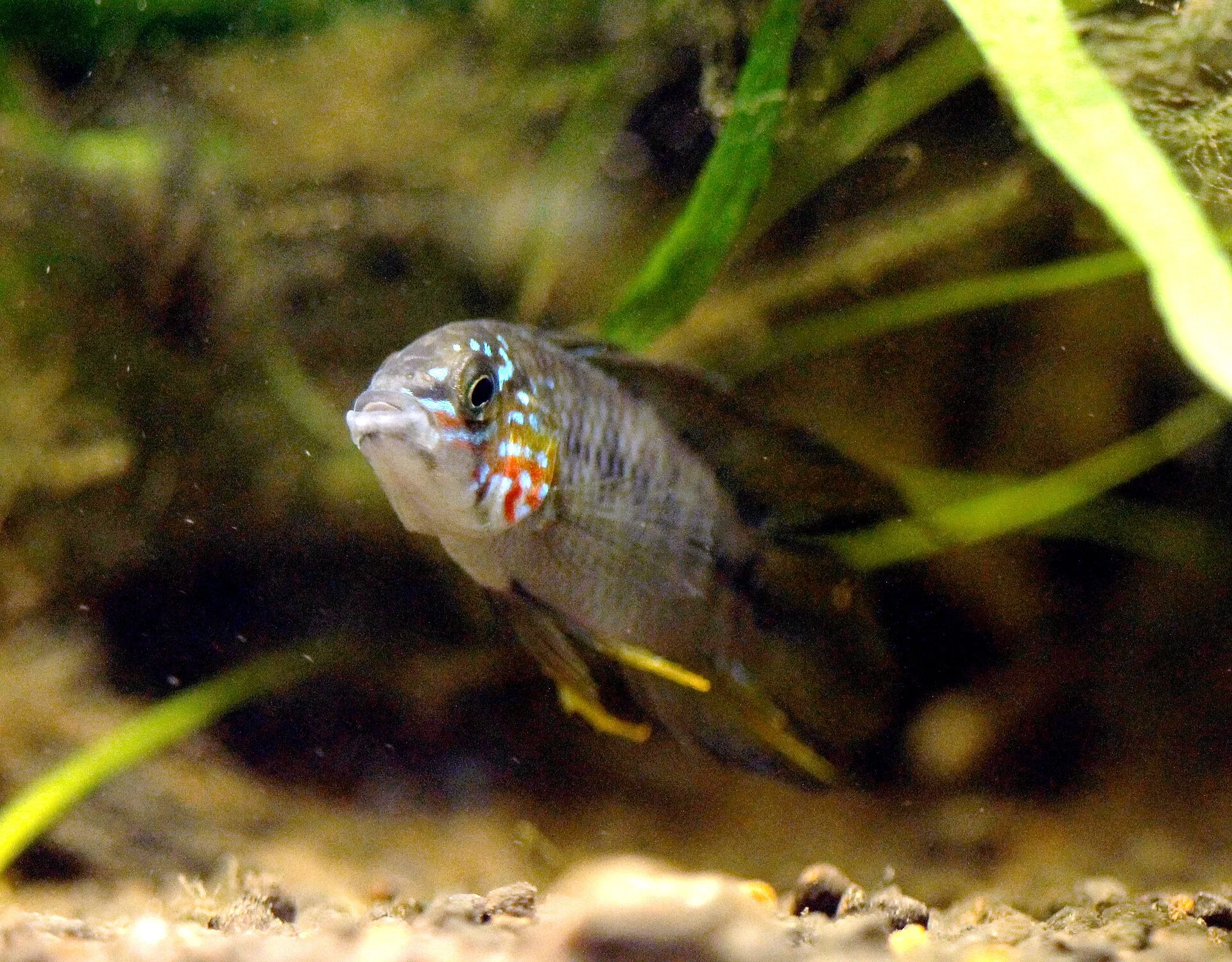
Walk a flooded pasture in the Paraná basin after rain and the water is warm, stained, and full of leaf. That is the world of Apistogramma borellii, the yellow dwarf cichlid that aquarium literature still sometimes calls the reitzigi. It is not a blackwater specialist in the A. agassizii sense. It is a floodplain fish that will live in water many other apistos would sulk in — and that difference is why it became a favourite of people who wanted dwarf cichlid behaviour without a laboratory pH.
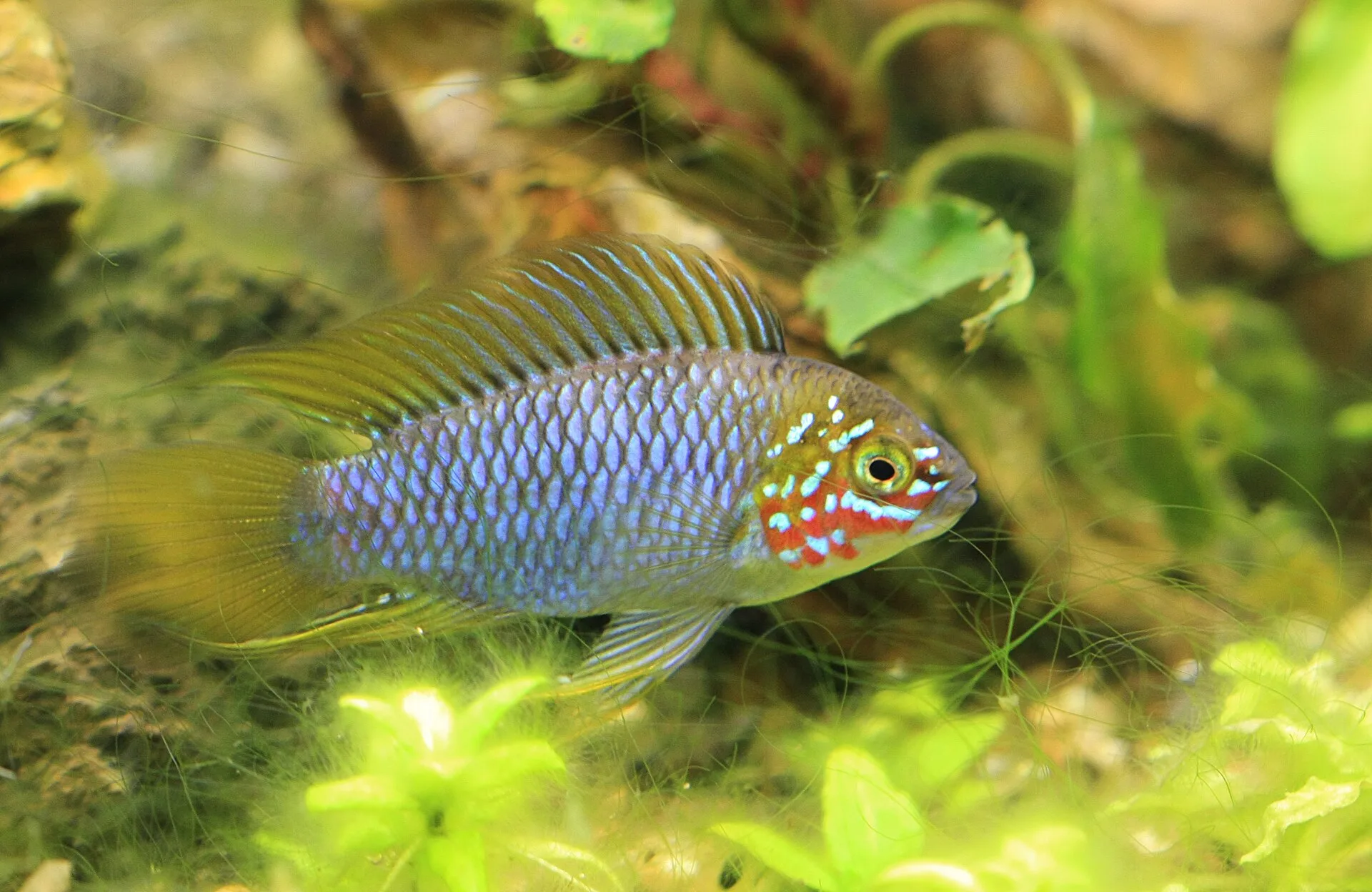
Males in breeding dress are butter-yellow with blue in the fins and a dark comma through the eye. Females stay smaller, rounder, and often a quieter gold until they have eggs, when the yellow intensifies and the fins look painted. If you have only seen washed-out shop fish in a crowded box, you have not seen the species. Colour is a result, not a paint job applied at the wholesaler.
Yellow on a brown floodplain
Apistogramma borellii ranges through parts of Paraguay, northern Argentina, and southern Brazil, in the Paraguay–Paraná system. The water is not always tea-dark. Conductivity and hardness vary with season. Temperatures swing more than they do in a rainforest creek under forest cover. That ecological flexibility is real, but it is not a licence to dump them into a hard, alkaline community with barbs and a powerhead. “More forgiving than cacatuoides” still means a South American dwarf cichlid with a cave and a floor of fine substrate.
In the wild they work the edges: roots, grass stems, packed leaves, the kind of cover a fry can vanish into. Current is usually modest. Light through shallow water can be bright. An aquarium that is a dim cave with no open patches will hide them; an aquarium that is a bare sand desert will stress them. You want both: litter and wood, and a few clear lanes where a male can show that yellow.
How to tell the sexes without a lecture
Adult males reach about 6–7 cm, females a centimetre less. The male’s dorsal and anal fins are longer and more pointed. His body is the colour advertisement. The female’s body is shorter and deeper when she is gravid, and her pelvic fins often show a darker leading edge. Immatures overlap. If you buy six young fish you will probably get a mix; that is useful, because a working group is one male and two or three females, not two males in a 60 litre box.
There are aquarium strains — “opal,” yellow, and so on — selected for more blue or more gold. They are still A. borellii. Do not mix them with other Apistogramma species in a small tank and hope for “pretty hybrids.” You will get harassment and, if spawning happens, messy genetics you cannot undo.
A floor of leaves, not a showroom scape
Sixty litres can hold a pair. Eighty to a hundred litres is more honest for a male and two females, because each female needs a cave the others cannot see into. Caves can be coconut halves, clay pots on their side, or rock slabs with a low entrance. The entrance should face away from the filter outflow. Dwarf cichlids spawn in still pockets, not in a current they have to lean into.
Substrate: sand. They sift. Gravel traps food and scrapes the gular area. A layer of botanicals — catappa, oak, or beech leaves — is not decoration for Instagram; it is cover for fry and a source of biofilm the adults pick at. Wood can span the tank and break sightlines so the male cannot see every female at once. Plants that tolerate soft to moderately hard water — Java fern on wood, crypts in the sand, floating frogbit to cut glare — make the fish bolder. Bright open light with no shade produces fish that plaster themselves to the back glass.
Filtration should be gentle. A sponge filter is enough in a dedicated apisto tank. If you use a canister, baffle the outlet. These fish do not need a river. They need oxygen and clean water, which is not the same as flow they have to fight.
Chemistry they will accept

Temperature 24–28°C is the usual working range; they will tolerate the low twenties better than many Amazon dwarf cichlids, which matches a more southerly distribution. pH from the mid-sixes into the low sevens is fine. Soft to moderately hard water works. Very hard, high-pH tap (the kind you would use for Malawi) is a poor match and often shows up as poor colour, fungus on eggs, and females that eat every spawn.
If your tap is liquid rock, RO mixed with a little tap, or a remineraliser aimed at soft South American water, will serve you better than “they’re hardy, it’ll be fine.” Ammonia and nitrite stay at zero. Nitrate is best kept modest with weekly changes. They are not as fragile as wild-caught A. panduro, but they still live in a small body of water in your living room, and small bodies of water go bad quickly when you overfeed frozen bloodworms.
A micropredator that will take pellets
Wild fish take insect larvae, microcrustaceans, and whatever moves at the right size. In the tank, the reliable mix is a good small pellet or granule plus frozen foods: baby brine shrimp, daphnia, cyclops, chopped bloodworm. Live grindal worms or newly hatched brine shrimp bring females into breeding condition faster than flakes alone. They will graze biofilm on leaves. They will not replace that grazing with a diet of nothing but algae wafers; they are not otocinclus.
Feed twice a day in amounts that vanish. Males sometimes hold a cave and miss the first dump of food; drop a little at each cave mouth. If tank mates are tetras that are faster, the apistos lose. That is a stocking problem. Fix the company, do not just dump more food and pollute the sand.
One male is a decision, not a suggestion
Two adult males in a tank under a metre long will fight. The loser hides, fades, and often dies slowly of not eating. One male, two or three females, and enough caves is the social unit that matches how these fish use space. Females maintain small territories around their caves and will spar with each other; that is normal. Torn fins that never heal are not normal — add cover or reduce the number of females.
Companions that work are small, peaceful, and uninterested in caves: a school of ember tetras, Nannostomus, or similar fish that stay in the upper half and share soft to moderately soft water. Corydoras of a small species can work on the sand if the tank is large enough that the cichlids do not own every inch of floor. Avoid other dwarf cichlids in the same footprint. Avoid angels, which will eat fry and intimidate adults. Avoid anything that needs hard, alkaline water. Shrimp will be treated as food once the cichlids are hungry enough, especially when fry are being raised.
Eggs where you cannot see them
The female lays on the cave ceiling. The male fertilises. She takes over the cave; he patrols a wider area and may be driven off if he comes too close. You will know spawning happened when she is suddenly intense yellow and the cave entrance is a no-go zone. Eggs hatch in a few days; wrigglers become free-swimming in about a week, depending on temperature. She herds a cloud of fry. At that point the male’s usefulness in a small tank is limited and his presence can cause extra aggression. Some keepers move him. Some have enough space that he simply stays at the far end.
Fry need infusoria and then baby brine shrimp. The mother will chew food and the fry will pick at what she disturbs. If you want numbers, a separate rearing box with the same water is easier than hoping a community tank ignores a cloud of 4 mm fish. If you do not want numbers, the tetras will solve the problem for you.
When the yellow goes out
A pale male that hides is telling you the tank is too bright, too bare, or too crowded with fish that swim through his court. White fungus on a spawn usually means hard water, cold water, or a female that is too young. Ich appears after a chill or after a rough import; treat in a hospital setup if you can, because some medications and plants do not mix, and because you want to see whether he is eating.
Quarantine new apistos for a couple of weeks. They arrive thin more often than they arrive diseased. Feed them well in a small planted tank with a sponge filter before they have to compete. A borellii that has been eating for a month in decent water is a different animal from the one that sat in a cup at a show. Give it the floodplain floor — leaves, a cave, sand — and the yellow is not a strain name. It is the fish, finally, looking like itself.
Explore other topics
Dive into more aquarium guides across the site.