

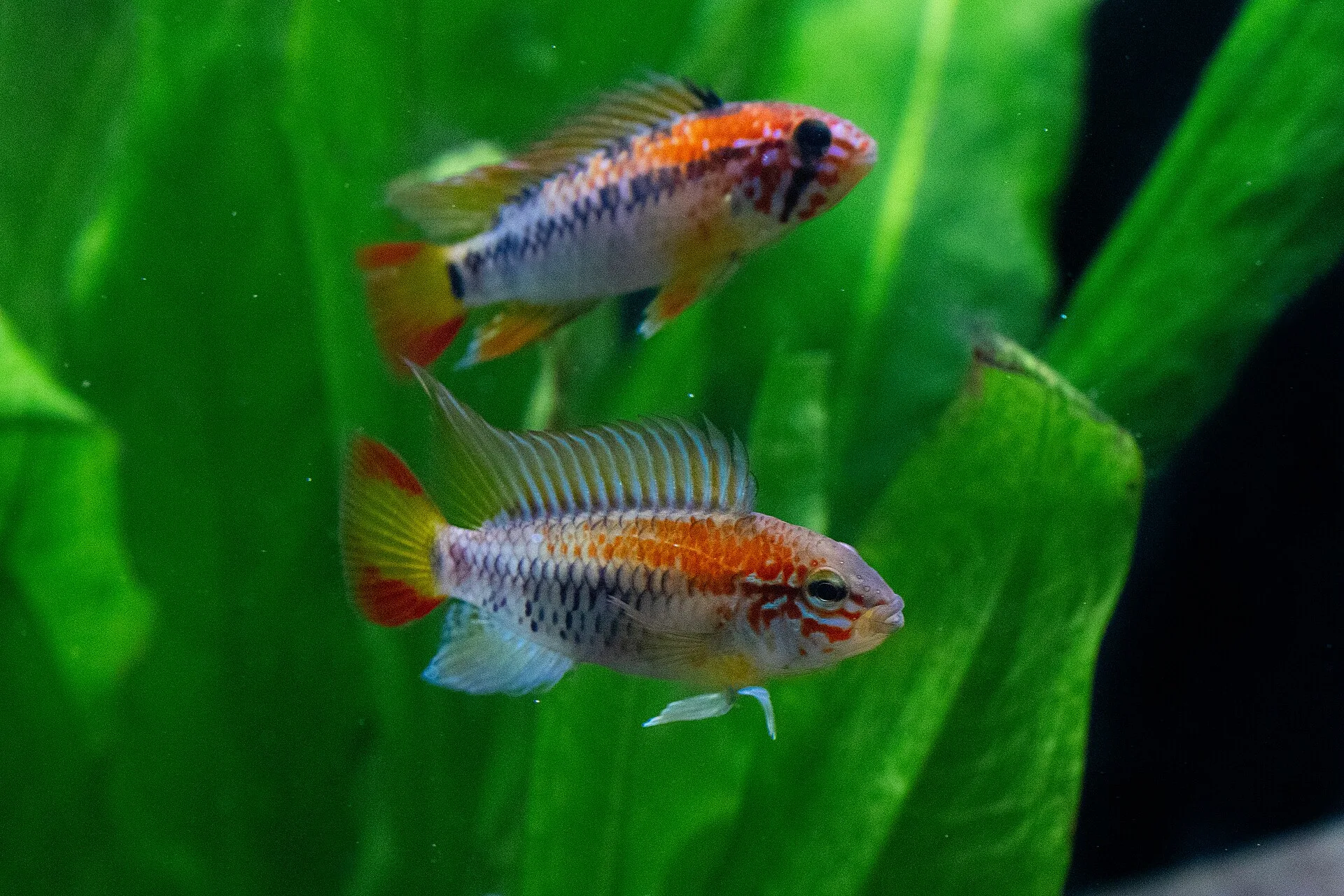
The first Apistogramma macmasteri I ever saw in person was not the red-orange flag that photographs promise. It was a skinny Colombian import the colour of wet cardboard, hugging a lump of wood in a dealer’s trough of hard tap water. Two months later, in soft, warm, stained water with a clay pot and a floor of sand, the same male looked like a different animal. That gap — between the fish as shipped and the fish as kept — is the whole story of this species. It is a Meta and Orinoco dwarf cichlid with real colour, and it will not show that colour in a generic community recipe.
People buy macmasteri because the male’s dorsal can run from rust to fire, with blue in the face and a body that carries a dark lateral mark. Females are smaller, yellow-gold when they are in breeding condition, and fiercely attached to a cave. If you wanted a “beginner apisto,” this is the wrong purchase. A. borellii forgives more. Macmasteri wants the water of a tea-stained creek and a tank that belongs to one male.
Creeks that drain toward the Orinoco
Apistogramma macmasteri is native to parts of Colombia in the Orinoco drainage, including waters associated with the Río Meta. The typical picture is forest creek and flooded margin: leaf litter, submerged wood, low conductivity, pH well below 7, temperatures in the mid-twenties. It is not a rift-lake fish and it is not a Central American cichlid. Mixing it with convicts or mbuna is a chemistry error before it is a temperament error.
Wild habitats are structured at fish scale. A fallen branch, a pocket under a bank, a cave of packed leaves — that is a territory. Your aquarium has to offer the same grain of cover. A single piece of driftwood in the centre of a glass box is a sculpture, not a creek.
The male you are actually buying
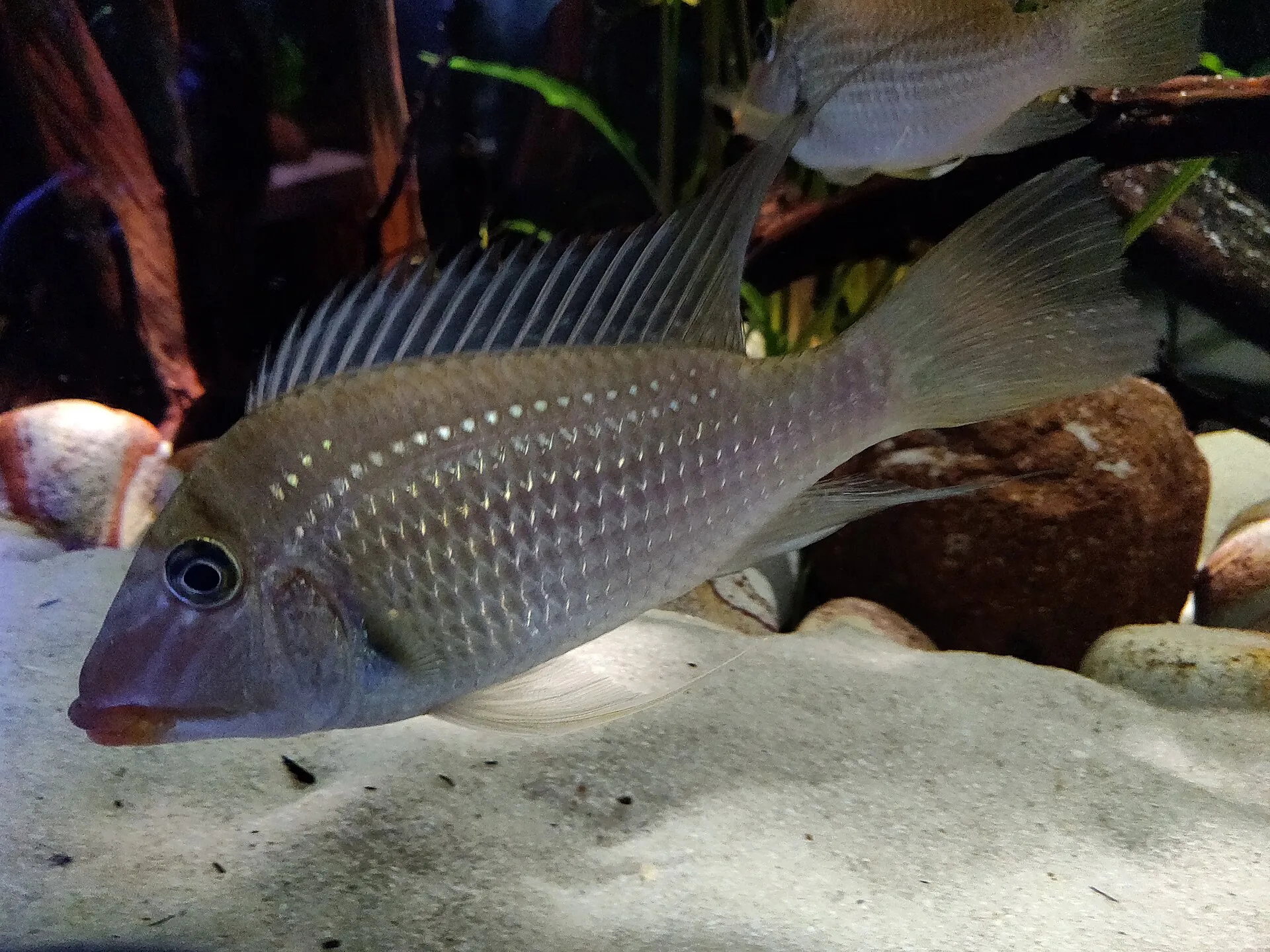
Adult males reach roughly 7–8 cm, females closer to 5 cm. The male’s spiny dorsal is taller, often with filamentous extensions, and his colour is the reason the species is in the trade. Red, orange, and blue distribution varies by locality and by aquarium strain; “red” macmasteri in shops may be selected lines. Females lack the sail and stay stockier. Sexing juveniles is guesswork. Buy a group of young fish only if you have a plan for extra males — a second tank, a club, a rehoming path. Two adult males in 80 litres will not “sort themselves out.” One will own the tank and the other will own a corner until it starves.
Look at the gill covers and the flanks when you buy. Pinched bellies, clamped fins, and a fish that will not take frozen food in the shop are a rehabilitation project, not a bargain. This species arrives stressed more often than locally bred kribs do. Budget quarantine time into the purchase.
Hardscape a male can claim
Eighty litres is a working minimum for a male and two females if the footprint is long. A tall hexagon of the same volume is a bad joke. Lay sand, then wood that runs diagonally so the tank is split into visual rooms. Put caves in each room: clay pots, coconut shells, stacked slate with a low gap. The male will choose a court. Each female needs a hole he cannot easily occupy at the same time. If you can see every cave from one spot, so can he, and he will police them all.
Blackwater cues help: botanicals, alder cones, a modest tannin stain. Plants that handle soft water — Microsorum, Anubias on wood, floating Salvinia or frogbit — reduce glare and give fry a chance. Lighting should be enough for the plants, not a spotlight. These fish colour up under broken light. They bleach under a bare LED panel aimed straight down.
Flow stays low. A sponge filter, or a canister baffled into a rainbar at the surface, keeps oxygen up without blasting the caves. They will jump if panicked. Use a cover.
Blackwater without superstition
Target pH 5.5–6.8, very soft to soft water, 25–28°C. You do not need pH 4.5 unless you are a specialist breeding wild fish and you know what you are doing with ion-poor water. You do need to get off alkaline tap. RO plus a South American remineraliser (or a known ratio of tap to RO that you have tested) is the usual method. Measure GH and KH. If KH is high, pH will not stay in the sixes no matter how many catappa leaves you throw in.

Tannins are a tool, not a religion. They modestly influence pH, they reduce visual stress, and they make the red on a male look like red instead of washed brick. Replace leaves as they break down. Do not let the tank become a stagnant soup. Soft water still needs nitrate control. Change water weekly with matched, remineralised RO. A 50 percent change of untreated hard tap is how you kill a spawn and shock the adults in one afternoon.
Protein at the size of a mouth
This is a micropredator. Frozen cyclops, baby brine, daphnia, and grindal worms do more for condition than any flake labelled “colour enhancer.” A high-quality micro pellet can be a daily staple once they recognise it. Feed twice a day. Females coming into spawn need extra. Males that spend the day displaying still need to eat — they often miss food that is gone in ten seconds, so feed in two places.
Avoid a diet of large bloodworms only. Gut blockage and obesity show up in dwarf cichlids that live on that menu. Variety is not a slogan; it is how you keep the liver from turning into paste. They will pick at biofilm. They will not live on it.
Why a second male usually fails
Harem structure — one male, two or three females — matches their use of space. Extra males need their own aquaria or a much larger, heavily broken layout that most living rooms will not provide. Tank mates must ignore caves and share soft, warm water. Small characins that stay up in the water can work in a bigger tank. Other dwarf cichlids will not. Large cichlids will eat them or terrorise them. Shrimp are food. Snails may survive.
A species tank is the honest recommendation. You will see courtship, cave defence, and the female’s gold. You will not see that if a boisterous barb school treats the lower third of the tank as a racetrack.
A clay pot with a deadline
She lays in the cave. He fertilises. She guards. Eggs of soft-water apistos rot if the water is hard or cold or dirty. When it works, you get a female who will bite your siphon and a male who has become a problem for everything else in the aquarium. Move him if the tank is small. Leave him if there is a real visual break and he has stopped ramming the pot.
Fry need microscopic food immediately: infusoria, then newly hatched brine shrimp. A dedicated breeding tank with the same chemistry saves you from watching tetras vacuum the cloud. If you are not set up for fry, enjoy the courtship and accept that most eggs will not become adults. That is still a successful keep. Not every spawn has to be a production run.
Stress you can see on the flanks
The dark lateral mark intensifies when they are frightened or beaten. A male that stays in that pattern all day is not “showing his marking.” He is losing. Check for a second male you missed, a heater the female has claimed as a cave, or nitrate that crept up. White spots after a chill are ich; treat in quarantine. Velvet looks like gold dust and kills faster — again, quarantine, not a mystery mix in the display.
Hold new macmasteri separately until they eat aggressively and the faeces look normal. Colombian imports can carry intestinal issues; a week of good food and clean soft water solves more of that than a shotgun deworm on day one, though stubborn cases need a proper diagnosis. Do not add them to an established harem and “see how it goes.” It will go badly for the new fish.
Kept well, they live several years and stay small enough that the tank does not outgrow the room. The price of the red is not a special heater. It is water that could pass for a forest creek, a male who does not have to share his title, and a pot in the shade. Meet those three and Apistogramma macmasteri stops being cardboard. It becomes the reason people keep dwarf cichlids in the first place.
Explore other topics
Dive into more aquarium guides across the site.