
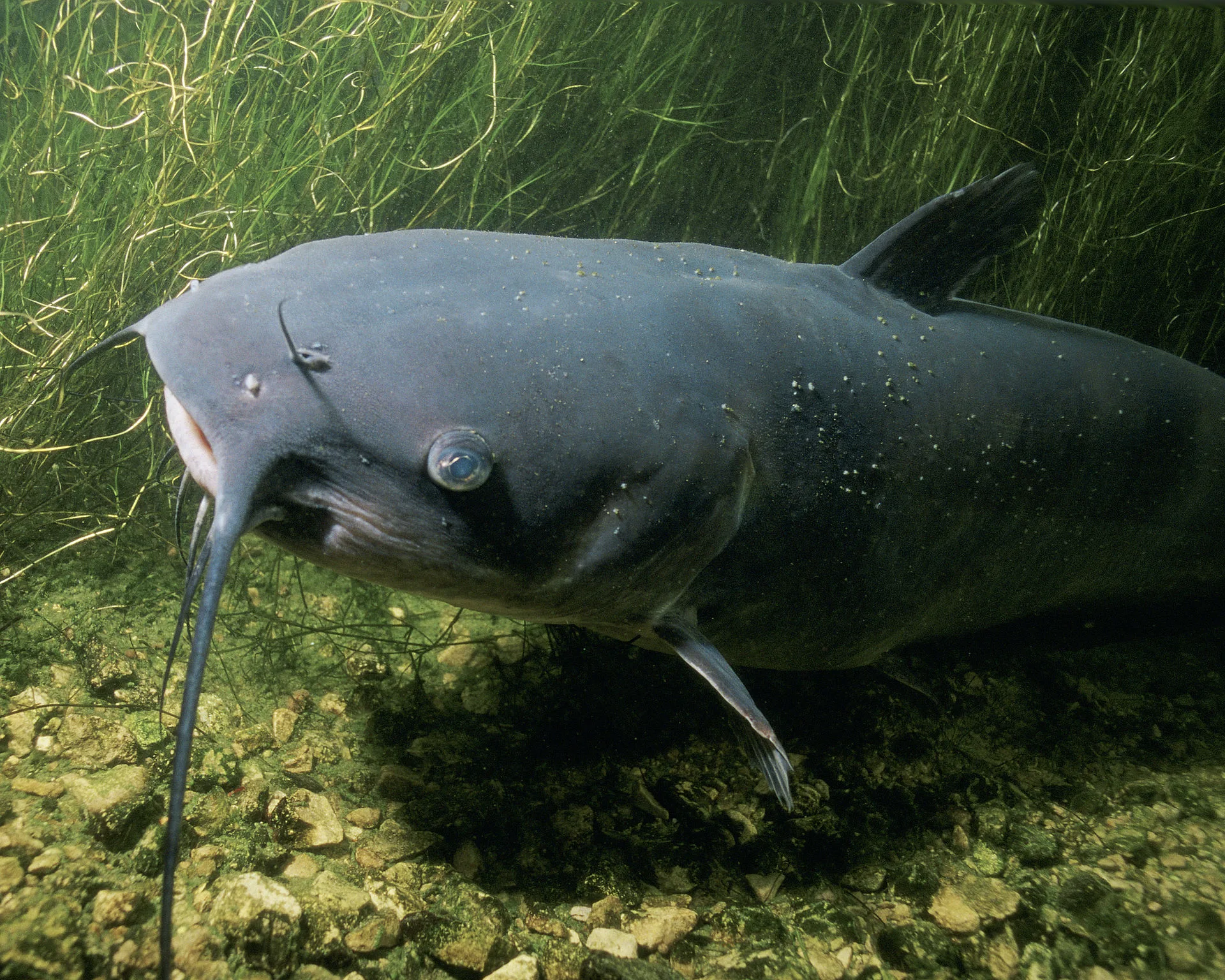
The channel catfish is the fish of Midwestern rivers, farm ponds, and Friday-night fish fries, not the fish of a heated Amazon community tank. Ictalurus punctatus is a North American ictalurid. Juveniles show black spots on a silver-olive body and a deeply forked tail. Adults become grey slabs with a huge mouth. In open water they routinely reach 50–70 cm in ponds and well over a metre in big rivers. That is a huge river fish. It is not a community catfish, not a tropical pleco, and not a “cleaner” for a 200 litre living-room box.
Mississippi water, not the Rio Negro
Wild channel cats belong to the Mississippi basin and related drainages of the United States and northern Mexico, with introductions far beyond that range because people like to eat them. They use rivers, reservoirs, oxbows, and ponds. They tolerate a wide swath of temperate and subtropical temperatures. They do not come from the Amazon, the Congo, or the Mekong. Putting a baby channel cat in a 28 °C discus tank because “catfish like it warm” is a category error. This species evolved to winter in cold water and to feed up in summer. Constant tropical heat is a stress, not a kindness.
In rivers they roam along channels, cut banks, and snags, tasting with barbels. In ponds they mill in open water and come to pelleted feed. An aquarium that looks like a planted nano scape is scenery the fish will outgrow and then destroy. The honest habitat analogue at home is a pond, a stock tank, or a public-aquarium river exhibit — not a community glass box.
Fisheries biologists manage this species as a sport and food fish. The pet trade sometimes sells four-inch spotted juveniles next to tropical tetras. Those two markets should not share a shopping basket.
Spots that fade, a fork that stays
The diagnostic wild look is the forked caudal fin, the spotted juvenile body, and four pairs of barbels around a wide mouth. As the fish grows, spots often fade and the head becomes a wedge. The anal fin has a characteristic ray count that keys it from blue catfish (I. furcatus) and from bullheads, but shop staff will not do that for you. If it is sold as “channel cat” and it is a North American spotted fork-tail, assume it will become a slab.
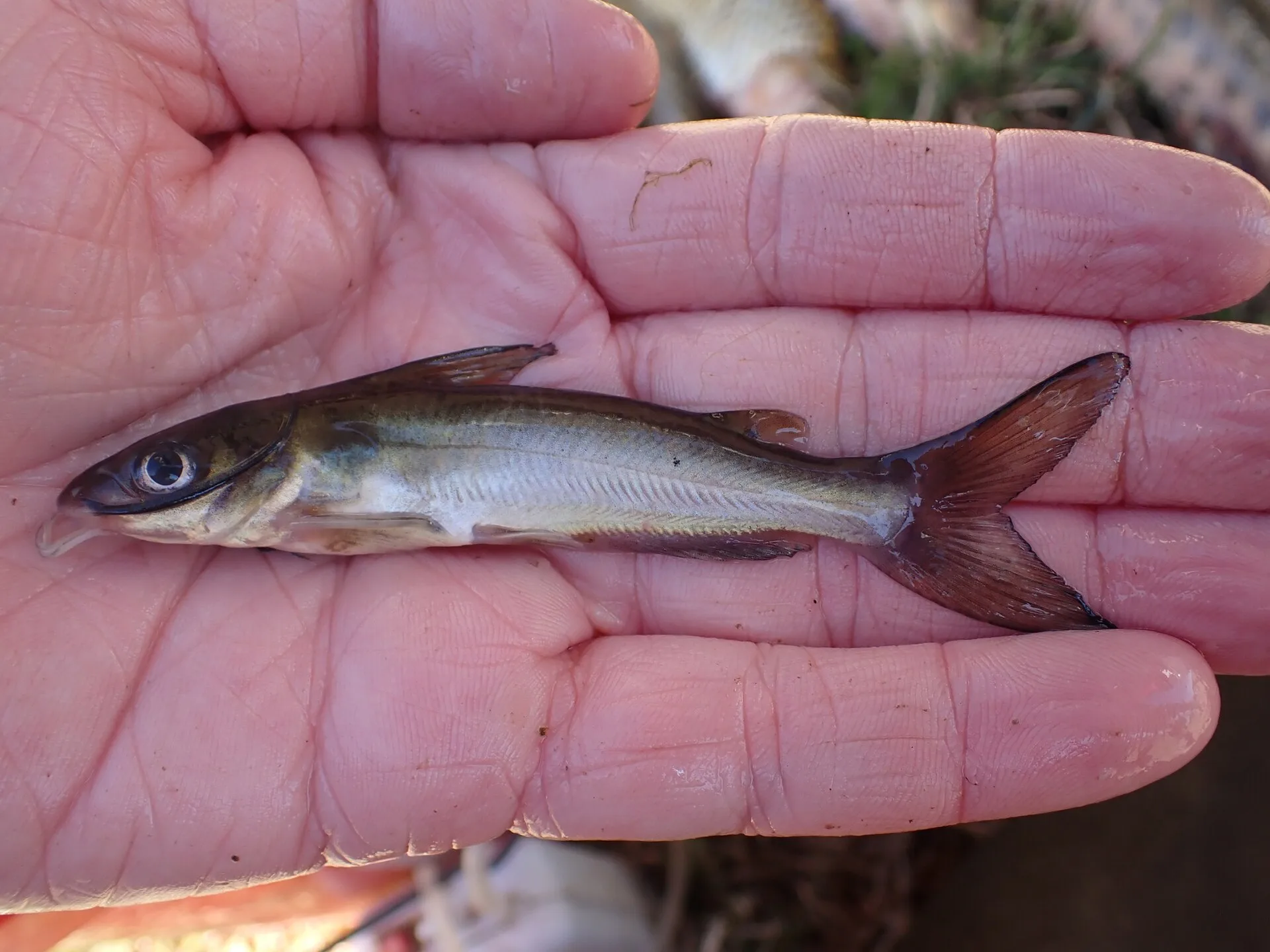
A healthy pond fish has intact barbels, a firm belly, and clear eyes. Shop juveniles in warm tropical systems often show eroded barbels, clamped fins, and a hunger that will later erase every small tank mate. That is not “personality.” That is a giant forager in the wrong building.
Males in the breeding season can get swollen heads and darker colour; females look heavier with eggs. Pond culture uses those cues. A 12 cm pet-shop fish cannot be sexed usefully.
Ponds, stock tanks, and why 400 litres is still a joke
Adult channel catfish belong in outdoor ponds or in truly enormous indoor systems measured in thousands of litres with swimming length in metres, not in “a big aquarium.” A long cattle trough with filtration is closer to honest than a tall 300 litre show tank. They need oxygen, cool or temperate water, and a place to mill. Décor should be sparse, rounded, and immovable. They will uproot plants, smash light wood, and eat anything that fits.
A lid or pond net stops jumpers and herons. Filtration must handle a high-protein waste load. Under-gravel filters and cute sponge filters are toys. Think pond pumps, settlement, and large water changes — or do not buy the fish.
Indoor keepers who insist on glass should treat this as a single-specimen river exhibit for a public space, not a hobby community. If that sounds like too much, it is, and the correct action is to walk away from the spotted juvenile.
Cooler water is not optional flavour
Channel cats do well from the mid-teens to the mid-20s °C. Many North American ponds freeze at the surface in winter while the fish sit in deeper water. A heater holding 27 °C year-round is the wrong climate. pH around 6.5–8.0 with moderate to hard water matches a lot of their native range. Stability and oxygen beat tropical “blackwater” recipes. Ammonia must be zero; a big omnivore fouls water fast.
Summer pond crashes happen when density is high and aeration fails at night. Indoor tanks fail the same way when a powerhead dies. Watch gill rate. Add air. Do not medicate a gasping channel cat for “ich” until you have tested oxygen and ammonia.
A river omnivore that becomes a predator of tank mates
In nature and in aquaculture, I. punctatus eats insects, crustaceans, plant material, carrion, pellets, and fish. In a home tank that menu becomes: everything you feed, then everything that still fits in the mouth. Quality sinking pellets formulated for large omnivores, earthworms, and occasional fish or prawn pieces are appropriate in a pond. Feeding live “feeder fish” as a staple is poor welfare for the feeders and dirty for the system. Do not expect algae wafers to be a diet. Do not expect leftover flake to grow a metre-class fish cleanly.
Growing juveniles eat often. Adults in ponds take substantial meals and can be trained to a feeding station. Uneaten pellets on a pond bottom are an ammonia factory. Feed to appetite, not to boredom.
Who survives in the same water
Other similarly huge, cool-water fishes — in a pond, not in a community aquarium — are the only honest companions. Bluegill, large bass, or other channel cats in aquaculture densities are a fisheries conversation, not a tropical stocking list. Small tropical fish are food. There is no “once it gets to know them” exception. If you wanted a peaceful South American community, you wanted a different species on a different continent.
A single channel cat in a tiny indoor tank becomes a bored, dirty, stunted animal. That is cruelty dressed up as a pet.
Cavity nests on a continental schedule
In late spring and summer, males of I. punctatus clean a cavity — a hollow log, a hole in a bank, a spawning container in a pond — and guard a mass of eggs. This is well documented in aquaculture. It is not a behaviour you should expect in a 200 litre tropical tank, and you should not buy two juveniles “to breed.” Pond culture is how the food industry makes more channel cats. Your living room is not a hatchery.
Farmed, wild, and the impulse buy
Most channel cats in North America are farmed for food. A few enter the ornamental trade as spotted babies. Conservation is not the same issue as with giant Mekong pangasiids, but welfare is. A fish that belongs in a pond does not become an aquarium fish because it is small this week. If you have a legal, well-aerated pond in a climate that suits them, you can keep channel cats as the huge river and pond fish they are. If you have a heated community tank, you cannot.
For tropical community catfish, look at species that stay small. For this one, look at pond literature, not at Amazon pleco guides. Chemistry primer: aquarium water chemistry. Cycling still matters in a pond filter: cycle the system before you add a protein factory.
Explore other topics
Dive into more aquarium guides across the site.