

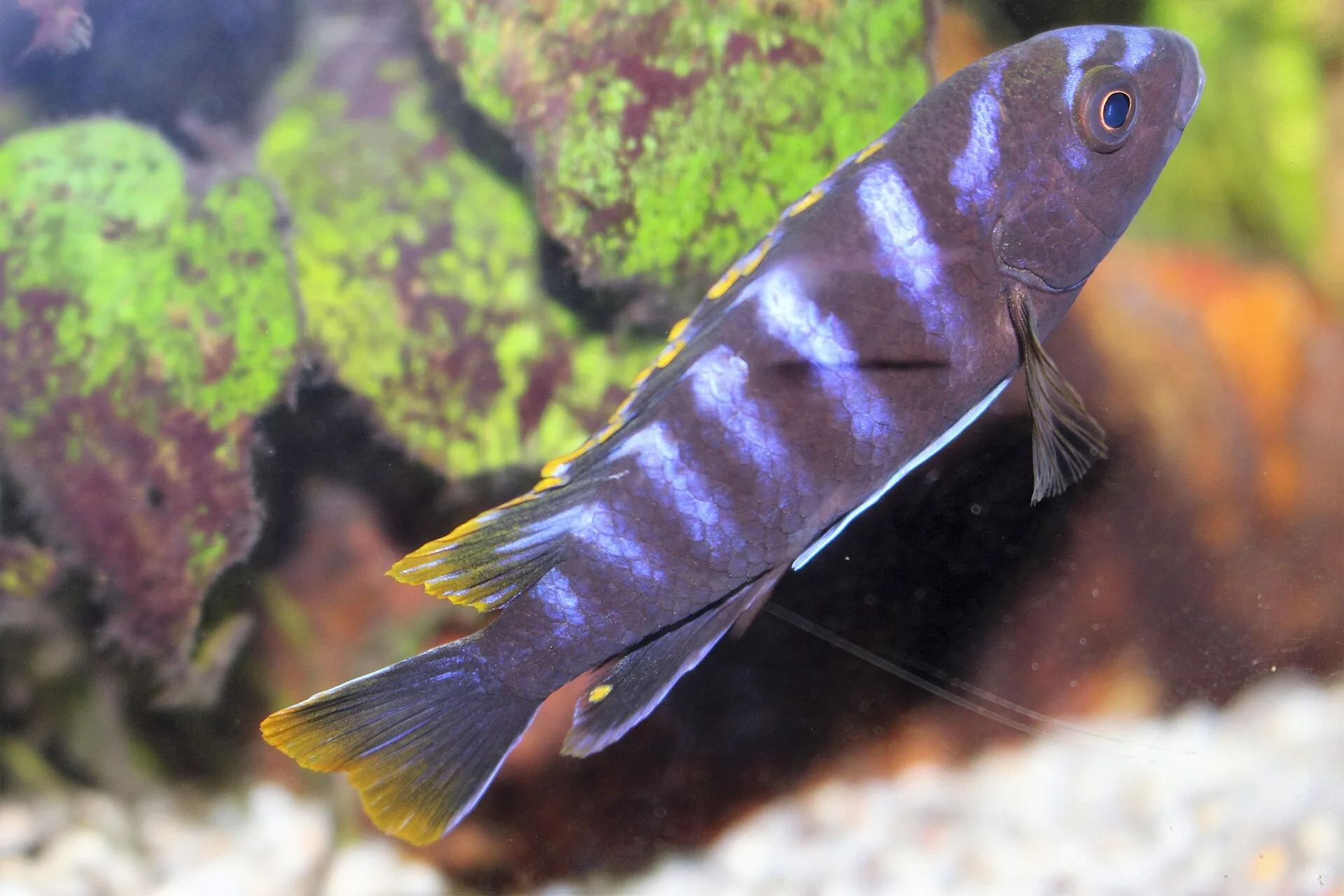
Demasoni are small in the way a wasp is small. Pseudotropheus demasoni tops out around 6 to 8 cm, both sexes barred in blue and black, males a little more electric, and they will run a 200 litre tank as if they were twice the length. They come from a tight locality — Pombo Rocks, Tanzania, Lake Malawi — and they evolved as a specialised mbuna on a crowded reef. The aquarium translation that actually works is counter-intuitive: you keep a lot of them, in a lot of rock, on a vegetable diet, in water that could be a limestone quarry. You do not keep a pair in a 60 litre “dwarf cichlid” box because someone said 7 cm.
Named for Laif DeMason, they hit the hobby as a novelty: a miniature zebra. The novelty wore off for people who understocked them. The fish did not get gentler. A lone pair produces a male who never clocks off and a female who never eats in peace. A group of twelve or more in 200 litres, with other mbuna of dissimilar pattern, dilutes the beating. That is not crowding as cruelty. That is crowding as the closest fake of a busy reef the glass can manage.
Both sexes wore the uniform
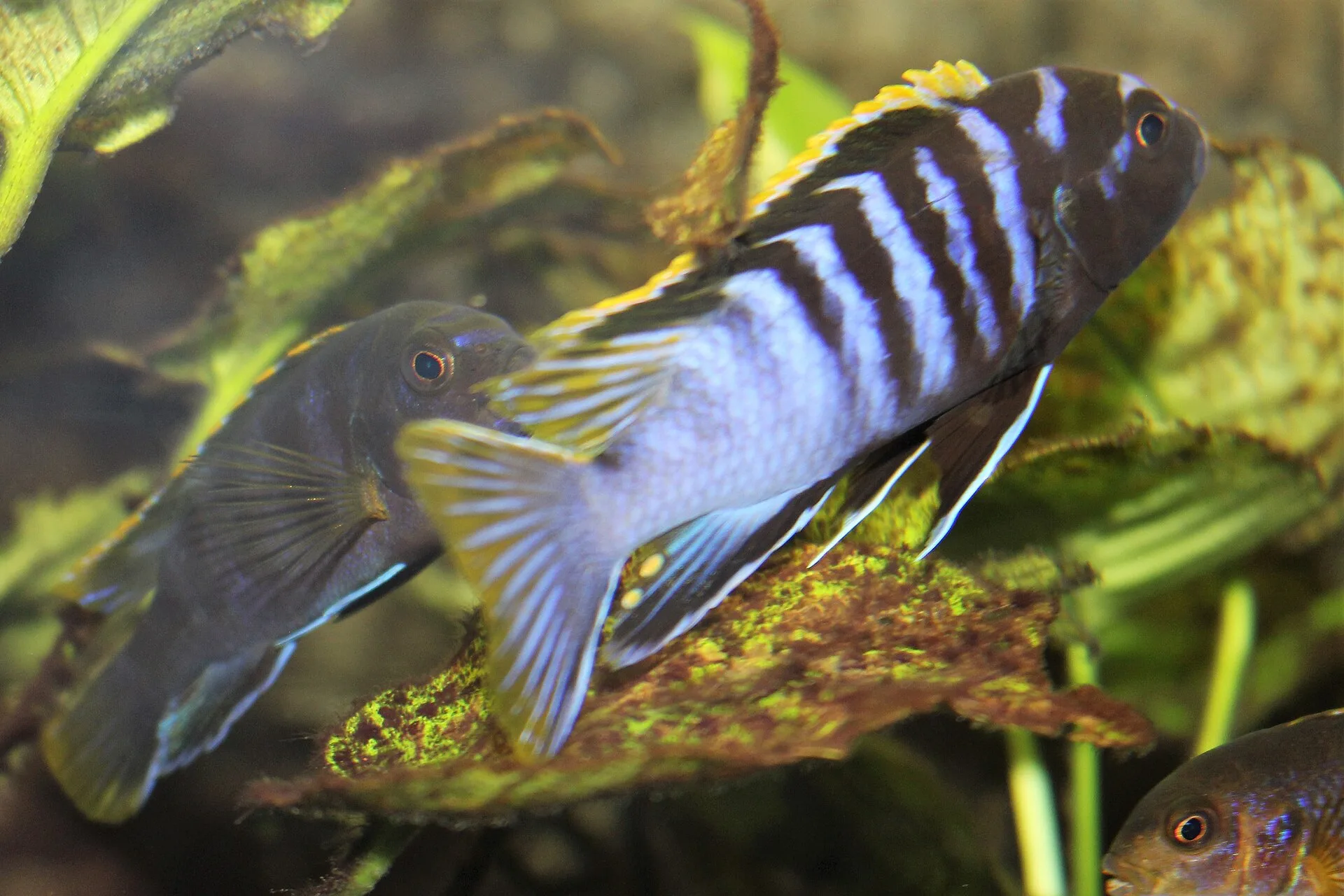
Unlike Kenyi, you cannot sort Demasoni by colour into male and female at a glance. Both are blue with black bars. Males are typically more intense, slightly larger, with more egg-spots. Females are still barred and still capable of holding a grudge. Buy a group of juveniles and let them grow. Assume you will need to pull extra males. Assume the smallest fish is getting robbed of food until you prove otherwise.
A reef in a box, minus the pair-tank fantasy
- Water: 24–28°C, pH 7.8–8.6, high KH, no tannin tea.
- Volume: 200 litres as a serious starting point for a Demasoni-heavy mbuna tank, not 80 litres because they are “dwarfs.”
- Rock: piled to the waterline in places, caves on caves, seated on the glass so digging does not kill anyone.
- Sand: in the remaining lanes, for the look and for the odd invertebrate, not as a peacock hunting ground you also filled with Demasoni.
- Stock: a dozen Demasoni or a slightly smaller Demasoni group plus other mbuna that do not look like more Demasoni.
- Flow: strong, oxygenated, Malawi-clear.
- Lid: yes. Mbuna jump when they chase.
That list is the species. Pretty photos of two fish on a rock are a crop.
They will die of steak
Pombo Rocks Demasoni are aufwuchs specialists. Spirulina, vegetable pellets, blanched greens, and the algae on your rockwork are the diet. Frozen bloodworm as a staple is a way to watch bloat from the sofa. A little protein is acceptable. A carnivore menu is not. Feed small amounts several times a day so the subordinate fish eat. The dominant male will occupy the feeding zone as if he paid rent. He did not. You did. Feed accordingly.
Colour food will not save a starved female. It will not save a bloated male either. The blue-black bars sharpen when the fish is well-fed on greens and unstressed by a too-small social group. They wash toward grey when the tank is wrong.

Aggression is the point, managed, not cured
Do not mix Demasoni with other similarly barred small mbuna if you can help it; they see cousins as rivals and they hybridise with related Pseudotropheus. Do not mix them with peacocks you wanted to stay pretty. Do not mix them with anything that needs soft water. Do mix them, if you mix, with mbuna of different shape and colour in a tank that is already a rock city. Watch new additions; introducing two fish into an established Demasoni clan is feeding them diplomacy problems. Introduce several at once, or rearrange rocks when you add, which resets territories and also stresses everyone — pick the lesser mess.
They will kill their own in a sparse tank. That sentence should be on the bag.
Mouthbrooding at 7 cm
Females hold for about three weeks. A holding Demasoni is a tiny fish with a huge chin and a bigger target on her. Extra rock and extra females are how she survives the male’s attention. Fry are minute. They will be eaten in the display. A breeder who wants numbers uses a nursery at the same pH. A keeper who wants a display accepts that fry are a snack and that the population is maintained by the original group plus the occasional shop top-up. Either is honest. Pretending a pair will raise a colony in 80 litres is not.
Bloat, ich, and the miniature body
Malawi bloat is the famous killer. Stop the bloodworms, check the vegetables, change water, and consult a protocol that does not start with “maybe they need more colour flakes.” Ich happens after shipping; treat in alkaline water with medications that are safe for scaled fish, and do not crash the pH. Quarantine is hard when you need a crowd for them to feel normal; do it anyway in a rock-furnished QT, not a bare box that turns them into missiles.
A Demasoni that hides alone in a pipe for days is losing. Count fish after lights-out with a torch. Mbuna disappear into rock. Deaths disappear with them until the smell.
Small fish, full Malawi rules
Pseudotropheus demasoni is not a nano pet. It is a compressed mbuna reef that happens to fit fewer centimetres of body into the same centimetres of attitude. If you can build the rock city, feed the garden, and keep a crowd, the blue and black bars in motion are as good as any larger zebra. If you cannot, the 7 cm on the care sheet will trick you, and the wasp will do what wasps do in a jam jar. Build the reef. Stock it. Then enjoy the miniature. The other order is how Demasoni got a reputation as impossible, which they are not. They are just honest about space, diet, and numbers.
Explore other topics
Dive into more aquarium guides across the site.