

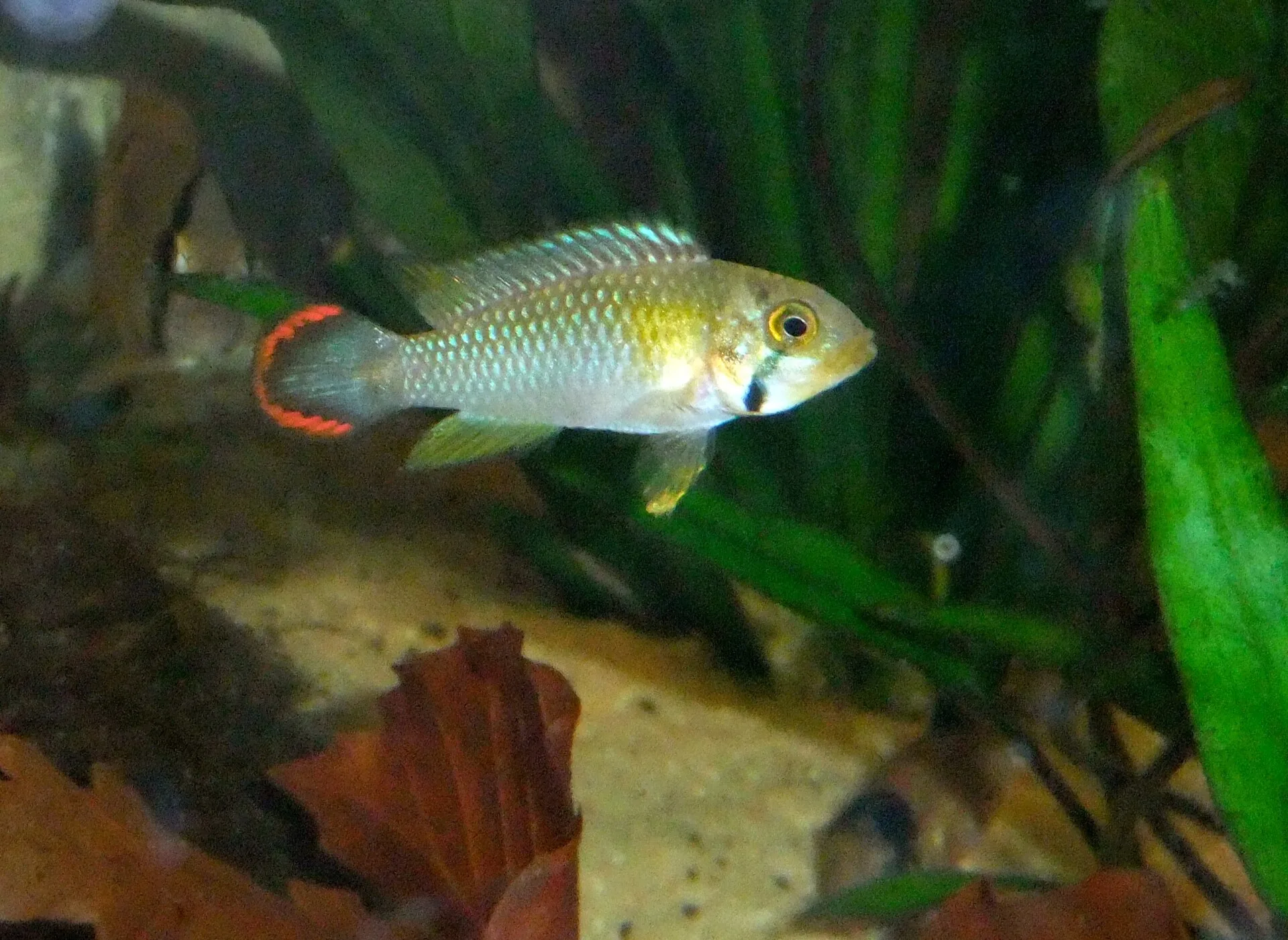
Panduro is an apisto you keep for the male’s blue-grey to steel sheen and the female’s sulphur-and-black brood dress, not for a “small cichlid” checkbox on a Malawi list. Apistogramma panduro comes from Peruvian Amazon tributaries where the water is soft, the bottom is leaves, and a cave is a seed pod or a hollow in the bank. Adults 5–6 cm. They are polygamous in the usual apisto pattern: a male’s range, several females with caves, fry guarded by the female. They are not shell-dwellers from Tanganyika. They are not Julies. They are not rams, though rams share the dwarf-cichlid shelf at the store.
If you cannot provide soft water and leaf litter, you will own a faded, hiding fish that never shows the reason you paid for a named apisto.
Leaf-litter streams in Peru, not a sand beach in Africa
Wild panduro occupy soft leaf-litter streams in the Peruvian Amazon. Tannins, low conductivity, pH often well below 7, warm water, slow flow, a floor of decaying leaves over sand. Caves happen among roots and litter. The fish are micropredators of invertebrates in that soup. There is no Neothauma shell field. There is no alkaline buffer. Copying a Tanganyika layout “because cichlid” is how you kill a panduro slowly.
Botanicals are not optional scenery. They are the habitat. Catappa, oak, and similar leaves, plus a few proper caves (coconut, ceramic, wood hollows), are the furniture list.
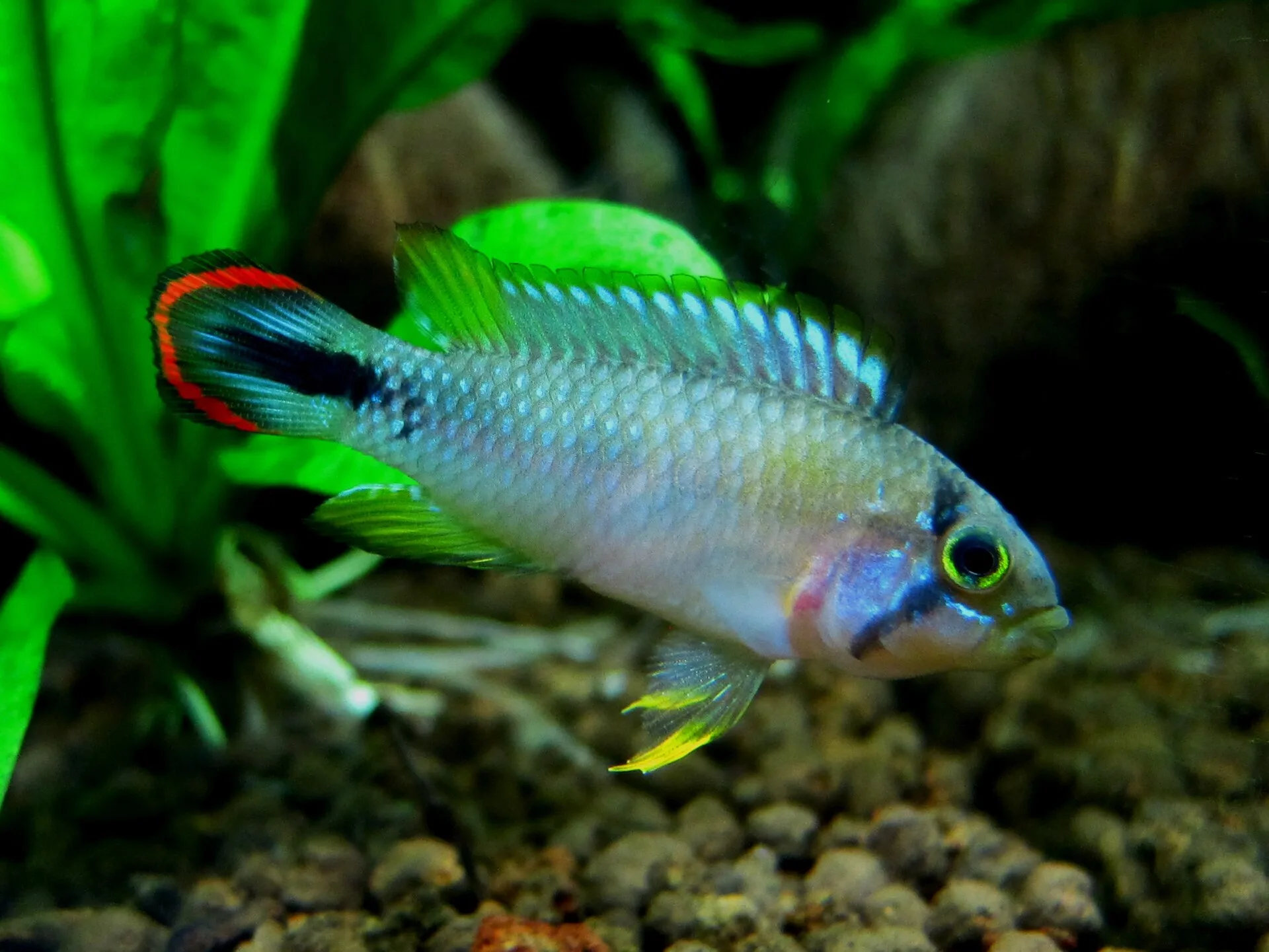
Steel on the male, warning yellow on the female
Males develop elongated fins and a cool, often bluish-grey body with darker markings that intensify when displaying. Females in brood care can show a strong yellow with a dark lateral blotch — a flag that says the cave is occupied. That female dress is half the hobby. A female that never colours is a female that never settled or never spawned. Size stays modest; a 10 cm fish is not this species.
Do not mix panduro with nijsseni to “get more colour in the tank.” They are both Peruvian blackwater apistos with overlapping needs and overlapping aggression. Pick one, or give them a very large, heavily broken tank — most people should pick one.
Seventy litres of litter and sight-breaks
A male and two females need 70 litres or more, more if the male is a tyrant. Fine sand, a real leaf layer, caves that do not all face the same way, wood, dim light, floating plants. Gentle filtration — a sponge is enough if you change water. This is the opposite of a 200 litre nigripinnis wall tank and the opposite of an 80 litre ocellatus sand flat. Flow should barely ruffle the leaves.
Do not add crushed coral. Do not add rift rock as the main scape. A little stone is fine; a pile of alkaline limestone is not.
Soft, warm, stained
Temperature 24–28°C. pH 5.0–6.5. Soft water. Many people use RO and a light remineralisation, plus botanicals to keep the tank tea-coloured. pH 7.5 community water is how panduro lose colour and pick up infections. Ammonia must be zero; dwarf cichlids in small tanks do not ride out a cycle. Chemistry, cycling.
Water changes: small, matched, frequent. Do not vacuum every leaf. Replace a portion of the litter as it breaks down.

Micropredators, not wafer grazers
Live and frozen foods make this species: baby brine, cyclops, daphnia, grindal, good frozen mixes, and only then quality micro pellets. They will take food from the sand and the leaf layer. They will not thrive on leftover flakes for tetras. They will not eat algae sheets like a Uaru. Feed both the male in the open and the females near caves.
Gut problems follow poor dry-only diets. Variety is husbandry.
Dithers that are not food and not Tanganyika
Suitable dithers are small, peaceful characins that enjoy the same soft water — and even then, choose species too big to eat and too calm to stress the apistos. Pencilfish, some small tetras, and shrimp (with fry risk) appear in hobby tanks. Unsuitable: anything from Lake Tanganyika, mbuna, large barbs, and other apisto species in a small tank. Corydoras can work on sand in a larger, well-oxygenated soft-water tank if you feed them separately; they are not required, and they are not a substitute for leaves.
Do not add a shell-dweller “for the bottom.” Wrong water, wrong house.
The female’s cave is the nursery
She lays in the cave. She fans. She escorts a cloud of fry. The male’s job is the perimeter, and he may also be a threat to fry if the tank is cramped. This is leaf-litter cave spawning, the apisto classic. It is not a Tanganyika shell spawn. It is not a mouthbrooder. If you want numbers, you may pull the cave to a rearing box; if you want behaviour, leave them and accept losses.
Sexing: males larger, longer fins; females stockier, brood colours. Buy a group of juveniles and let a harem form, or buy a known pair plus a second female if the tank is big enough.
Faded steel and empty caves
Hard water and bright barren tanks produce grey ghosts. Hole-in-the-head and thinness track organics and diet. Quarantine in soft water with a cave and leaves, not in a hard-water hospital. Watch the female’s colour. Watch whether the male allows anyone to eat. Velvet and ich hit imports; treat the water first in your mind.
Other Peruvian blackwater dwarfs: A. nijsseni. A more beginner-shaped apisto: cockatoo apisto. Classic long-bodied: A. agassizii. None of those articles are Julie care. None of them want Tanganyika salt.
Reading the female before you read a forum
A panduro female that is yellow-black and blocking a cave mouth is working. Do not tear the tank down to “find the eggs.” Do not add a second male to “help distribute aggression.” Feed her at the door. Keep the dithers. If she goes pale and hides in the corner, the male is too much or the water moved. Forums will tell you to lower pH overnight with acid. That is how you get slime-coat disasters. Change the social layout with wood, not with a chemical stunt.
Explore other topics
Dive into more aquarium guides across the site.