

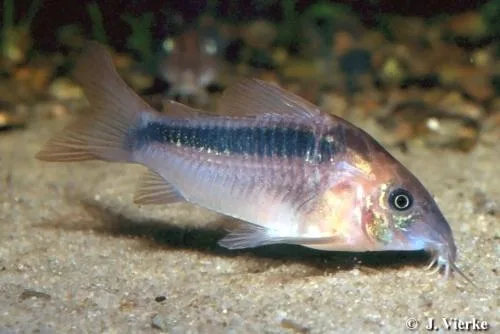
Some corys are all pattern. Rabauti Corydoras (Corydoras rabauti) is the Amazon fish that looks like a polished rust pebble with fins: warm brown-orange over the body, a darker mask through the eye, and almost none of the spotting people expect from the genus. If you like fireworks, buy schwartzi. If you like a uniform copper troop on sand, stay here.
The rusty cory, not a faded bronze
C. rabauti (sometimes still listed against older names in careless shops) is a short-snouted species from Amazonas drainages that include Brazilian and Peruvian waters. Adults reach about 5–6 cm. The colour is a live rusty orange to chocolate, often richer on the back, paler on the belly. There is typically a dark blotch on the dorsal fin or a duskier saddle, but the fish does not wear a Negro blaze or a leopard net. Under warm LED lighting the flanks can show a metallic sheen that photographs as gold-brown.
The usual confusion is Corydoras zygatus, a related rusty fish with a stronger dark dorsal saddle and a more contrasting mask. Side by side, zygatus looks like rabauti that put on a dark cape. Mixed “rabauti/zygatus” imports happen. If your group has two dorsal patterns, you may have both. Do not breed them together and invent a trade name.
It is also not an albino bronze, not a “gold laser” farm morph, and not Brochis splendens (which is green, deeper-bodied, and larger).
Where the rust comes from
Rabauti is an Amazonian sand-bank fish, found in tributaries and mainstem-adjacent waters with soft substrate, wood, and tropical temperatures. Water is typically warm, relatively soft, and anywhere from stained to clearer depending on the tributary. It is not a cool Atlantic-forest species and not a Pantanal wetland specialist. In the wild it forages in groups, pushing barbels through sand and organic fluff for insect larvae and other small foods, then darting up for a gulp of air.
A layout that shows copper, not hides it
Fine sand is the working surface. Dark wood makes the rust colour pop; neon gravel makes it look dirty. A long 80–100 litre-class tank suits a group of six to ten. Leave open sand. Add botanicals if you want, but rabauti does not require a blackwater tea as extreme as Adolfoi. Plants that tolerate tropical South American water are fine. Cover intakes. Use a lid. The fish is peaceful and plated, not glued to the glass.
Because the body colour is uniform, dirt shows. A mulmy bed looks worse under a copper fish than under a spotted one. Siphon lightly; do not stir the bed into a storm that clogs gills.
Water for a rusty Amazonian
Temperature 22–27°C, often happiest around 24–26°C. pH 6.0–7.5. Soft to moderate hardness. They are more adaptable than upper-Negro specialists and still unhappy in alkaline, hard, dirty water. Ammonia and nitrite at zero. If you mix them with discus, watch feeding and heat; rabauti can live in that chemistry if the discus do not steal every item of food and if you protect the sand.
A copper shoal

Six minimum. More is better in a wide tank. A single rusty cory looks like a lost snail. The group forages in contact, rests in contact, and panics in contact. You can keep them with other corys in a large aquarium, but a rabauti troop should still be rabauti. Mixing one rusty with one panda with one pepper does not produce “interesting behaviour.” It produces three lonely fish.
Feeding without the algae fairy tale
Omnivore. Sinking granules, frozen bloodworm, daphnia, brine shrimp, and quality flake that reaches the bottom. They will mouth plant matter and leftover crumbs. They will not replace a dedicated algae eater and they will not thrive on a Sunday wafer. Split feedings if tetras intercept. A well-fed rabauti looks almost glowing; a hungry one looks like brown gravel.
Peaceful company
Small tetras, rasboras, rams, Apistogramma, and other quiet South Americans. Avoid large cichlids and predatory catfish. Rabauti’s lack of high-contrast pattern does not make it invisible to bullies; it just makes it less photogenic while it hides. Other rusty corys (zygatus) can share a huge sand field if each species still has numbers — or keep them separate so you can see which pattern you actually own.
Spawning a plain-looking catfish
Cory ritual: ripe females, slimmer males, T-position, eggs on glass after a rain-style water change. Eggs are easy to miss because the adults are not famous and you may not be looking. Raise fry as for other medium corys. If your spawners include zygatus-patterned fish, label the fry honestly or do not sell them as pure rabauti.
Health on a uniform body
Ich is obvious as white specks on copper. Barbel erosion is obvious as pale stumps on a dark snout. Wasting is obvious as a keel. The uniform colour is a diagnostic gift: learn what healthy rust looks like in your lighting, then act when it goes matte and patchy. Quarantine new rusties; wild Amazon fish can carry skin parasites that a bronze farm strain has already been selected against.
Why rabauti exists in a hobby full of spots
Keep Corydoras rabauti because you want a warm-brown Amazon cory with a clean silhouette, not because you needed “any cory” and this one was on sale. Distinguish it from zygatus. Give it sand, a troop, and sinking food. The rust is the ID. The Amazon floor is the habitat. Pierre Rabault’s name is on a real species — treat it like one.
Copper that needs a backdrop
Photograph rabauti against dark wood, not against orange gravel. The rust is the species; the tank should not camouflage it into invisibility or clash it into ugliness. Uniform colour makes illness obvious: white ich dots, pale patches, a keel. Learn the healthy copper in your lighting at feeding time, then act when it goes dusty. Mixed bags with zygatus will always contain a darker-saddled fish. Pull those if you care about names, or keep a rusty cloud and stop arguing on the internet. Either way, the group on sand is non-negotiable. One copper pebble is not rabauti behaviour. It is a lonely Amazon catfish waiting for a troop that never arrives.
Explore other topics
Dive into more aquarium guides across the site.