

Walk a winter market stall along the Brahmaputra and the fish that catches the eye is not a gourami or a loach. It is a chunky little cyprinid with a peach flush on the flanks and a black blotch near the tail. Shopkeepers call it a rosy barb. Biologists call it Pethia conchonius. Home aquarists have kept it for more than a century, often in water that is warmer than the streams it actually prefers, which is how a hardy northern fish earned a reputation for fading to beige in a heated tropical box.
This species is native to the Ganges and Brahmaputra drainages of India, Nepal, Bangladesh and adjacent lowlands. It occupies vegetated pools, irrigation canals and slow side-channels rather than steep hill torrents. Water there swings with the monsoon: cooler and clearer in winter, warmer and siltier after rains. That seasonal swing matters. A rosy barb held at a steady 28°C all year will live, but the famous pink of a mature male is a cool-water, well-fed, unstressed colour, not a default setting you can buy in a bag.
The blush is not makeup
Adults commonly reach 6 cm in the aquarium, occasionally a little over 7 cm in long-finned strains. The wild-type body is a compressed oval, silver-gold, with that diagnostic dark spot on the caudal peduncle. Males in breeding condition turn rose, cherry or even brick along the back and belly; their fins pick up orange and black. Females stay rounder and more straw-coloured, with a fuller abdomen when they are carrying eggs. Gold, neon and veil-tail lines exist because this fish has been farmed for decades. Veil-tails look spectacular and swim poorly. They also invite nipping from their own school if the group is too small or the tank is too short.
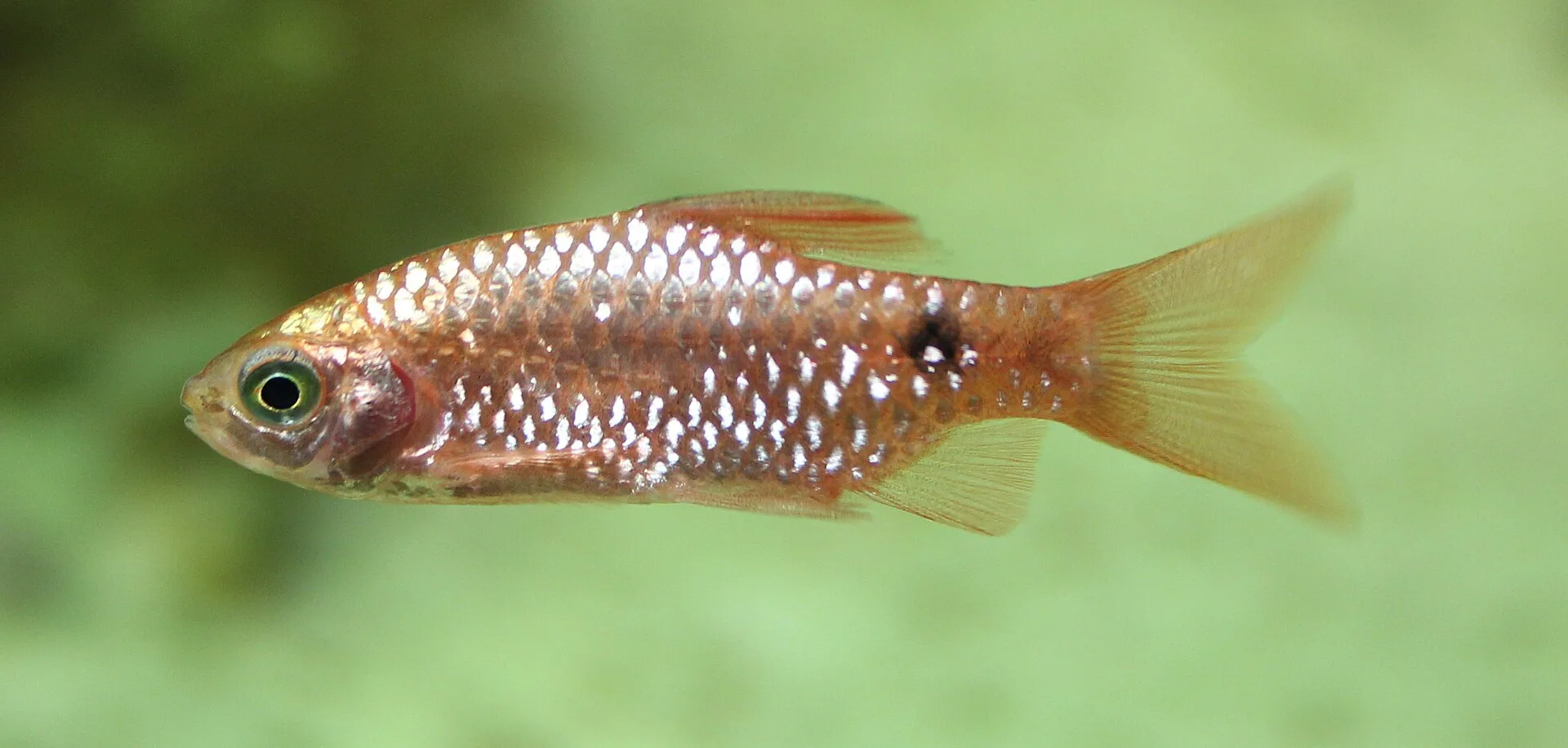
Sexing is straightforward once the fish are adult. Watch the school from the side, not from above. Males are slimmer, more restless, and they colour up first when you drop the temperature a couple of degrees or add live food. Females remain paler even when they are healthy. Immature fish all look like washed-out females; do not try to pair them from a shop tank of 3 cm juveniles.
Give them length, not a heated cube
A group of six to eight needs a footprint with swimming length. Seventy-five litres is a floor, not a destination; 100 to 120 litres with a long front pane is kinder. Rosy barbs patrol the middle and upper thirds. They will use plants as corridors and as cover when a hand appears above the glass, but they are not cave fish. An open centre, planted ends, and a darkish substrate make the colour read better than a pale gravel desert.
Temperature is the setting most keepers get wrong. Eighteen to 24°C is the range that suits this barb. Many houses can run it unheated in summer and with a modest heater only to stop winter crashes. Pushing past 26°C for months is how you get listless fish, faded males and a shorter life. pH is less fussy: 6.0 to 7.5, with moderate hardness, matches most tap water that is not extremely soft or extremely alkaline. Stability beats chasing a textbook number. Ammonia and nitrite must stay at zero; nitrate is best kept under 30 mg/L with regular water changes, because a busy school of omnivores produces waste in proportion to how eagerly they eat.
Filtration should move water without blasting the school into a corner. A gentle current along the length of the tank mimics a canal more than a waterfall. A tight lid helps. Rosy barbs are not dedicated jumpers the way some danios are, but a spooked fish will clear a low waterline.
Do they nip, or were they bored?
The nipping reputation is real and also oversold. A singleton or a trio in a small tank becomes a fidgety, fin-picking nuisance. A proper school of six or more, with space to chase each other instead of a slow tank-mate, usually settles into busy but civil behaviour. They still should not share a small aquarium with long-finned, slow species such as fancy guppies, male bettas, or veil-tail gouramis. That is a mismatch of speed, not a moral failing of the barb. Robust, similar-sized companions that enjoy the same coolish water work: other active barbs of comparable size, larger rasboras, and peaceful loaches that will not be outcompeted at feeding time. Avoid housing them with anything small enough to look like food once the barbs are adult, and avoid notorious fin-shredders that will return the favour.
They are not a dither fish for a predatory cichlid. They are also not a nano species. Treat them as a mid-sized, long-lived school that will occupy the tank for four to five years if water and diet are decent.

What a canal omnivore actually swallows
In the wild, Pethia conchonius takes insects, zooplankton, plant fragments and whatever else the current delivers. In the tank that translates to a rotating menu, not a single flake. A quality omnivore pellet or granule can be the staple. Frozen or live daphnia, brine shrimp and bloodworm add the animal protein that brings colour. Blanched courgette, spirulina wafers or a pinch of crushed peas cover the vegetable side. Feed what they finish in a couple of minutes, twice a day for juveniles, once or twice for adults. Overfeeding does not make them rosier; it makes the water worse, which makes them paler.
Colour foods with astaxanthin help farmed strains, but they will not override chronic heat, dim light on a pale tank, or a lonely pair. Fix those first. If a fish goes hollow-bellied while the rest are round, isolate it and check for flukes or a bacterial issue rather than pouring more food into the display.
Eggs on the glass, then nobody cares
Rosy barbs are egg scatterers with no parental care. In fact the adults will eat the eggs if they find them. Breeding is not mysterious. Condition a separate pair or a small group on live food, keep them a little cooler than a typical tropical community, and provide fine-leaved plants or a spawning mop. A slight water change with slightly softer, cooler water often triggers a chase. The female sheds adhesive eggs among the plants; the male fertilises them. Remove the adults the same day. Eggs hatch in about 24 to 36 hours at the upper twenties, longer if you keep the breeding tank in the low twenties, which is more natural for this fish. Fry take infusoria or commercial fry food, then newly hatched brine shrimp. Growth is rapid if you change water and do not crowd them.
You do not need to breed them to keep them well. You do need to accept that a shop “pair” is a marketing idea. Buy a group, let them sort their own hierarchy, and you will see more colour and less harassment than you will from two fish rattling around a rectangle.
Buying without buying a problem
Look for fish that are already showing a hint of pink or a clean gold, with intact fins and no white film. Clamped fins and hovering at the surface in the shop tank are reasons to walk away, not reasons to rescue. Quarantine new arrivals in a simple tank of their own for two to four weeks. Watch them eat. Treat only if you see a disease you can name. Ich is common after a temperature shock; raising heat as a treatment sits awkwardly with a species that prefers cooler water, so medication and stable, moderate temperature are often kinder than cooking them.
Once in the display, the daily test is simple. Are they swimming as a loose school, grazing and chasing without splitting one fish off into a corner? Are the males coloured? Are the faeces formed, not stringy and pale for days on end? If the answer stays yes, you are keeping rosy barbs, not merely storing them. If a fish wedges itself behind the heater and refuses food, the chemistry, the temperature or the company is wrong for Pethia conchonius.
Long-finned strains need extra honesty. They are the same species with a handicap. Give them even more length, a slightly lower flow, and a larger school so aggression is diluted. Do not combine them with short-finned, hyperactive conspecifics if you can avoid it; the short-fins will win every race to food and every nip.
A northern fish in a tropical hobby
The rosy barb became popular because it ships well, breeds in farm ponds, and looks cheerful in a brightly lit tank. None of that changes the biology. It is a northern Indian and Himalayan-foothill cyprinid that colours best when the water is closer to a cool canal than to a discus vat. Keep a real school, feed it like an omnivore that actually chews plants as well as insects, and stop treating 26 to 28°C as the default for every “tropical” fish on a list. Do that, and the blush that gave the species its common name is not a photograph from someone else’s aquarium. It is the fish in front of you.
Explore other topics
Dive into more aquarium guides across the site.