

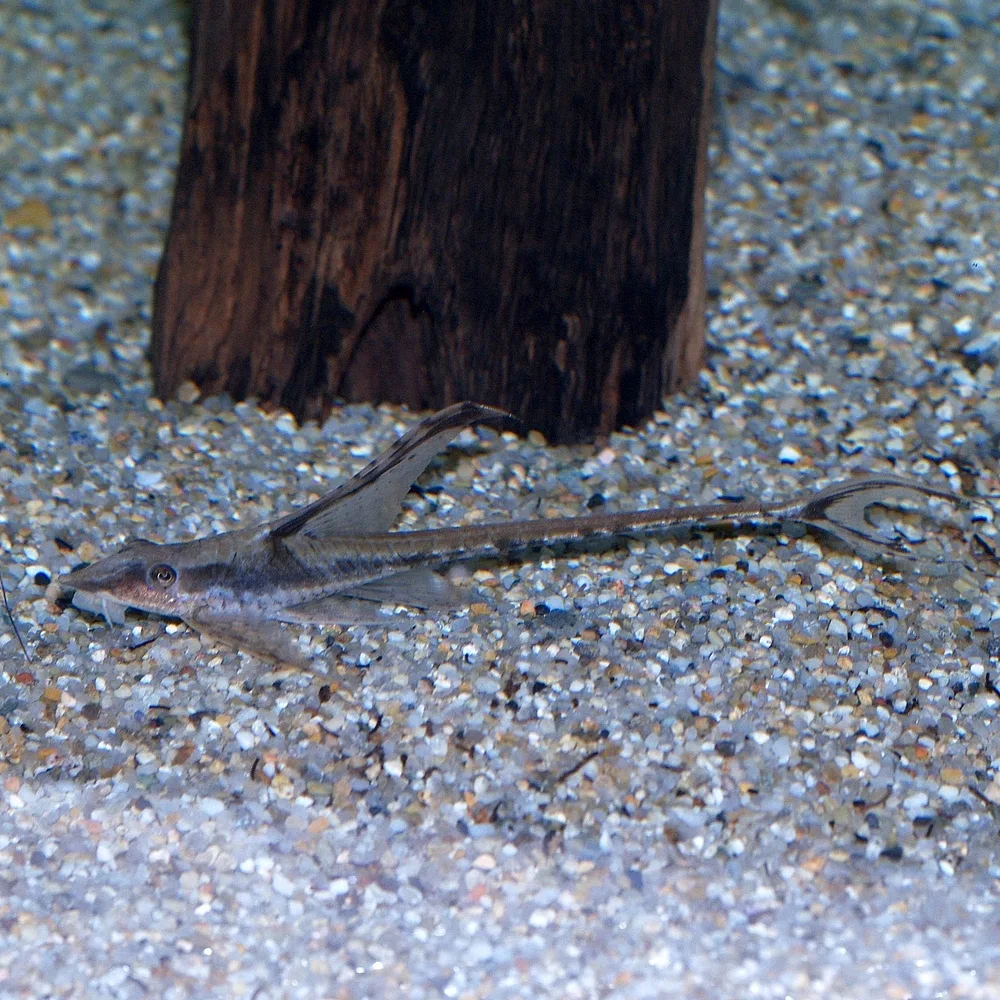
Royal is a fair word for the silhouette. Royal Whiptail (Sturisoma panamense, often moved toward Sturisomatichthys panamensis in newer lists) is a Central American loricariid: a flattened, elegant whiptail with a long caudal filament, a triangular head, and a grazing habit that sits between a twig cat and a tube-dwelling rineloricaria. It is not a Corydoras, not an Orinoco Farlowella, and not a Panama tetra. It wants current, wood, and a diet of film and vegetables in a long tank.
Whip, crown, and a Panama passport
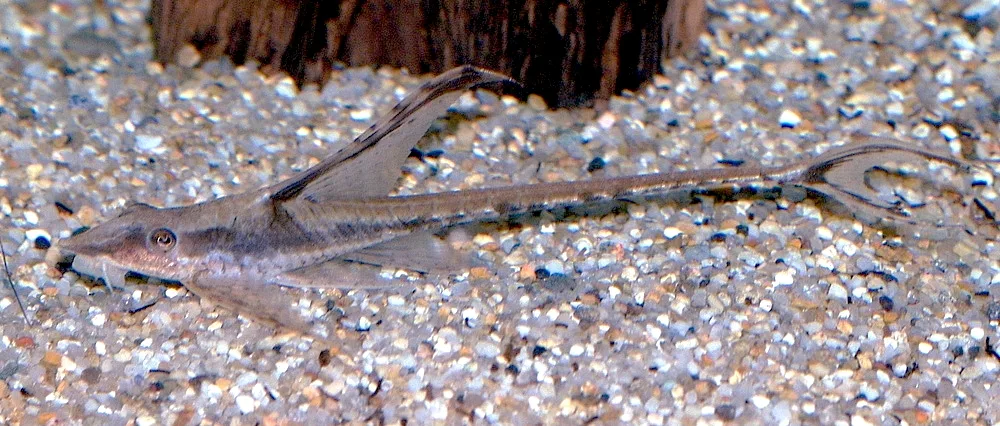
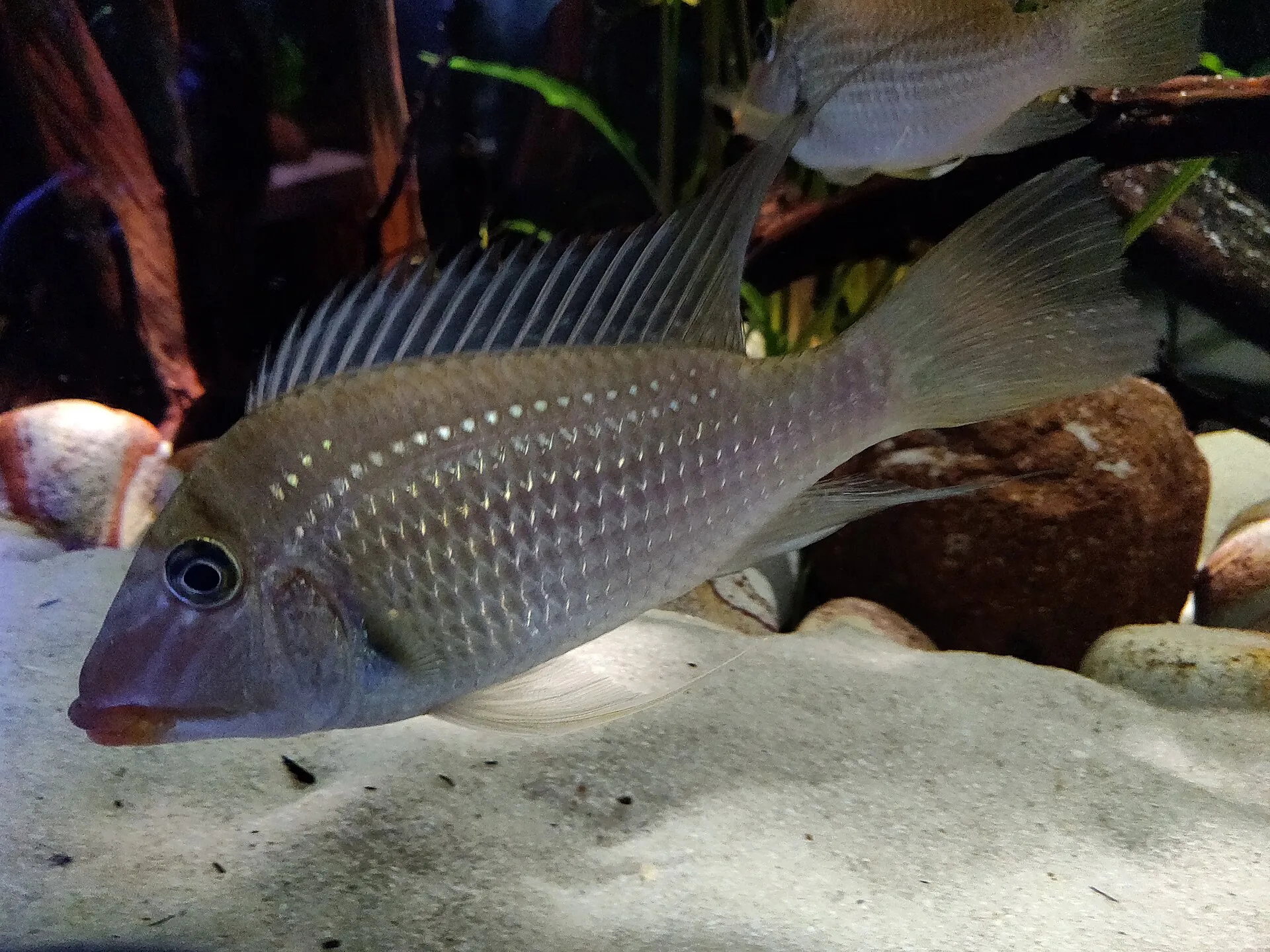
Adults reach about 15–20 cm in body with filaments that make the fish look longer. The head is broad and depressed, with a suckermouth. The body tapers to a whip tail. Colour is brown to tan with darker saddles and mottling — camouflage on wood, not a polka-dot syno and not a gold-net cory. Males in breeding condition develop odontodes on the sides of the caudal peduncle and sometimes a more bristled look; they are the ones that guard egg patches on glass or slate. Females are fuller in the belly when ripe and less ornamented.
Range is the Pacific and adjacent drainages of Panama and neighbouring southern Central America / Pacific Colombia in the broad sense of the species complex. This is not Amazon. This is not Congo. Water can be a bit harder and more mineral than a Negro creek. Current is part of the story. If your last whiptail was a Paraguay Rineloricaria parva, this fish is larger, more regal in outline, and more of a mid-water-wood grazer than a sand-sitter.
Flowing Central American wood
Think rivers and streams with snags, moderate current, tropical temperatures, and surfaces for rasping. They rest on wood and glass at a slope, looking like debris. They are not inverted synos. They are not air-gulping callichthyids. Oxygenated water is the climate. A stagnant, warm, dirty box is how royal whiptails come unglued — literally losing hold and lying thin on the sand.
A long aquarium with a current lane
120 cm is a sensible adult home. Driftwood arranged so they can lie along branches. Plants that tolerate flow. Sand or smooth gravel they are not obliged to sift. A spray bar or powerhead that creates a swimming/grazing lane without a tornado. High oxygen. Lid — filaments catch, and they jump. Strong filtration, prefiltered so they are not intake ornaments. They are more robust than Farlowella and still not a pleco you ignore.
Height helps if you want vertical wood; length helps more. A cube is a poor royal tank.
Current chemistry for a Panama whip
Temperature 24–28°C. pH 6.5–7.8. Soft to moderately hard; they often accept tap that would annoy Adolfoi. Cleanliness is not optional. They show stress as clamped filaments, lost colour, and sitting on the glass gasping. Water changes, oxygen, and a mature biofilm beat any bottle of “algae starter.”
One royal or a grazing party
They can be kept singly as a show fish, or in small groups if the tank is large and food is plentiful. Males may defend a spawning pane. They do not need six-as-a-shoal psychology; they need calories on surfaces. Two males in a small tank may bicker over the best glass wall. A pair in a 120 cm river scape is a classic.

Diet of a royal grazer
Biofilm, algae, sinking plant wafers, blanched vegetables, specialised loricariid gels, some protein (they are not strict herbivores). Farlowella is even more film-dependent; Sturisoma will take wafers more readily and still starve in a sterile tank with hungry ancistrus. Feed vegetables every day. Watch whether the fish’s abdomen has a gentle curve. They will rasp the front glass — that is healthy, not a defect in your aquascape.
Who can share a royal grazer's lane
Peaceful, similarly oxygen-loving fish: some Central American tetras, smaller peaceful cichlids if they do not eat the whiptail, Corydoras on the sand in a community that is not too warm-dirty. No large predators. No aggressive mbuna. No crowd of otos plus two Sturisoma in a new tank. Synodontis of adult size are a bad idea.
Eggs on the pane
Males clean a vertical site. Females deposit. Males fan. This is one of the most viewable catfish spawns in the hobby. Do not scrape the glass that week. Keep the flow and oxygen. Fry need biofilm and tiny foods; a mature tank raises more than a hospital tub. If you wanted tube-spawning, you wanted Rineloricaria. If you wanted T-position eggs, you wanted Corydoras.
Filament health
Split tails from poor water or nipping. Skinny mid-body from no food. Ich. Jumping. Intake death. Quarantine with wood and vegetables, not a bare box. Handle as little as possible; they are armour and paper at once.
Panama, not Paraguay, not Orinoco
Keep Sturisoma panamense because you want a royal, filamented Central American whiptail that grazes wood in current and may spawn on the glass. Keep Farlowella for a thinner Orinoco twig. Keep Rineloricaria parva for a smaller, easier, tube-spawning sand whiptail. Keep Corydoras for barbels and groups. The odontodes on the peduncle are the male. The Panama map is the water. The wafer-plus-film diet is the work. That is a loricariid article, not a cory article in a longer font.
Current without a washing machine
A spray bar along the back gives a lane they will lie in, heads up-current, rasping as they hold station. That is Sturisoma. A still, hot corner behind a sponge is Farlowella-without-film, and a royal will go thin there too. Aim for movement you can see in the plants, not a gyre that rips the caudal filament. Panama rivers are not mill-races in a 60 litre cube. Length first, then flow. When a male claims the front glass, reduce the glass-cleaning schedule and enjoy the spawn instead of scraping it into the bucket. Odontodes on the peduncle mean he is dressed for work. Let him work.
Vegetables on a clip, wafers at dusk, and a mature film on the wood are the three meals. Miss all three and the elegant outline becomes a concave stick with a fancy name. They are more willing to eat wafers than a twig cat, which is why people call them easier — easier, not automatic.
Explore other topics
Dive into more aquarium guides across the site.