

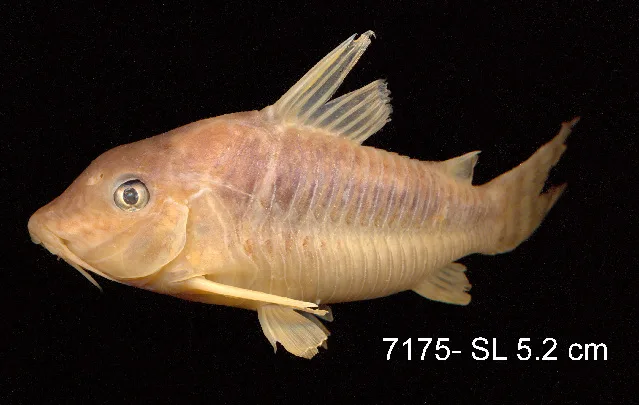
People who wanted Sterba’s cory and got a longer face are often holding Seuss's Corydoras (Corydoras seussi), the long-snouted, orange-spined fish from the Mamoré–Guaporé world that once wore the code C027. It is not a sterbai with a stretched nose as a trick of the camera. It is a different animal that happens to share the warning-coloured fin spines that make this cluster famous — and painful to handle.
Long snout, orange spines, not Sterbai
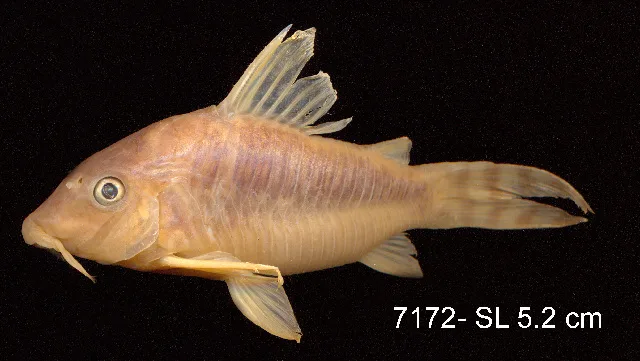
C. seussi (placed in Brochis by some recent revisions; the hobby still searches the old combination) comes from the Rio Mamoré basin of Brazil and Bolivia, in the same broader neighbourhood as C. gossei, while C. sterbai and C. haraldschultzi are the famous Guaporé pair. Adults are medium cory size, about 5–6.5 cm, with a distinctly longer, more sloping snout than the round-faced sterbai. The body is pale with dark spotting; the pectoral and dorsal spines are vivid orange. Those orange spines are aposematic: a puncture from a seussi hurts for days. Net them with a mind, not with a grab.
The short-snouted lookalike in the same warm, orange-spine club is C. gossei. Seussi is the longer-nosed counterpart. Mixed shoals of gossei and seussi occur in the wild. In the shop, look at the snout first, orange second. If the snout is short and the fish is a polka-dot with orange pecs, you probably have sterbai or gossei, not seussi.
Warm Mamoré water
This cluster is thermophilic. Hobby reports sit at 26–30°C, which is hotter than nattereri and hotter than many “general cory” charts. The Mamoré can carry sediment; the Guaporé blackwater influence is a neighbouring story. For seussi, think warm, clean, oxygenated water, sand, and room for a group — not a cool Atlantic-forest stream. Werner Seuss’s fish is a warm-water specialist. If your house runs 22°C unheated tanks, this is the wrong cory.
Wild mixed schools with gossei can number in the thousands. You will not copy that, but you should copy the idea: this is a crowd species.
A tank that does not fight the heat
Because they like warmth, oxygen matters. Surface agitation without a hurricane on the sand. Fine sand for the long snout. A 90 cm tank for a group of six to ten. Wood, plants that tolerate warmth (many Amazon plants will), lid, covered intakes. Discus tanks are a traditional match for this cluster if you actually feed the catfish. Do not combine seussi with cool-water Scleromystax. That is two climates in one box.
Chemistry
Temperature 25–29°C as a working target. pH 6.0–7.5. Soft to moderate. Breeding is more likely in softer, more blackwater-like values; maintenance is less fussy. Zero ammonia. Warm water holds less oxygen and grows bacteria faster — your maintenance schedule should tighten, not loosen, because the fish likes heat.
A long-snouted orange-spine crowd
Six minimum. More if you can. They forage with the head down, snout in sand, orange spines catching the light. Mixed with gossei they may mill as one orange-spine school; that is biologically authentic and a labelling nightmare if you breed. Mixed with sterbai in a discus tank they will probably get along, but you will have short and long snouts and three marketing stories. Decide whether you are keeping a species or a look.

Orange-spine feeding in warm water
Omnivore, slightly greedier in warm water. Sinking foods, frozen bloodworm, extra feedings if discus inhale everything. The long snout wants food in the sand, not only on a dish. They are not algae replacements.
Handling and tank mates
Peaceful toward other fish. Dangerous toward careless fingers. Use a solid container to move them when you can; spines lock in nets. Companions: discus if the system is mature, tetras that like warmth, rams. No cool-water companions. No predators. No gravel.
Breeding the rare orange long-snout
Sterbai is farmed globally. Seussi is not. If you spawn them, you are doing scarce work. Condition at warmth, then a water-change pulse; some breeders still drop temperature slightly even on thermophilic corys. Eggs on glass. Soft water for eggs. Do not cross with gossei or sterbai. Raise fry warm and clean. The orange develops with age.
Health in the heat
Warm dirty water is a bacterial incubator. Watch barbels and the long snout. Ich still happens. A seussi that sits in the flow gasping is telling you about oxygen. Quarantine expensive long-snouts. Never lift them with dry hands.
C027 as a real fish
Keep Corydoras seussi because you want the long-snouted orange-spine cory of the Mamoré, in a warm tank, in a group, on sand. Keep sterbai if you wanted the common polka-dot. Keep gossei if you wanted the short-snouted partner of seussi. The snout is the ID. The orange is the warning. The heat is the climate. That is not a sterbai article with the title changed.
Warmth, orange, and a snout you can measure
Put seussi next to sterbai if you ever get the chance. The polka-dot short face versus the sloping long face is a five-second lesson. Orange spines are shared with gossei, haraldschultzi, and sterbai; they are a club colour, not a species ID. Seussi is the long-snouted Mamoré member of that club, formerly C027, thermophilic, uncommon in farms. If your tank runs 22°C for nattereri or barbatus, do not add seussi “because cory.” You will cook the cool fish or chill the orange-spine fish. Pick a climate.
Handle with a container. The orange is a warning colour that works. A puncture ruins a weekend. In the tank they should be on the sand, snouts in, spines catching light, in a group that looks like a warm-water herd. Mixed with gossei they may mill as one orange-spine school in a way that is authentic to huge wild shoals and annoying if you wanted labelled fry. Decide whether you are keeping biology or a barcode. Either way, feed sinking food in heat that stays clean, because warm water plus waste is how a rare long-snout becomes a short story.
Explore other topics
Dive into more aquarium guides across the site.