

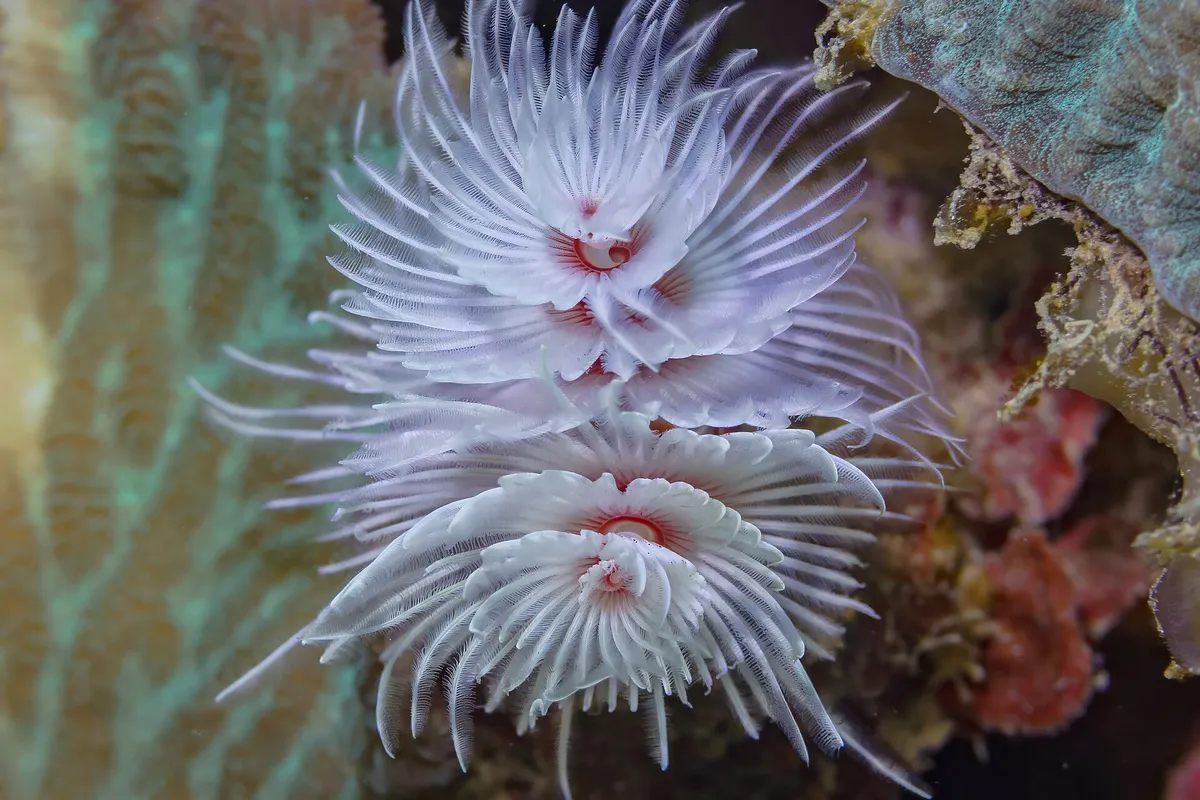
Feather duster worms are some of the most graceful animals you can put in a reef tank. From a leathery tube in the rock, each worm spreads a crown of feathery, banded tentacles that sway in the current to catch food. At the slightest shadow or touch the whole crown vanishes into the tube in a split second.
The two species usually sold are Sabellastarte spectabilis from the Indo-Pacific and Sabellastarte magnifica from the Caribbean. They are cared for the same way, and both rely on regular feeding in a mature tank.
Where feather duster worms come from
S. spectabilis lives across the Indo-Pacific, including Hawaii, while S. magnifica is found in the Caribbean and western Atlantic. Both build tubes in cracks in rock and coral on shallow reefs, harbours and lagoons, usually where gentle current carries plankton past.
Appearance and behaviour
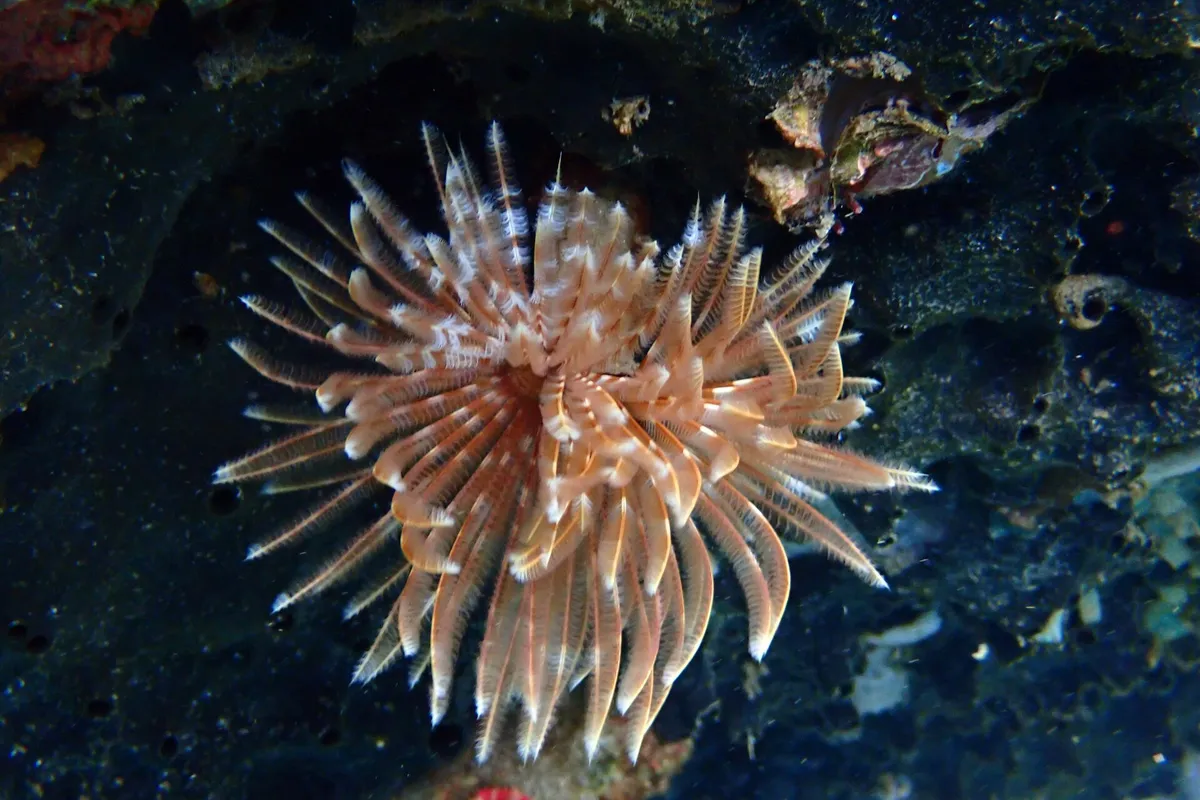
The tube is grey to brown, made of mucus and sand, and the crown can reach 5–10 cm across. The tentacles, called radioles, are banded brown, tan, white or purple. Feather dusters are filter feeders: tiny hairs on the radioles move plankton and particles down to the mouth.
They are completely peaceful and pose no risk to fish, corals or other invertebrates.
Tank setup
Feather dusters suit tanks of 40 litres and up that have been running for at least a few months. Wedge the tube base into a crack in the rock or bury it in the sand, upright, in a spot with moderate, indirect flow. Too little flow means less food; too much keeps the crown closed. Acclimate gently with drip acclimation.

Water parameters
Keep the temperature at 24–27°C, salinity at 1.024–1.026 and pH 8.1–8.4. Feather dusters need calcium and stable alkalinity to build their tubes, and they are sensitive to copper and sudden salinity changes.
Feeding
In a well-stocked tank they pick up some fish waste and plankton, but most need extra food to thrive. Feed two or three times a week with phytoplankton, rotifers, oyster eggs or very fine powdered foods, ideally with the pumps on low. Spot feed with a pipette near the crown. Tanks with heavy skimming and very clean water often starve feather dusters.
Tank mates
Feather dusters live with most reef animals. Avoid fish that nip at crowns, such as some angelfish, butterflyfish, puffers, triggers and large hawkfish, and crabs that may pull worms out of their tubes. Arrow crabs and some hermit crabs are known culprits.
Breeding
Feather dusters can reproduce in aquariums, either by spawning or by splitting. Small new tubes sometimes appear on the rock, especially in tanks with a refugium.
Common problems and lifespan
A worm that drops its whole crown is not always dead. Stress from moving, poor water or starvation can make it shed the crown, and a healthy worm grows a new one within a few weeks. Leave the tube in place and keep feeding. A tube that is empty or smells bad should be removed. With good care feather dusters live 2–5 years or more.
Explore other topics
Dive into more aquarium guides across the site.