

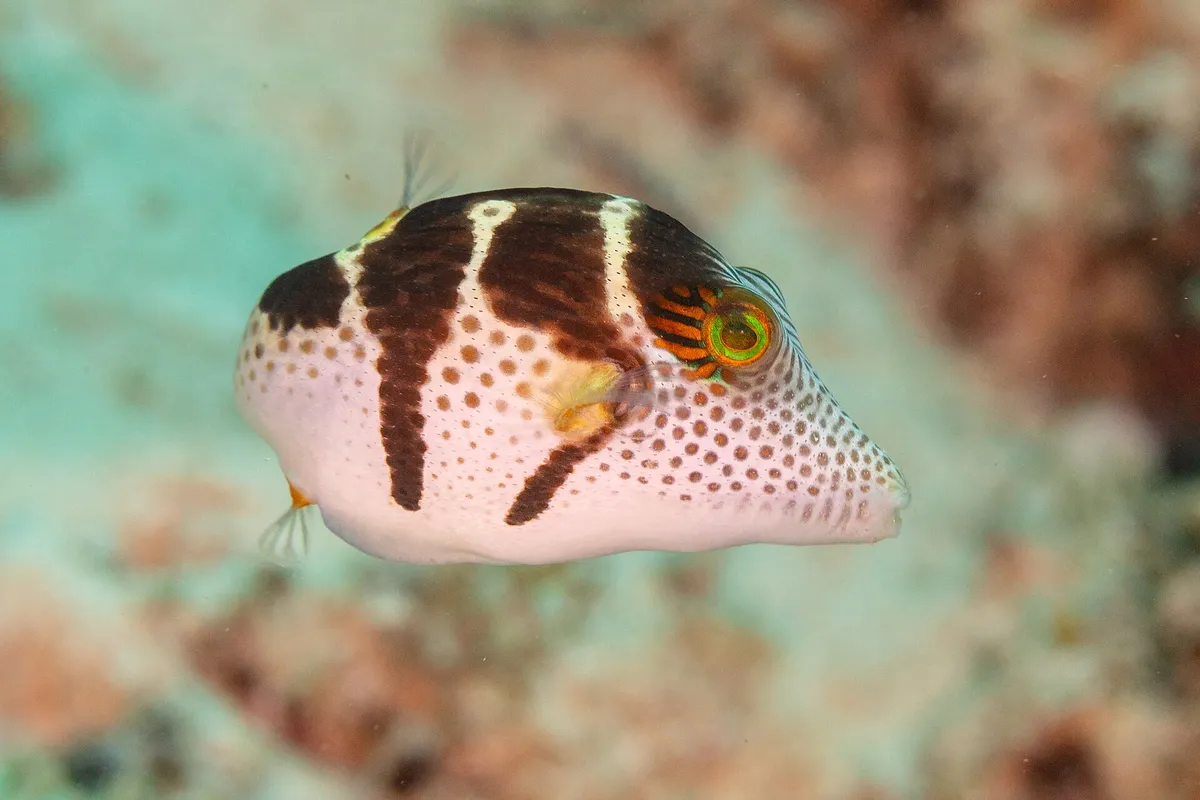
The Valentini puffer is a small sharpnose puffer with a big personality. Four dark saddles across a white, orange-spotted body, bright green eyes and a busy, curious way of swimming make Canthigaster valentini a favourite for fish-only marine tanks. It soon learns to recognise its owner and begs at the glass.
It is not a reef fish, though. Valentinis nibble corals, clams, shrimp and snails, and their teeth need hard foods to stay healthy. Plan for that and it is one of the hardiest small marine fish around.
Where Valentini puffers come from
Valentini puffers live across the Indo-Pacific, from the Red Sea and East Africa to the central Pacific. They are found on coral reefs and lagoons down to about 50 m, usually alone or in small harem groups.
Their pattern is copied by the mimic filefish, Paraluteres prionurus, which is harmless. Predators avoid both because the real puffer is toxic.
Appearance and behaviour
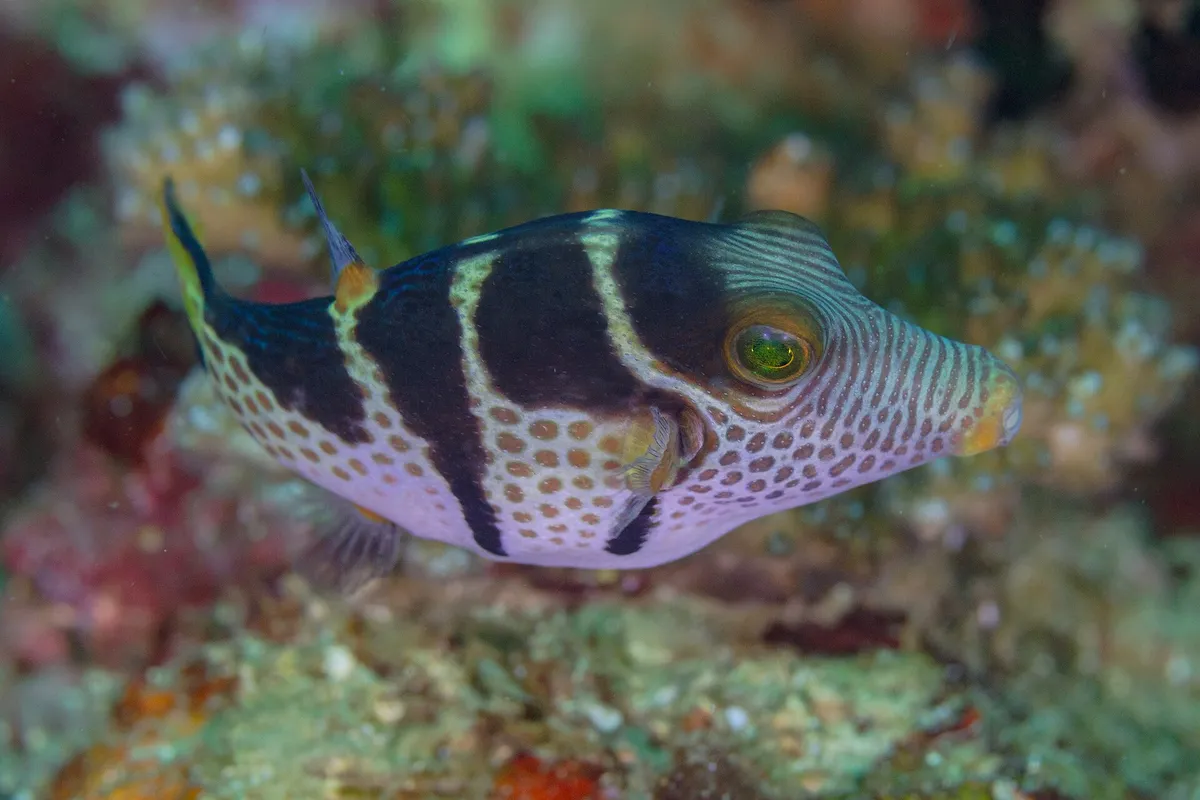
Valentinis reach about 10 cm. The body is white with fine orange to brown spots, four dark saddles over the back, a yellow tail and a pointed snout. Like all puffers they can inflate with water when threatened, but this is stressful and should never be provoked.
They are active, inquisitive and generally peaceful with other fish, though they may nip slow, long-finned species. Two males will fight, so keep one per tank unless the tank is large.
Tank setup
One Valentini needs at least 120 litres. Give it live rock with caves and open sand, plus moderate flow. Puffers produce plenty of waste, so use good filtration and a protein skimmer. Cover overflows and pump intakes, because curious puffers can get stuck.

Water parameters
Keep the temperature at 24–27°C, salinity at 1.023–1.025, pH 8.1–8.4 and nitrate low. Our guide to the key marine parameters to test covers the basics. Puffers have no scales and are sensitive to copper, so avoid copper treatments or use them only at reduced strength with careful testing.
Feeding
Valentinis are carnivores with beak-like teeth that keep growing. Feed a mix of frozen mysis, krill, chopped squid and clam, plus hard-shelled foods such as small snails, cockles in the shell and crab legs a few times a week. Hard foods wear the teeth down; without them the beak overgrows and the fish cannot eat. Our reef fish feeding schedule helps with portions.
Tank mates
Good companions are robust, active fish: tangs such as the yellow tang, clownfish, larger damsels, wrasses and dwarf angelfish. Avoid slow, long-finned fish, and do not add ornamental shrimp, crabs, snails, clams or most corals, which may be eaten.
Breeding
Valentinis have rarely been bred in aquariums. In the wild a male keeps a harem of females and spawns daily on algae, which the male guards. The larvae are tiny and need plankton that is hard to supply at home.
Common problems and lifespan
Overgrown teeth, marine white spot and stress from bullying are the main issues. Quarantine new puffers in a quarantine tank and acclimate them slowly. With good care Valentini puffers live 5–10 years.
Explore other topics
Dive into more aquarium guides across the site.