

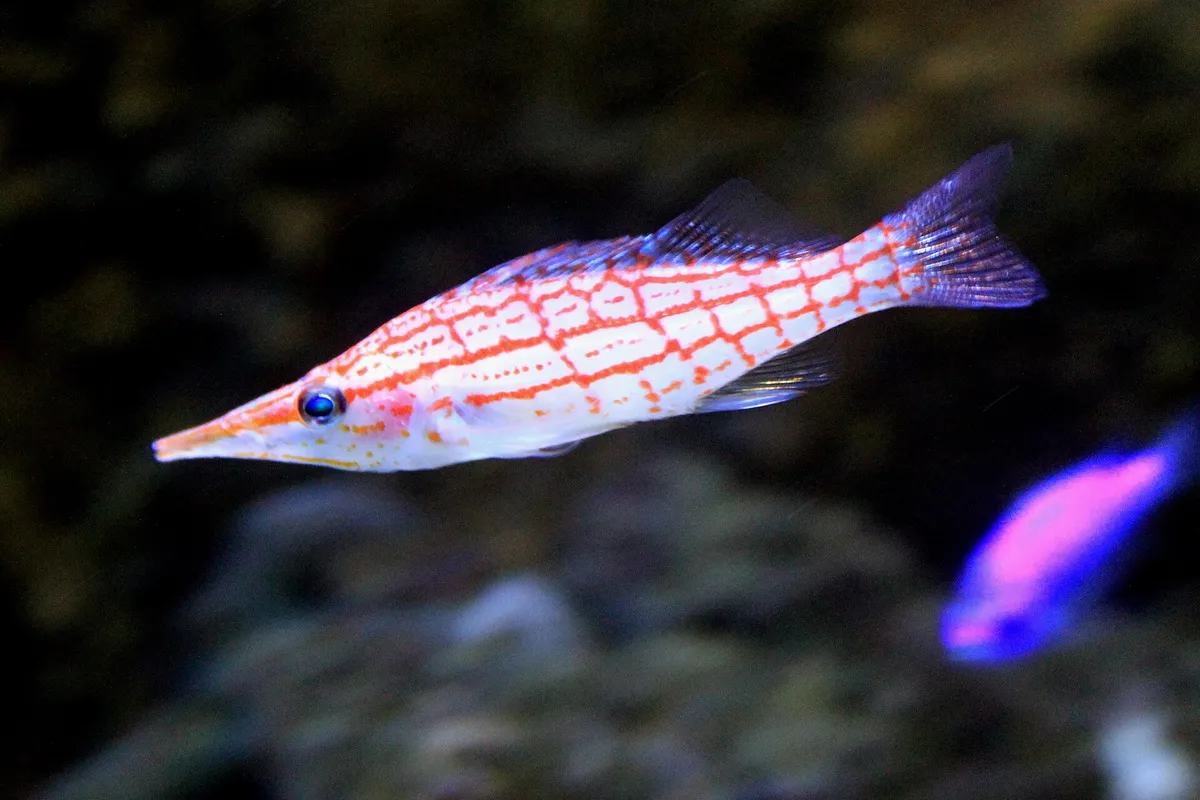
The longnose hawkfish looks like it was drawn with a ruler. A white body covered in a red grid, a long, thin snout and a habit of perching on top of corals make Oxycirrhites typus one of the most recognisable reef fish. It watches the tank from a high spot, darts out to grab food, then returns to its perch.
It is hardy and fairly peaceful, and it fits most reef tanks. The one big caveat is small shrimp, which it will happily eat.
Where longnose hawkfish come from
Longnose hawkfish live across the Indo-Pacific and the eastern Pacific, from the Red Sea to the Gulf of California. They are usually found on steep reef walls with strong current, perched in gorgonians and black corals at 10–100 m.
Appearance and behaviour
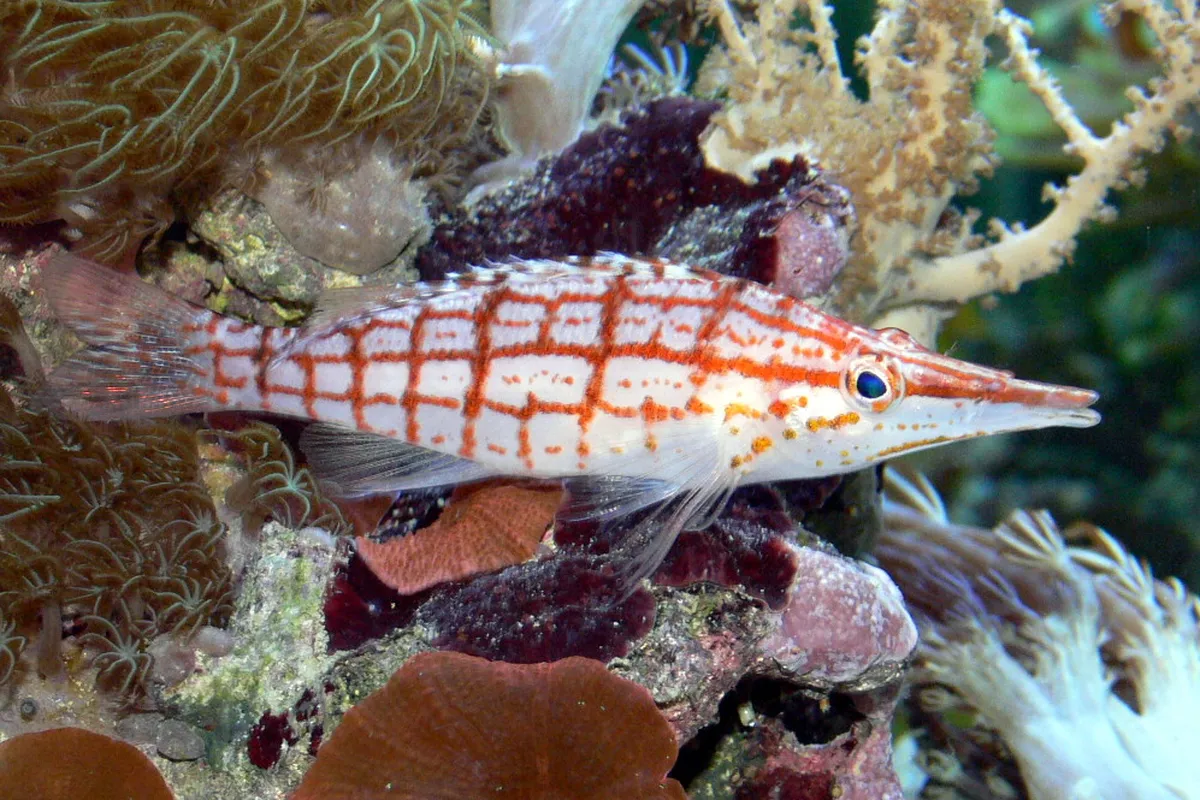
Adults reach about 13 cm. The body is white with a red to orange check pattern, the snout is long and narrow, and the tips of the dorsal fin spines carry small tufts called cirri. Like other hawkfish, they have no swim bladder, so they rest on surfaces instead of hovering.
Longnose hawkfish are calmer than many hawkfish, but they are still predators. They usually ignore fish too big to swallow and can live with other hawkfish in a large tank. Mated pairs are possible if you buy a male and a smaller female together.
Tank setup
One longnose hawkfish needs at least 120 litres. Give it high perches: tall rockwork, branching corals or a gorgonian near the top of the tank where it can watch the room. Moderate to strong flow suits it. Hawkfish jump, so use a lid or mesh cover; see our guide to stopping fish jumping out.

Water parameters
Keep standard reef conditions: 24–27°C, salinity 1.024–1.026, pH 8.1–8.4, and stable alkalinity. Longnose hawkfish are hardy and tolerate a wide range, but stable water keeps them colourful.
Feeding
They are carnivores that pick small prey from the water. Feed frozen mysis, enriched brine shrimp, small krill and good marine pellets once or twice a day. Frozen mysis is a reliable staple. Most accept food straight away.
Tank mates
Longnose hawkfish get on with most peaceful to semi-aggressive reef fish: tangs, clownfish, wrasses, gobies and dwarf angelfish. Avoid very small fish such as small gobies and firefish that fit in the mouth, and do not keep it with small ornamental shrimp. Larger cleaner shrimp are usually safe. Corals are not at risk.
Breeding
Pairs spawn in aquariums, usually at dusk, with the male courting the female from a perch. The eggs and larvae drift in the water and are very hard to raise, so captive-bred fish are rare. Some are now bred commercially.
Common problems and lifespan
Jumping and eating small shrimp are the main issues. Hawkfish can get marine white spot and velvet, so use a quarantine tank. With good care longnose hawkfish live 5–10 years.
Explore other topics
Dive into more aquarium guides across the site.