

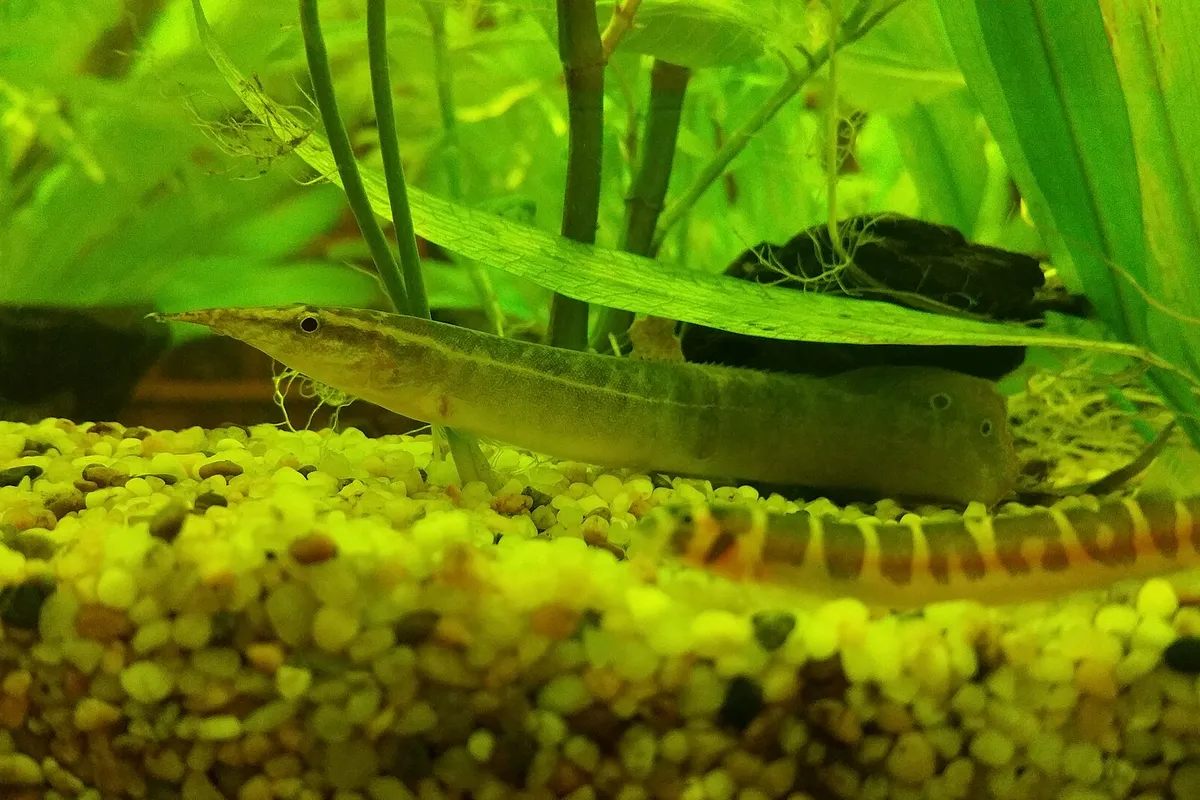
If the fire eel is too big for your room, the peacock eel is the spiny eel that actually fits a normal aquarium. Macrognathus siamensis, also called the spot-finned spiny eel, usually reaches 20–25 cm and rarely more than 30 cm. It is peaceful, curious and full of character, spending its days buried in the sand with only a pointed snout and two bright eyes showing.
It is still a specialist. Peacock eels need soft sand, a sealed lid and meaty food, and they will eat any fish small enough to swallow. Get those right and they are long-lived, hardy and a lot of fun.
Where they come from
Peacock eels live in slow rivers, canals, floodplains and rice-paddy channels across Thailand and the Mekong and Chao Phraya basins. The bottom is soft mud and sand, often with plenty of plants and leaf litter. They hunt worms, insect larvae and small crustaceans by probing the substrate with their sensitive snouts, mostly at dusk and through the night.
The peacock spots
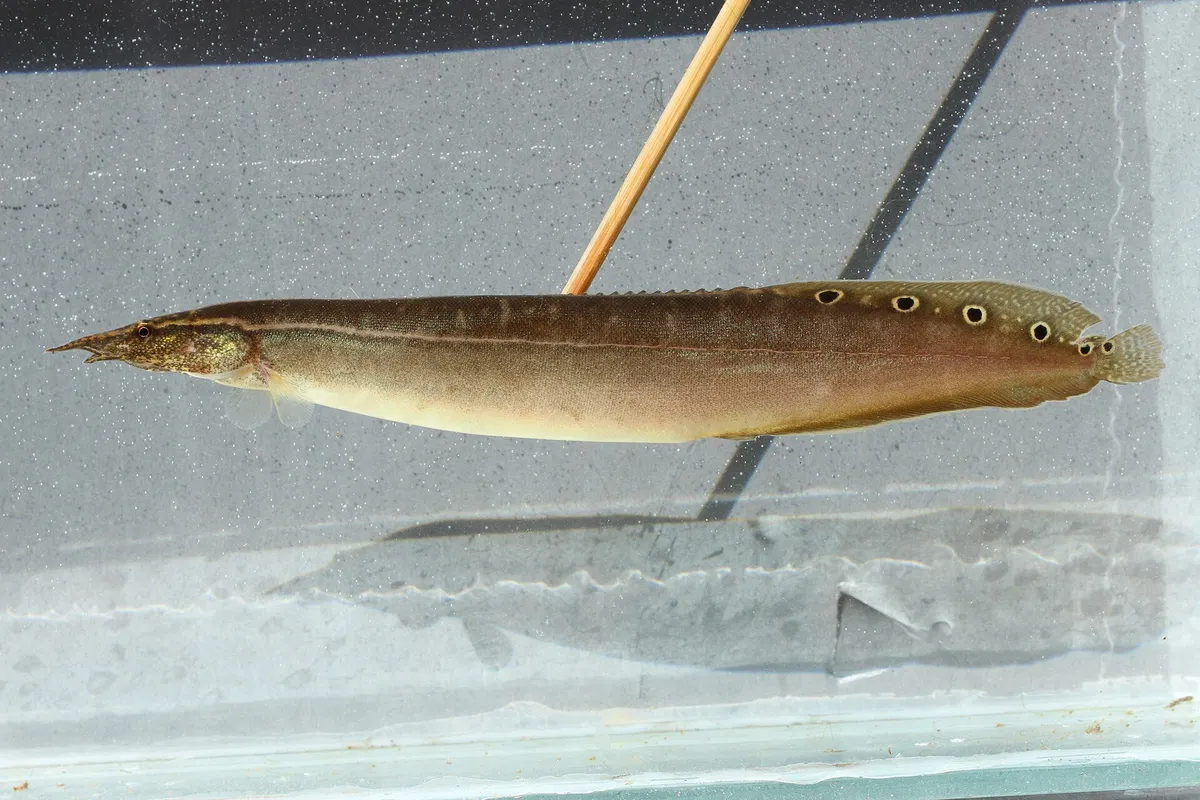
The name comes from a row of three to six black eyespots ringed in cream or yellow along the base of the soft dorsal fin, at the back half of the body. The rest of the fish is light to mid brown, with a pale stripe from the eye to the tail and a darker band below it. Like all spiny eels, it has a row of small spines along the back in front of the dorsal fin and a long, fleshy snout tip.
Do not confuse it with the larger tire-track eel (Mastacembelus armatus), which has wavy dark lines rather than eyespots and grows several times bigger.
Tank setup
One adult peacock eel needs at least 150 litres with a tank around 120 cm long. A pair or small group can share 200 litres or more. Peacock eels are more sociable than most spiny eels, and several in a large tank usually get along.
Use 5 cm or more of soft, fine sand. Gravel damages their skin and stops them burrowing, which is the behaviour that makes them feel secure. Add caves, smooth rocks, driftwood and plants such as Java fern and Anubias on wood, since rooted plants may get dug up. Seal every gap in the lid: spiny eels escape through holes that look far too small.
Water parameters
Keep the temperature at 23–28°C, pH 6.5–7.5 and soft to moderately hard water. Peacock eels are tolerant of a range of conditions but not of dirty water. They live in the substrate, where waste collects, so steady filtration and regular water changes are essential. Vacuum the sand surface gently and avoid deep, compacted sand that can turn anaerobic.
Only add a peacock eel to a fully cycled aquarium. They are scaleless enough to react badly to ammonia and to many medications.
Feeding
Peacock eels are carnivores and most will not touch flakes. Feed frozen bloodworms, blackworms, brine shrimp, mysis and chopped prawns, plus live foods when available. Some learn to take sinking carnivore pellets or wafers once settled. Feed once a day, in the evening, close to the eel's hiding place.
New peacock eels often starve because they cannot compete with fast fish at feeding time. Target feed with tongs or a pipette, or drop food after lights out. Our guide on feeding bottom-dwelling fish in a community tank has more tips, and blackworms are often the food that wins over a fussy eel.
Tank mates
Choose peaceful fish too large to fit in the eel's mouth: gouramis, rainbowfish, larger rasboras and danios, peaceful barbs, angelfish and corydoras. Loaches are fine if there is enough sand and cover for everyone. Neon tetras, small rasboras, guppy fry and shrimp are likely to become food as the eel grows.
Avoid aggressive cichlids and fin-nippers, which harass a slow, bottom-dwelling fish, and avoid big predators that might try to eat the eel itself.
Health and lifespan
Most problems come from the same few causes: gravel or sharp décor causing skin damage, poor water quality in the substrate, and starvation. Spiny eels are sensitive to copper and many anti-parasite treatments, so use reduced doses or treat in a separate tank. Quarantine new fish so you never have to medicate the eel's main tank.
Well kept, a peacock eel can live eight to ten years or more. Breeding in aquariums is rare, so most are wild-caught. Settle them gently, feed them well, and they will quickly become the fish everyone asks about.
Explore other topics
Dive into more aquarium guides across the site.