

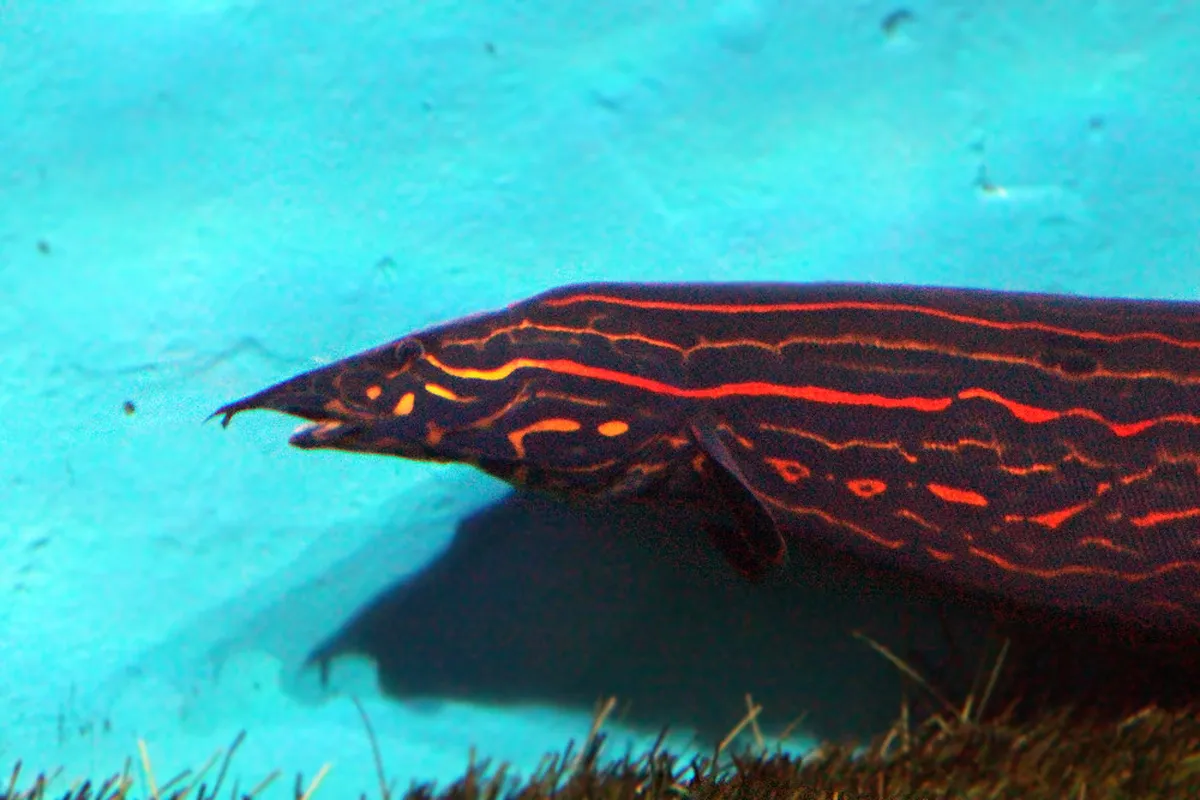
A 10 cm fire eel in a shop tank is one of the most tempting fish in the hobby: dark velvet body, glowing red stripes, a pointed snout and a habit of peering out of the sand like a periscope. Then it grows. Mastacembelus erythrotaenia routinely reaches 60 cm in aquariums and can approach a metre in the wild. Buy one only if you can house the adult.
If you can, it is one of the most personable large fish there is. Fire eels learn their owners, take food from fingers and spend their evenings exploring every corner of the tank.
Not a true eel
Fire eels are spiny eels, a family of long-bodied freshwater fish related more closely to swamp eels than to the eels of the sea. They come from slow rivers, floodplains and swamps in Southeast Asia, including the Mekong and Chao Phraya basins and parts of Borneo and Sumatra. The bottoms there are soft mud and sand, often among roots and leaf litter, and the fish spend the day buried with just the head showing.
Stripes, snout and spines
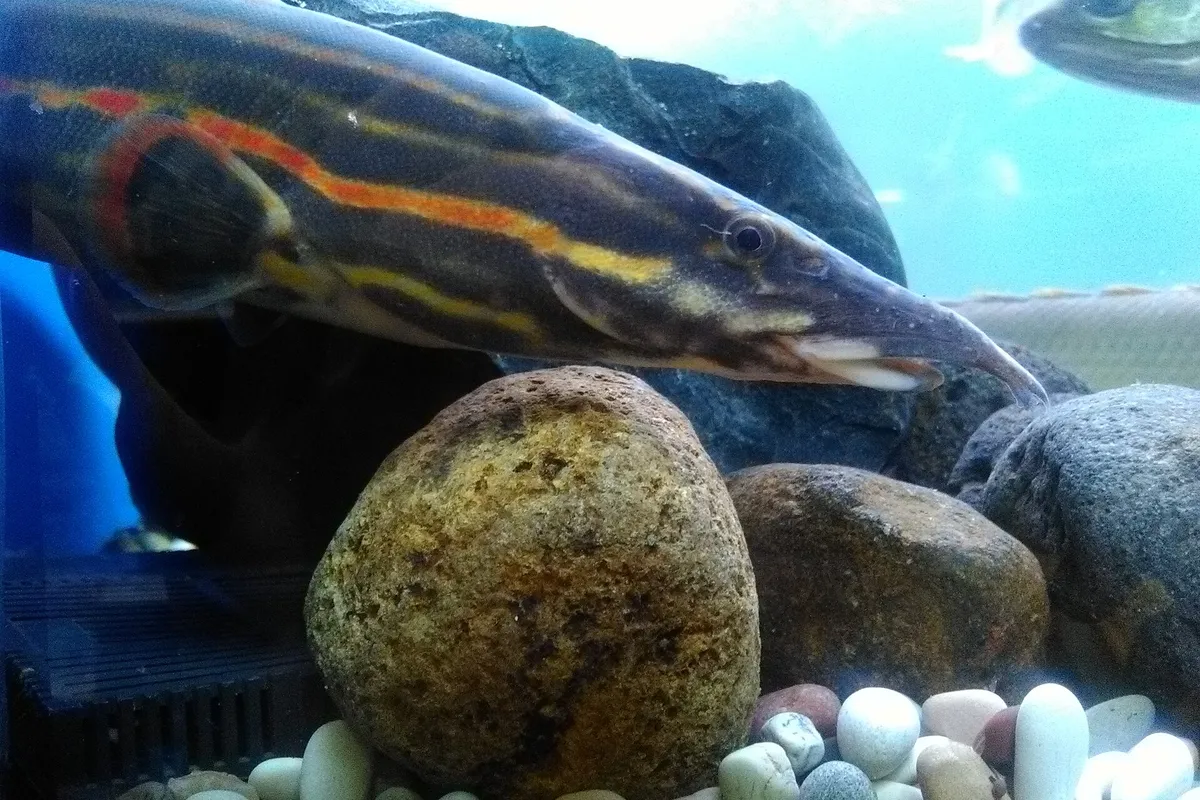
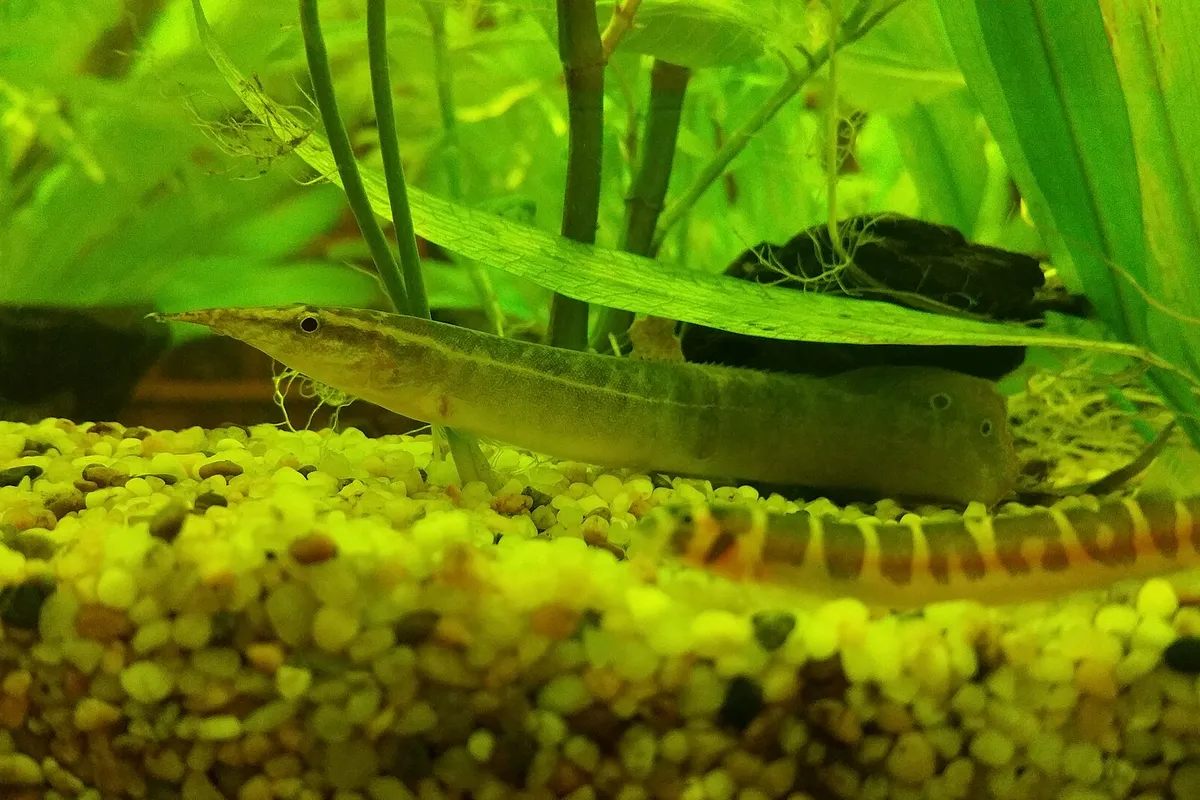
The body is long and slightly flattened, dark grey to near-black, with bright red to orange stripes and spots running along the sides. The snout ends in a small, mobile tip that the eel uses to probe the substrate for food. A row of small spines runs along the back in front of the dorsal fin, which is where the name spiny eel comes from. They are not venomous, but handle them with a net or a gloved hand.
Fire eels are slow growers, adding a few centimetres a year, and can live 10 to 15 years or more. Plan for a long commitment.
Tank size: think long term
A juvenile can start in a 200 litre tank, but an adult needs at least 400 litres with a footprint of 180 cm by 60 cm or more. Length matters more than height. Spiny eels are strong swimmers when they want to be and easily injure themselves in cramped tanks.
Fill the bottom with 5–8 cm of soft, fine sand. This is not optional. Fire eels burrow constantly, and gravel scratches their skin and leads to infections. Add smooth rocks, PVC pipes and driftwood caves so the eel has places to hide that it cannot collapse onto itself.
A locked lid and stable water

Fire eels are notorious escape artists. They push through feeding holes, climb up filter returns and squeeze through gaps you would not believe. Use a tight, heavy lid and cover every opening. A lot of fire eels are lost on a carpet, not to disease.
Keep the water at 24–28°C, pH 6.5–7.5 and soft to moderately hard. More important than exact numbers is clean, stable water: a large, mature filter, regular water changes and zero ammonia and nitrite. A powerful canister or sump with gentle outflow suits them. Our guide to using two heaters in a large aquarium is worth reading for tanks this size.
Feeding a meat-eater
Fire eels are carnivores. Offer bloodworms, chopped earthworms, prawns, mussels, krill, white fish fillet and good sinking carnivore pellets. Juveniles should eat daily; adults every one or two days. Many become hand-tame, which makes feeding and health checks much easier.
New arrivals are often shy and may only feed at night. Drop food near the eel's burrow after lights out until it settles. Avoid feeder goldfish, which bring disease and poor nutrition; see our guide to feeding carnivores, herbivores and omnivores for better options.
Tank mates
Anything that fits in a fire eel's mouth will eventually be eaten, so choose medium to large, peaceful fish: larger gouramis, silver dollars, big barbs, peaceful cichlids such as severums, and plecos. Choose fish that will not nip a slow, burrowing tank mate.
Fire eels are usually tolerant of other species but can fight with their own kind or other spiny eels. One per tank is safest unless the aquarium is very large.
Health and medication
Spiny eels have tiny scales and sensitive skin, so they react badly to many medications. Use half doses of ich and parasite treatments, or better, treat new tank mates in a separate quarantine tank before they ever reach the eel. Skin infections and fungus are the most common problems, and nearly always trace back to gravel, sharp décor or poor water quality.
Is a fire eel right for you?
Yes, if you have room for a 400 litre-plus tank, can feed meaty foods several times a week and are happy to keep the same fish for over a decade. No, if the plan is a community tank of small fish or a standard 120 litre setup. Breeding in home aquariums is extremely rare. Treat a fire eel as a single, long-lived pet fish, and it will become the centrepiece of the room.
Explore other topics
Dive into more aquarium guides across the site.