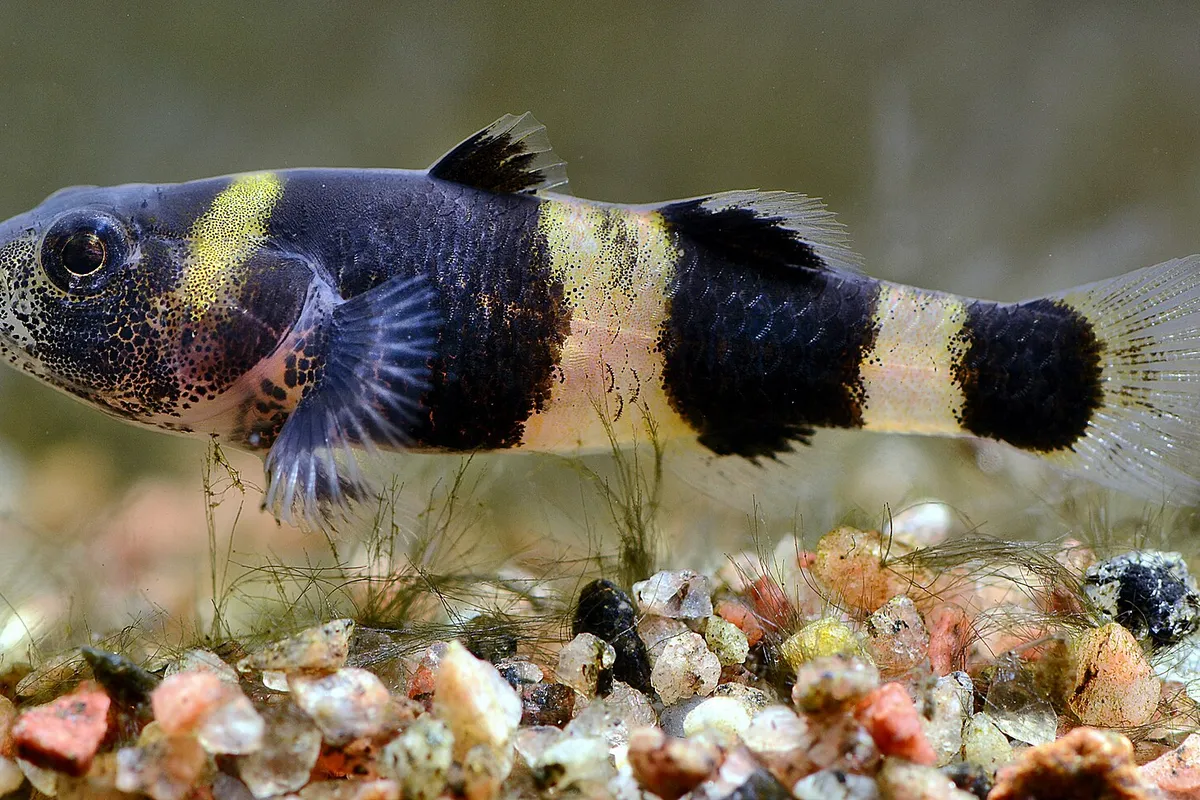
The bumblebee goby is a fish with a big personality packed into 3–4 cm. Bright yellow and black bands, a blunt little face and a habit of perching on rocks and glaring at everything make Brachygobius doriae one of the most charming nano fish you can buy. It is also one of the most often mis-sold. Shops label it a freshwater community fish. It is neither, quite.
Bumblebee gobies come from brackish estuaries, they guard territories, and most refuse flake food entirely. Set them up for what they actually are and they are tough, entertaining and long-lived. Drop them into a soft-water community and they fade away.
Mangroves, estuaries and the name confusion
Wild bumblebee gobies live in mangrove swamps, tidal creeks and the lower reaches of rivers in Borneo and nearby parts of Southeast Asia. Salinity there rises and falls with the tides, from almost fresh to clearly brackish, over muddy and sandy bottoms full of leaf litter and roots.
Several closely related species are traded under the same name, mainly B. doriae, B. xanthozonus and B. sabanus. They look nearly identical in a shop tank and are cared for the same way, so do not worry if your fish turns out to be a cousin. What matters is the setup.
Stripes, perching and attitude
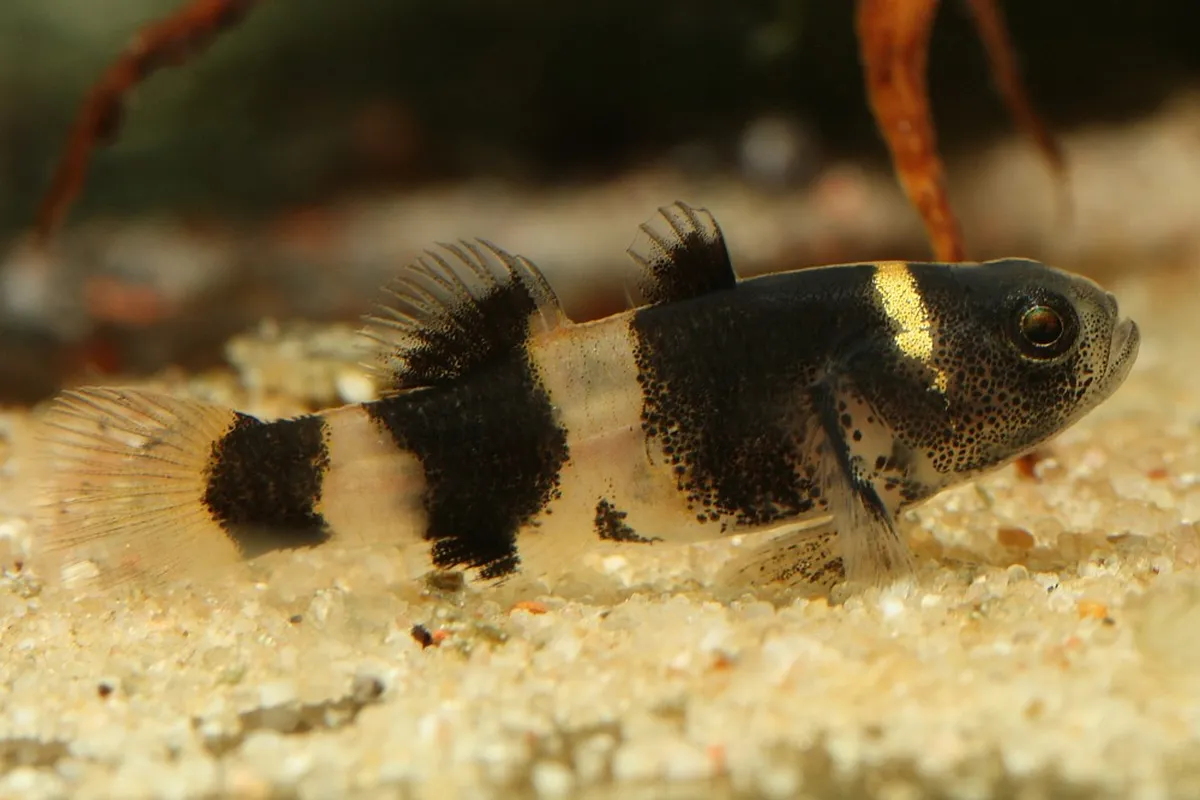
The body is stocky, with four broad black bands on yellow to cream, and fused pelvic fins that work like a little suction cup. Bumblebee gobies spend most of their time resting on the bottom, on stones or on the glass, then darting a few centimetres to grab food or chase a rival. Colour deepens in good conditions; washed-out, pale fish are usually stressed or underfed.
Mature females look rounder and often show a yellower belly. Males tend to be slimmer, more intensely coloured and much more territorial, especially around a cave.
Tank setup for a small group
Keep them in a group of six or more in at least 40 litres. A group spreads out the squabbling; a pair or trio usually ends with one dominant fish bullying the rest. Every fish needs a spot to call its own, so break up the floor with small caves, shells, rocks and roots. Count the hiding places and aim for more than the number of gobies.
Use sand or fine gravel, gentle filtration and moderate lighting. A tight lid matters less than with many fish, but they will hop between décor and occasionally get sucked toward strong intakes, so a pre-filter sponge is a good idea.
Brackish or freshwater?

Bumblebee gobies are hardy in hard, alkaline fresh water, and many live for years that way. They usually do best, and show their best colours, in low-end brackish water: a specific gravity of around 1.002–1.008. Use marine salt mixed to the right level, never table salt, and measure it with a hydrometer or a refractometer used correctly.
Whichever you choose, avoid soft, acidic water. Aim for 24–29°C, pH 7.5–8.5 and hard water. If you are keeping them fresh, our guide to hard-water fish chemistry covers raising and holding hardness. Keep salinity stable: change water with pre-mixed water at the same level so the tank does not swing.
Feeding a picky carnivore
This is the deal-breaker for most new keepers. Bumblebee gobies are micro-predators and most ignore flakes and pellets completely. Feed small frozen or live foods once or twice a day: bloodworms, brine shrimp, daphnia, cyclops and mysis. Live foods bring out hunting behaviour and help settle new fish that are not eating. See our guide to live food for aquarium fish for easy options.
Because they sit on the bottom and strike at moving food, faster tank mates can easily steal everything. Feed with a pipette near their perches, or turn off the filter for a few minutes so food settles where the gobies can reach it.
Tank mates
The best bumblebee goby tank is often a species tank. If you want company, choose small, peaceful fish that like the same hard or brackish water: mollies, some killifish, glassfish and other small brackish-tolerant species. Nerite snails are a good clean-up crew and handle low salinity well.
Avoid puffers, which will eat them, larger gobies, crabs, and fast, greedy feeders such as most tetras and barbs, which also prefer much softer water. Shrimp are risky: adult shrimp may be ignored, but baby shrimp will be eaten.
Breeding in a cave
Bumblebee gobies breed readily in a well-fed group. The male claims a cave, such as a small shell or tube, and courts females with flared fins and deepened colour. Eggs are laid on the cave roof, and the male guards and fans them until they hatch. The fry are tiny and need infusoria, then newly hatched brine shrimp. Many breeders raise them in slightly brackish water, which seems to improve survival.
Common problems
Not eating: almost always flake-only feeding or competition. Switch to live or frozen foods and target feed. Constant fighting: too few fish or too few caves. Pale fish and wasting: soft water, low salinity swings, or starvation. Kept in a mature tank with stable, hard or lightly brackish water and a varied meaty diet, bumblebee gobies typically live three to five years.
Explore other topics
Dive into more aquarium guides across the site.