

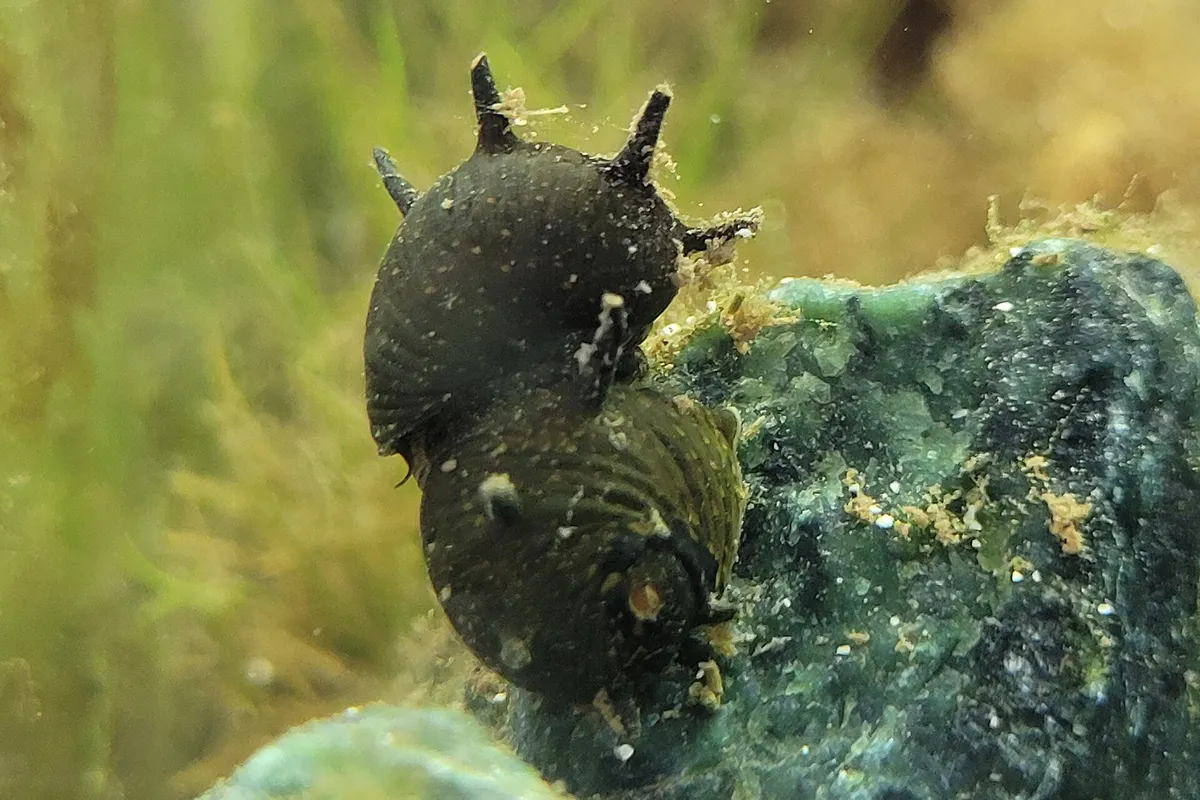
The horned nerite is the snail for people who do not want snails. Clithon corona grows to only 1–2 cm, spends every waking hour scraping algae off glass, rock and wood, and cannot breed in fresh water, so it will never turn into a plague. The crown of spikes on its dark shell makes it one of the most distinctive animals you can add to a nano or shrimp tank.
It does have two needs that catch people out: hard enough water to keep its shell healthy, and enough algae or supplementary food to stop it starving in a spotless tank.
Streams and estuaries
Horned nerites come from coastal streams, river mouths and estuaries across the Indo-Pacific, including the Philippines, Indonesia and many Pacific islands. Adults live in fresh to slightly brackish water, grazing biofilm and algae on stones in moving water. Their eggs hatch into tiny larvae that drift out to sea and develop in salt water before returning upstream. Several similar species are sold under the same name, including Clithon diadema, and all need the same care.
Spikes and stripes
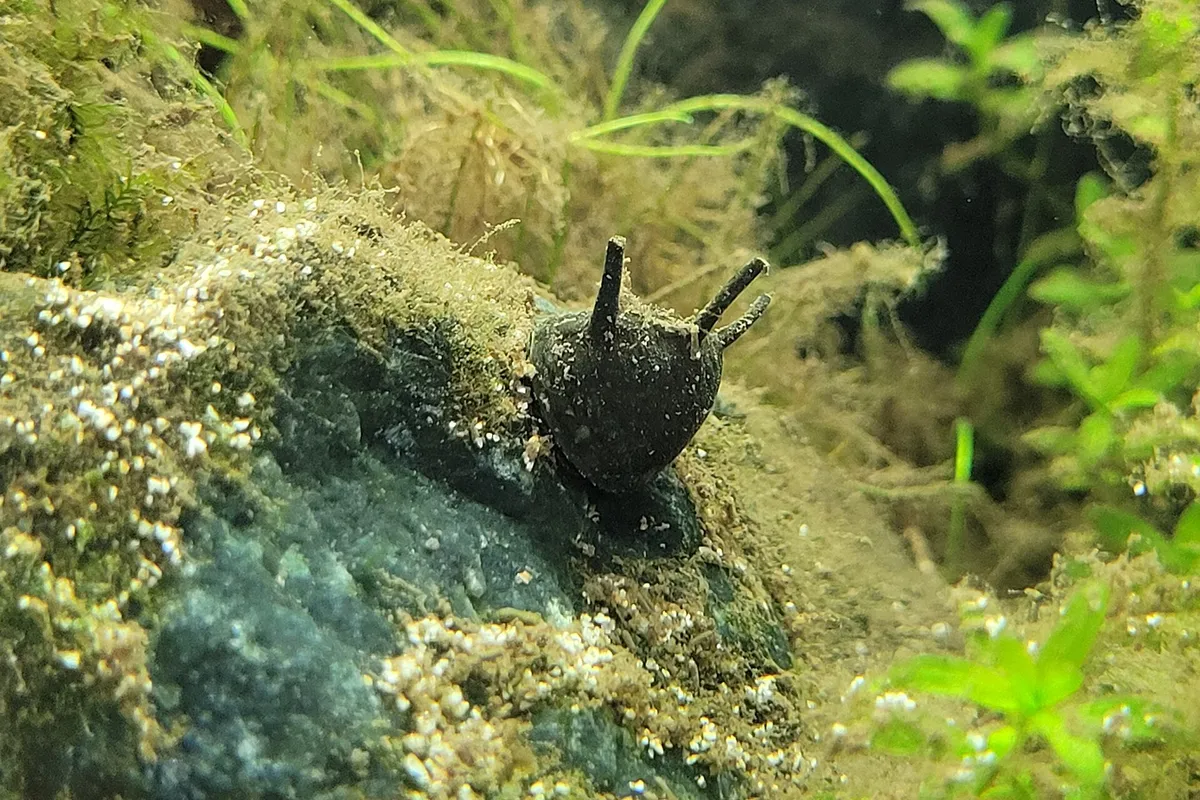
The shell is round, dark olive to black, often with faint yellow or gold bands, and topped with a ring of short, horn-like spines. Spine length varies between individuals and populations. The snail closes its shell with a hard trapdoor (operculum) when disturbed. Like other nerites, it is a fully aquatic snail that breathes through a gill.
Worn or broken spines and pale, pitted shells are a warning sign that the water is too soft or acidic.
Tank setup
Horned nerites fit almost any tank from about 10 litres upwards. A good rule is one snail per 10–20 litres, depending on how much algae grows. They are excellent in shrimp tanks, planted nano tanks and community tanks, and they do not eat healthy plants.
Nerites are famous for climbing out. Keep the water level a few centimetres below the rim or use a lid, especially in the first weeks. A snail found dry on the floor can sometimes be revived if it is put back quickly.
Water parameters

Keep the temperature at 22–28°C and pH 7.0–8.5. Hardness is the important part: aim for GH of 6 or more and some KH buffer, so the shell has the calcium and carbonate it needs. In soft water, add a mineral supplement, crushed coral in the filter or calcium-rich rock. Our guide to general hardness (GH) explains how to measure and adjust it.
Like all invertebrates, nerites are very sensitive to copper, so check medications and fertilisers. Acclimate slowly, the same way you would acclimate shrimp.
Algae eating and feeding
Horned nerites eat soft green algae, diatoms (brown algae) and biofilm, and they work across glass, hardscape and plant leaves. They can slowly wear down some green spot algae but will not clear heavy hair algae or black beard algae.
The most common cause of death is starvation in a clean or newly set-up tank. If algae runs low, feed algae wafers, blanched courgette or spinach, and leave some glass unscraped. A mature tank with a steady film of algae is ideal. For more on clean-up crews, see our honest guide to the best algae eaters.
Tank mates
Horned nerites are completely peaceful and get along with shrimp, small community fish, other snails and most bottom-dwellers. Avoid snail-eaters: puffers, many loaches such as clown loaches, large cichlids and assassin snails, which hunt small snails. Crayfish and crabs may also attack them.
Eggs on the hardscape
Horned nerites lay small, hard, white egg capsules on rocks, wood and glass, whether or not a male is present. In fresh water the eggs do not develop, so there is no population boom. The downside is cosmetic: the white dots are hard to remove and can spoil a dark scape. Scraping them off with a razor blade works on glass.
Common problems
Snail upside down: nerites sometimes struggle to right themselves, so flip it over. Shell erosion: soft or acidic water; raise GH and KH. Not moving for days: check it is alive by smell or a closed trapdoor before removing it, because a dead snail quickly fouls the water. With hard, stable water and enough to graze, horned nerites usually live one to two years or more.
Explore other topics
Dive into more aquarium guides across the site.