

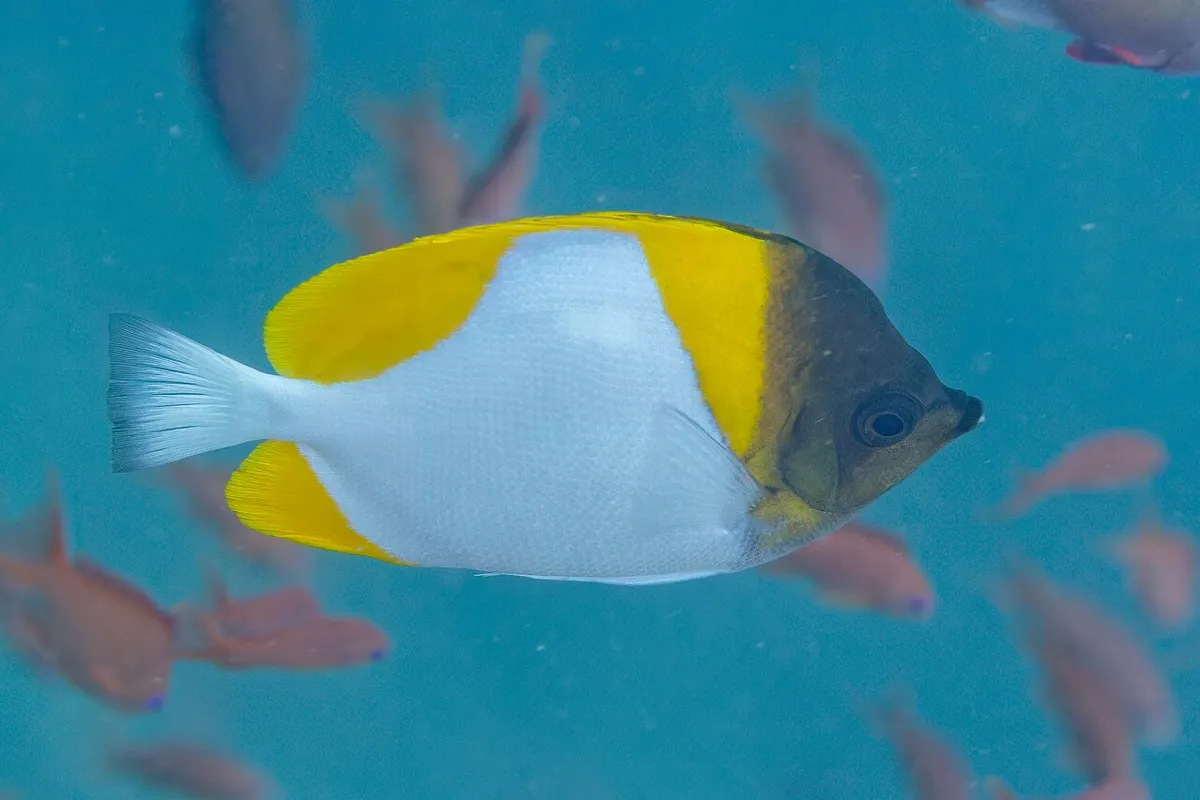
The pyramid butterflyfish is named for the white triangle on its side, framed by a brown head and yellow fins and back. It reaches about 18 cm. Unlike most butterflyfish, which pick at corals, Hemitaurichthys polylepis feeds on plankton in open water, so it is usually safe with corals.
It is peaceful, active and best kept in a small group, which makes it one of the best butterflyfish for a large reef.
Where pyramid butterflyfish come from
The species lives across the Pacific and eastern Indian Ocean, from Christmas Island to Hawaii and Pitcairn. Large schools gather above steep reef walls, feeding on zooplankton in the current.
Appearance and behaviour
Males and females look alike. Pyramids spend the day in midwater rather than among the rocks, so they are always on display.
They do well alone or in groups of three or more. Pairs sometimes squabble.
Tank setup
A single fish needs at least 450 litres; a group needs 700 litres or more. Provide open swimming space, strong flow and rockwork with some caves for night-time shelter.


Water parameters
- Temperature: 24–27°C
- pH: 8.1–8.4
- Specific gravity: 1.023–1.025
Feeding
Feed small meaty foods several times a day: frozen mysis, brine shrimp, copepods, and finely chopped seafood, plus quality marine pellets. A slow automatic feeder helps a plankton-picker.
Tank mates
Pyramids get along with most peaceful to semi-aggressive fish: tangs such as the yellow tang, anthias, clownfish and wrasses. Avoid aggressive triggerfish and large angelfish that may bully them.
Breeding
Pyramid butterflyfish have not been bred in home aquariums.
Common problems and lifespan
They are prone to marine velvet and ich, so quarantine carefully. A few individuals nip at soft corals or zoanthids. In a good system they live ten years or more.
Explore other topics
Dive into more aquarium guides across the site.