

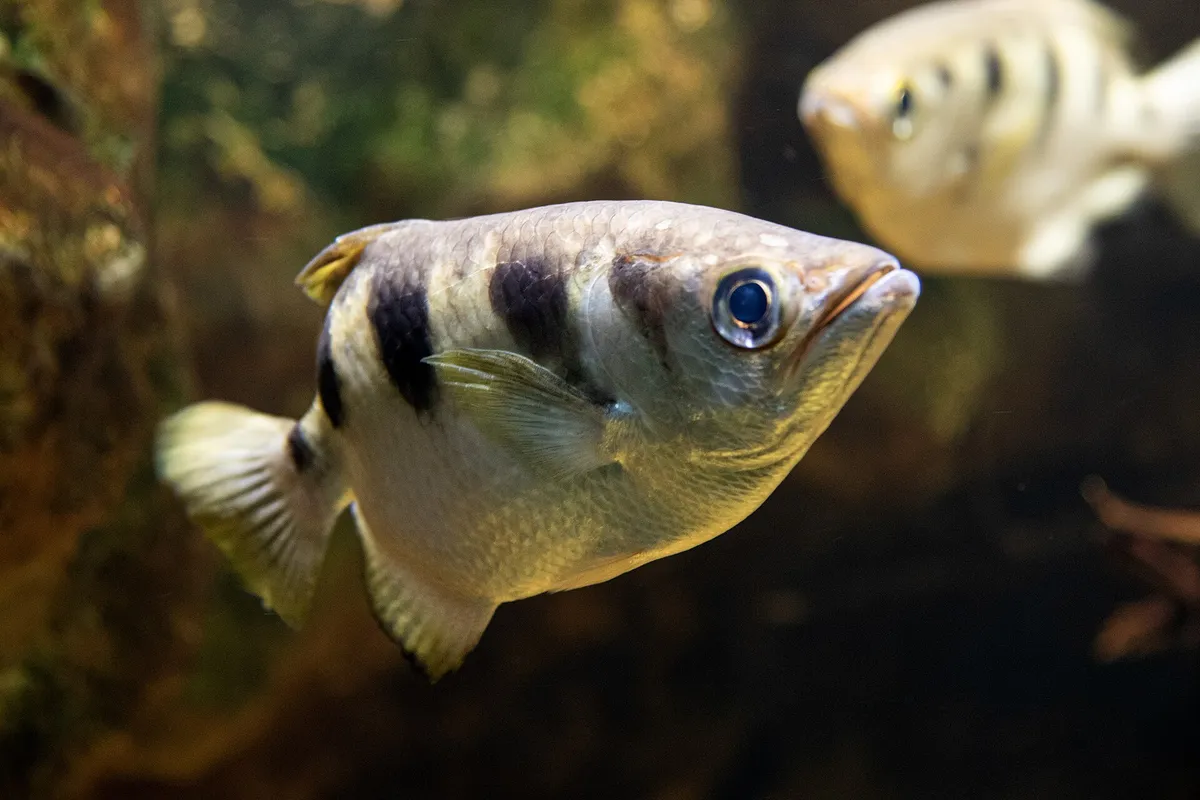
Few aquarium fish have a party trick like the archerfish. It spots an insect on a leaf above the water, lines up, and fires a jet of water from its mouth with enough force to knock the prey into the water. Watching Toxotes jaculatrix do this at home is the main reason people buy one, and the reason most of them end up in the wrong tank.
The banded archerfish is a large, brackish-water fish that needs space, open water and a gap above the surface. Give it those and it is hardy, intelligent and long-lived. Squeeze it into a small freshwater community tank and it struggles.
Where archerfish come from
Banded archerfish live in mangrove swamps, estuaries and the lower reaches of rivers from India and Southeast Asia to northern Australia and the western Pacific. The water there is usually brackish and changes with the tide. Adults often move into stronger salt water, while young fish can be found much further upstream in almost fresh water.
Overhanging mangrove roots and branches are the hunting ground. Insects, spiders and small crabs that sit just above the surface are the main prey, along with anything that falls in.
Appearance and behaviour
The body is deep and flattened, silver to pale yellow, with four to six bold black bars along the top half. The mouth is large and points upward, and the eyes are set to look forward and up. In aquariums they usually reach 15–20 cm, and up to 25 cm or more in very large tanks.
Archerfish swim just below the surface and watch everything above it, including you. They learn feeding times quickly and soon start spitting at fingers, lights and anything that moves. They are peaceful with fish too big to eat, but squabble among themselves, so keep one or a group of five or more rather than a pair.
Tank setup
One adult needs at least 300 litres; a group needs much more. Length and surface area matter more than depth. Keep the water level 15–30 cm below the rim so there is room for shooting, and use a lid with ventilation, because archerfish will also jump to grab prey. Our guide to stopping fish jumping out covers the options.
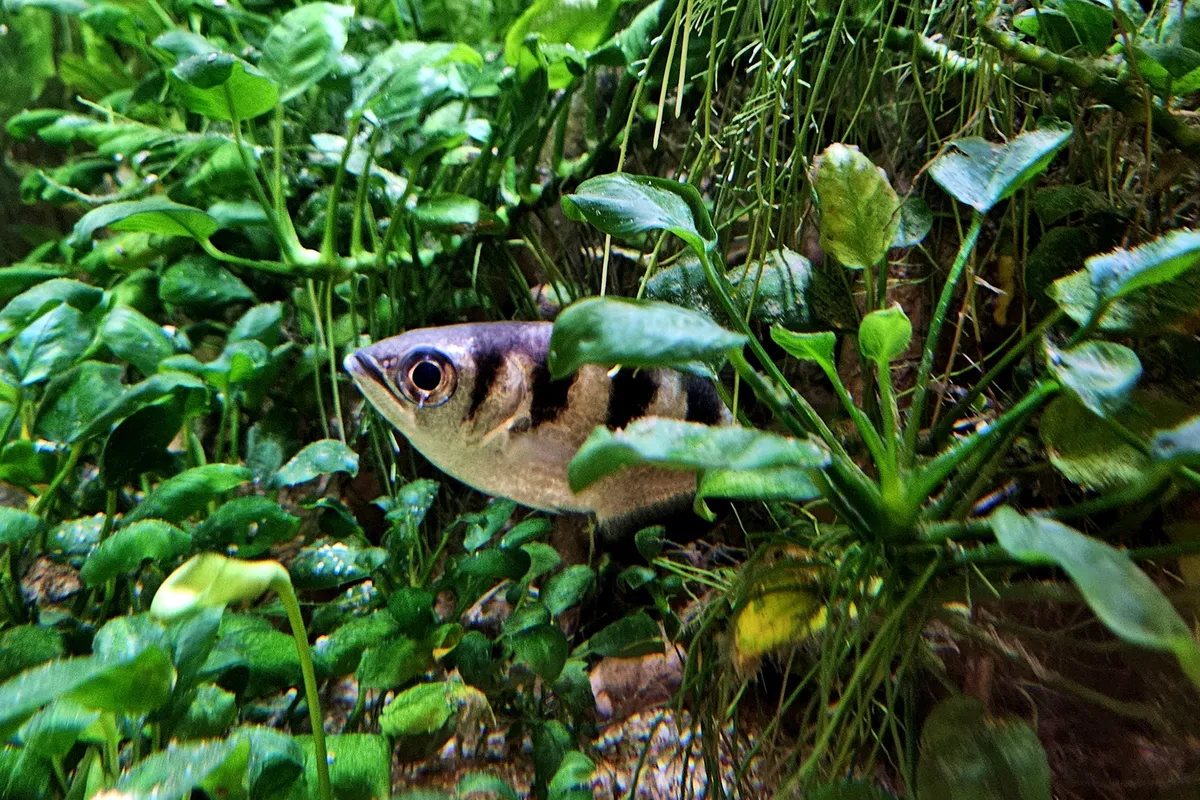
A paludarium-style setup suits them best: mangrove or driftwood roots rising out of the water, with plants or branches above for live insects to sit on. Leave plenty of open swimming space below. Sand or fine gravel is fine, and filtration should be strong because they are messy eaters.
Brackish water and parameters

Juveniles cope with hard fresh water for a while, but adults do far better in brackish water. Aim for a specific gravity of about 1.005–1.010, raising it slowly as the fish grows. Always use marine salt and check it with a refractometer, not a cheap swing-arm hydrometer.
Keep the temperature at 25–30°C and pH at 7.5–8.5, with hard, alkaline water. Pre-mix change water at the same salinity so the tank stays stable.
Feeding
Archerfish are carnivores. Floating sticks and pellets are accepted by most once settled, but the core of the diet should be meaty: crickets, mealworms, flies, frozen krill, mysis and chopped prawn. Our live food guide has easy ideas.
To see them shoot, stick a small piece of food or a live insect on the glass or a leaf just above the water. Most learn within days. Feed once or twice a day, and do not overdo fatty foods.
Tank mates
Choose other brackish fish that live lower in the water and are too large to eat: monos, scats, larger gobies and some brackish catfish. Avoid small fish, because archerfish will happily swallow anything that fits in that big mouth. See our spotted scat guide for one of the best companions.
Breeding
Archerfish have not been bred reliably in home aquariums. In the wild they are thought to spawn on reefs or in more saline water, with floating eggs. Almost all fish in the trade are wild caught, so buy from a seller who quarantines well.
Common problems and lifespan
Most problems come from soft fresh water and cramped tanks: faded colour, fin rot, skin infections and a weak immune system. Moving them to proper brackish water solves a lot of this. Jumping is the other big killer, so keep that lid in place.
Run new fish through a quarantine tank first. Well kept, archerfish live 5–10 years or more.
Explore other topics
Dive into more aquarium guides across the site.