

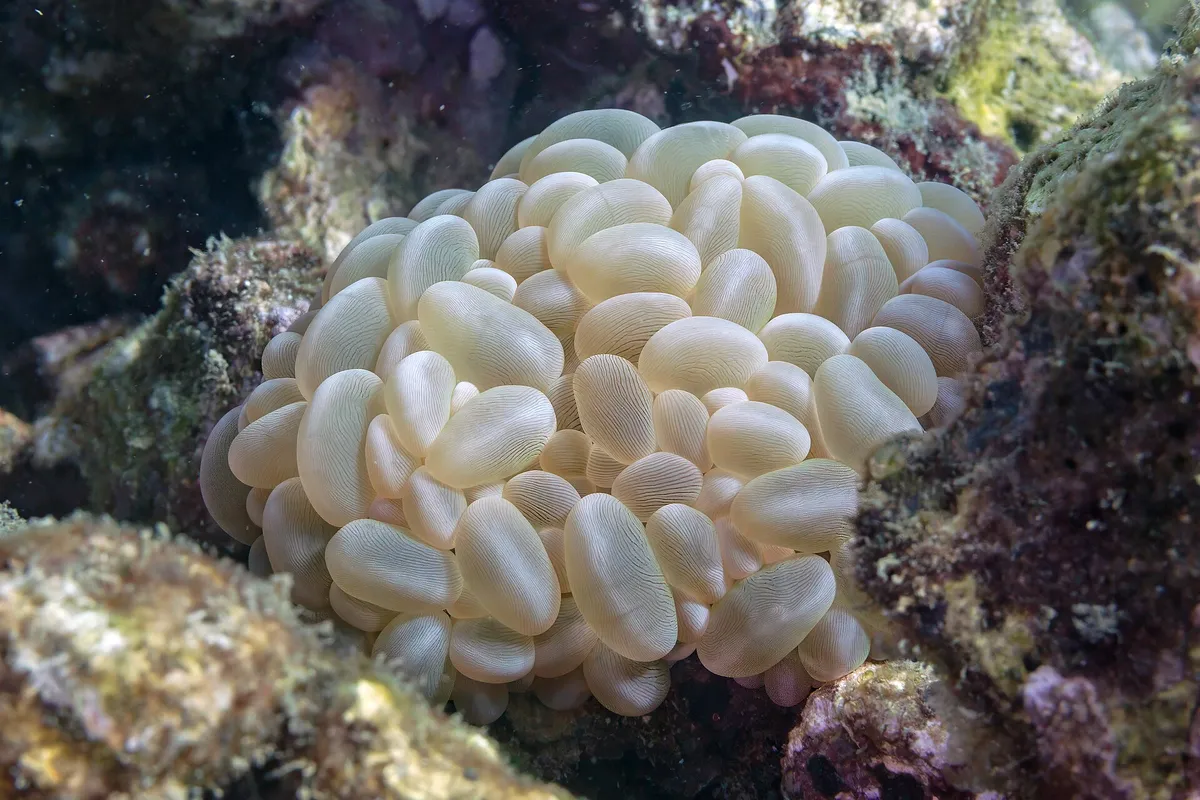
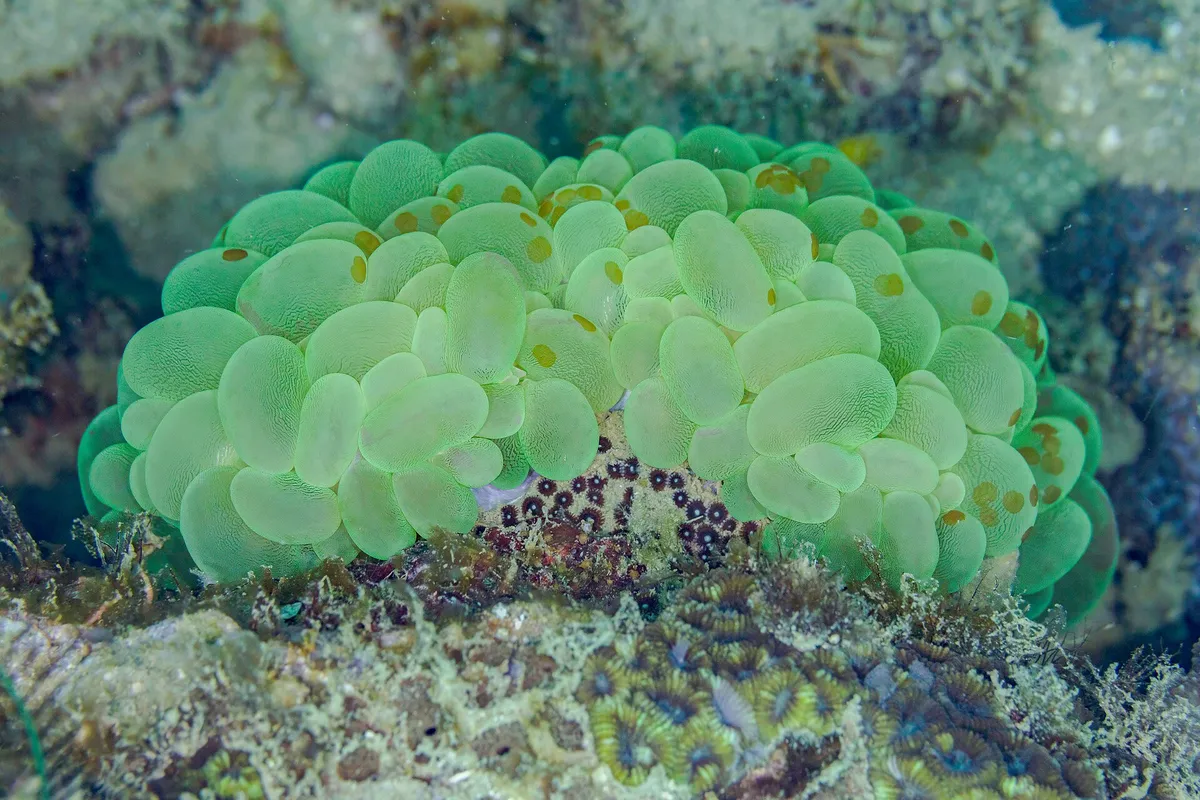
Bubble coral is one of the most eye-catching large-polyp stony (LPS) corals. By day, Plerogyra sinuosa is covered in soft, water-filled bubbles the size of grapes, in white, cream or green. At night the bubbles shrink and long feeding tentacles come out to catch food.
It is fairly easy to keep, but those night tentacles sting hard, and the bubbles tear easily. Placement is the key to keeping a bubble coral well.
Where bubble coral comes from
Bubble coral lives across the Indo-Pacific, from the Red Sea to Fiji, in sheltered reef areas, caves and slopes where light is moderate and water movement gentle. It is often found under overhangs at 5–20 m.
Appearance and behaviour
Beneath the bubbles is a skeleton of sharp, widely spaced ridges called septa. The bubbles, called vesicles, swell during the day to collect light for the coral's algae, and the colony can reach 30 cm or more across. A pearl bubble variety has smaller, more rounded bubbles.
At night the bubbles shrink and sweeper tentacles up to 15 cm long extend. These can kill nearby corals, so give bubble coral plenty of space, at least 15 cm from neighbours.
Placement, lighting and flow
Place bubble coral on the sand or low on the rock, under low to moderate light, around 50–150 PAR. Gentle, indirect flow is best: strong flow keeps the bubbles closed and can tear them on the sharp skeleton. Keep it away from fish that pick at soft tissue. Our guides to lighting and flow explain the basics.

Water parameters
Keep the temperature at 24–27°C, salinity at 1.025–1.026, alkalinity at 8–11 dKH, calcium at 400–450 mg/l and magnesium at 1250–1400 mg/l. Bubble coral tolerates some nitrate and phosphate, and actually does better in tanks that are not ultra-clean.
Feeding
Bubble coral is photosynthetic but benefits a lot from feeding. Target feed once or twice a week after the lights go out, when the tentacles are extended, with mysis, chopped shrimp or coral pellets. Fed corals grow faster and keep their bubbles fuller.
Tank mates
Most reef fish are fine. Avoid angelfish and butterflyfish that nip LPS corals, and keep hermit crabs and urchins away, because they can tear the bubbles. Keep it well apart from other stinging corals such as hammer and frogspawn corals.
Common problems
Torn bubbles, tissue pulling away from the skeleton and brown jelly infections are the main problems, often caused by strong flow, poor handling or stress. Always handle bubble coral by the skeleton, never the bubbles, and quarantine new corals. With good care bubble coral lives for many years.
Explore other topics
Dive into more aquarium guides across the site.