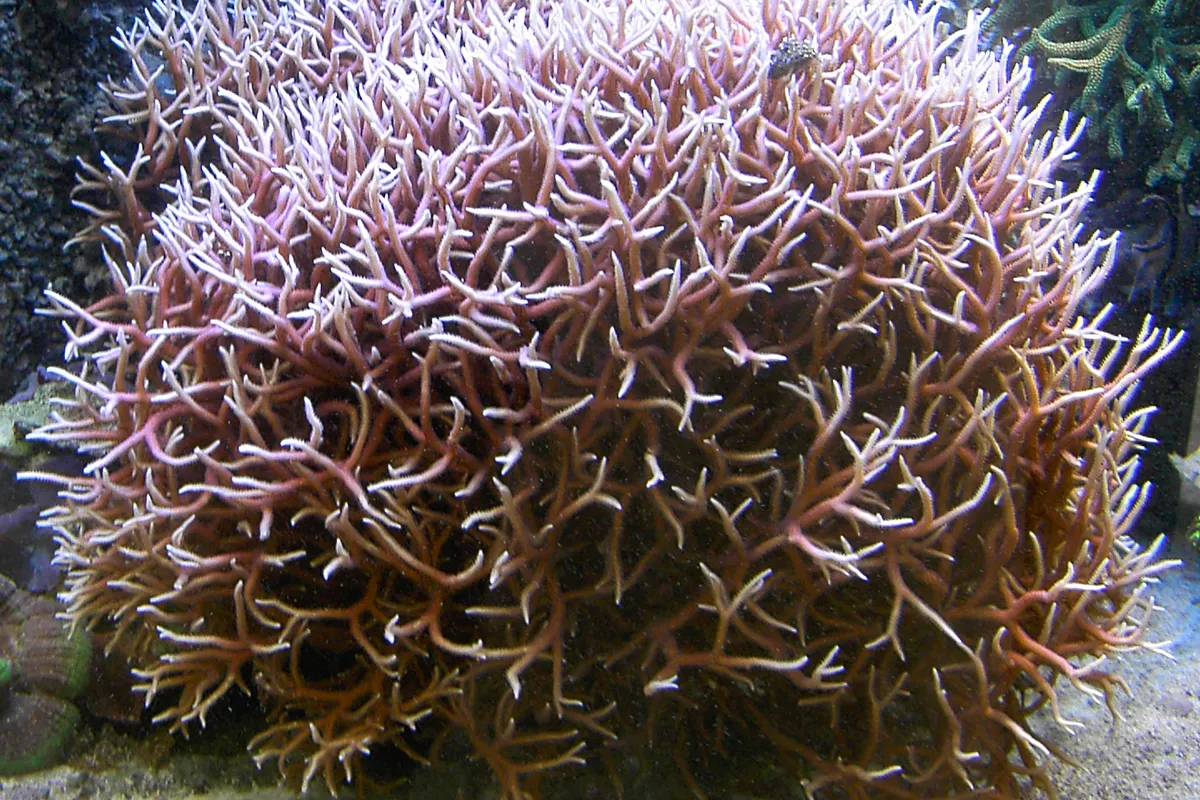
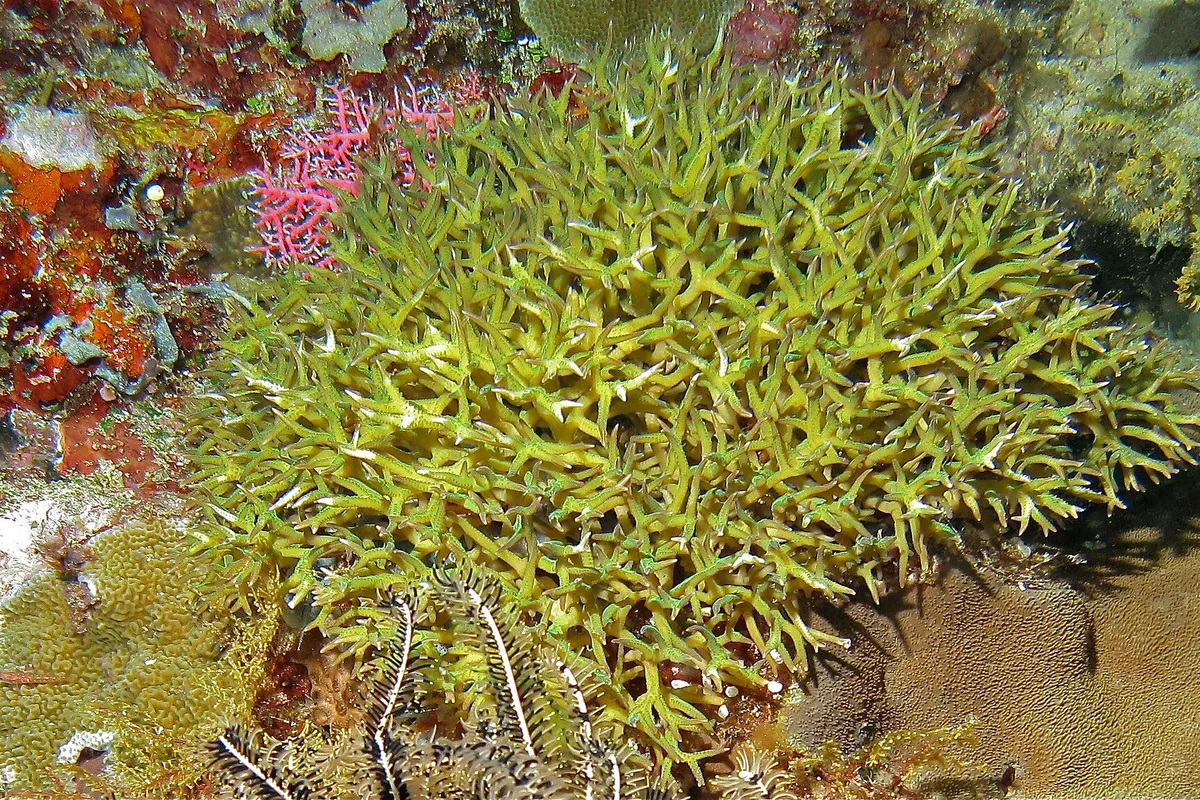
The birdsnest coral is often the first small-polyp stony (SPS) coral reef keepers try. Seriatopora hystrix grows into a dense bush of thin, pointed branches that looks like a bird's nest, in pink, purple, green or cream. Under good light it grows quickly and fills out within months.
It is more forgiving than many SPS, but it still needs stable water, good light and good flow. If your tank is already growing birdsnest well, it is a sign you are ready for harder corals.
Where birdsnest coral comes from
Birdsnest coral is widespread across the Indo-Pacific, from the Red Sea to the central Pacific. It grows on reef flats, slopes and lagoons at 3–40 m, often in sheltered areas. Most birdsnest in the hobby is aquacultured.
Appearance and behaviour
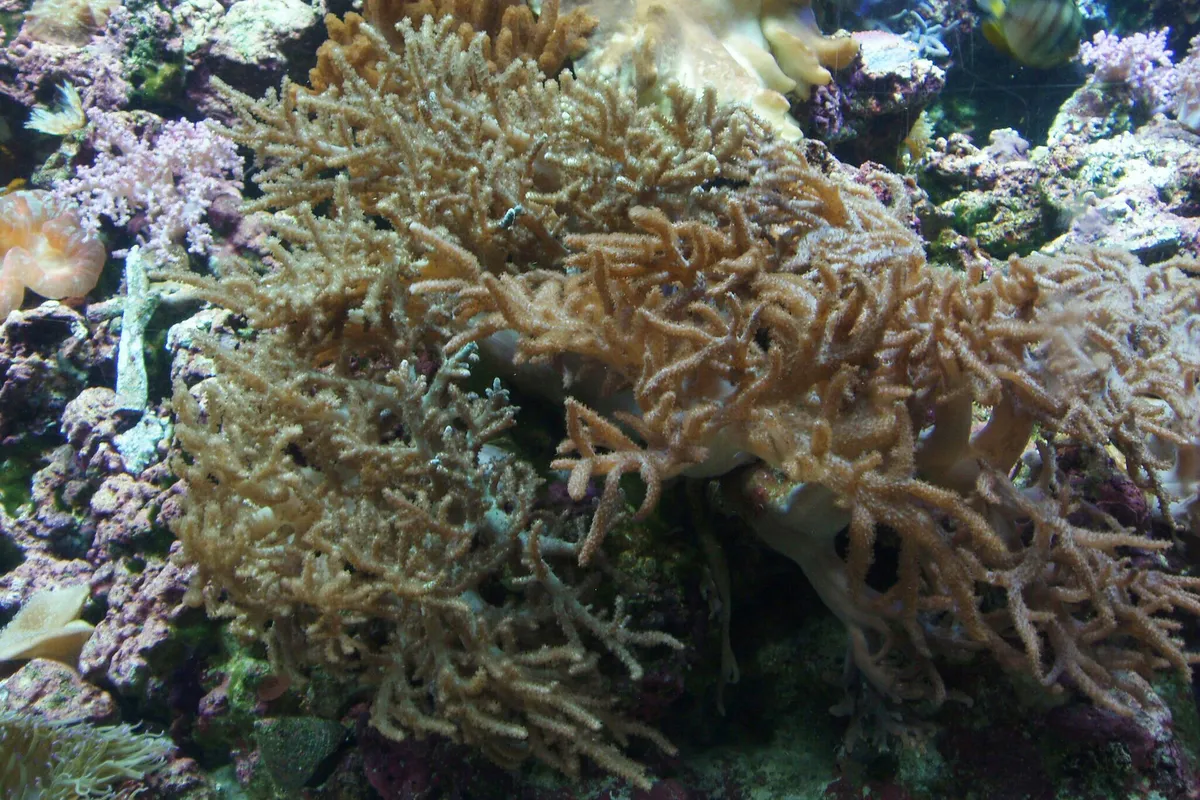
The branches are thin, round and taper to fine points. Tiny polyps line the branches in rows and extend as a soft fuzz when the coral is happy. Common colours are pink, purple-tipped cream, and green. A related species, Seriatopora caliendrum, has thicker branches and is cared for the same way.
Birdsnest has short sweepers and is not aggressive, but it grows quickly and can shade or touch neighbours, so leave room around it.
Placement, lighting and flow
Place birdsnest in the upper half of the tank under moderate to high light, around 200–350 PAR. Give it strong, random flow so detritus does not settle between branches. Our guides to lighting and wavemakers explain how to get both right. Acclimate new frags to strong light slowly over a couple of weeks.
Water parameters
Keep the temperature at 24–27°C, salinity at 1.025–1.026, alkalinity at 7.5–9.5 dKH, calcium at 400–450 mg/l and magnesium at 1300–1400 mg/l. Stability is everything: daily alkalinity swings of more than 0.5 dKH can cause tissue loss. Keep nitrate around 2–10 mg/l and phosphate at 0.03–0.1 mg/l. Our alkalinity guide covers dosing.
Feeding
Birdsnest gets most of its energy from light. It also takes fine foods from the water: phytoplankton, rotifers and fine coral powders. Feeding the fish well usually provides enough nutrients.
Fragging
It is one of the easiest SPS to frag. Snap or cut a branch, glue it to a plug, and it will encrust and branch within weeks. Our fragging guide walks through the steps.
Tank mates
Birdsnest suits most reef fish. Hawkfish like to perch in it, which is usually harmless. Avoid coral-eating fish and watch for coral crabs and pests that live between the branches.
Common problems
Rapid tissue loss (RTN) or slow tissue loss (STN) are usually caused by alkalinity swings, temperature spikes or very low nutrients. Pale colour often means too much light or too few nutrients. Dip and quarantine new corals to avoid pests. Kept stable, birdsnest colonies grow for years and are easy to keep going from frags.
Explore other topics
Dive into more aquarium guides across the site.