

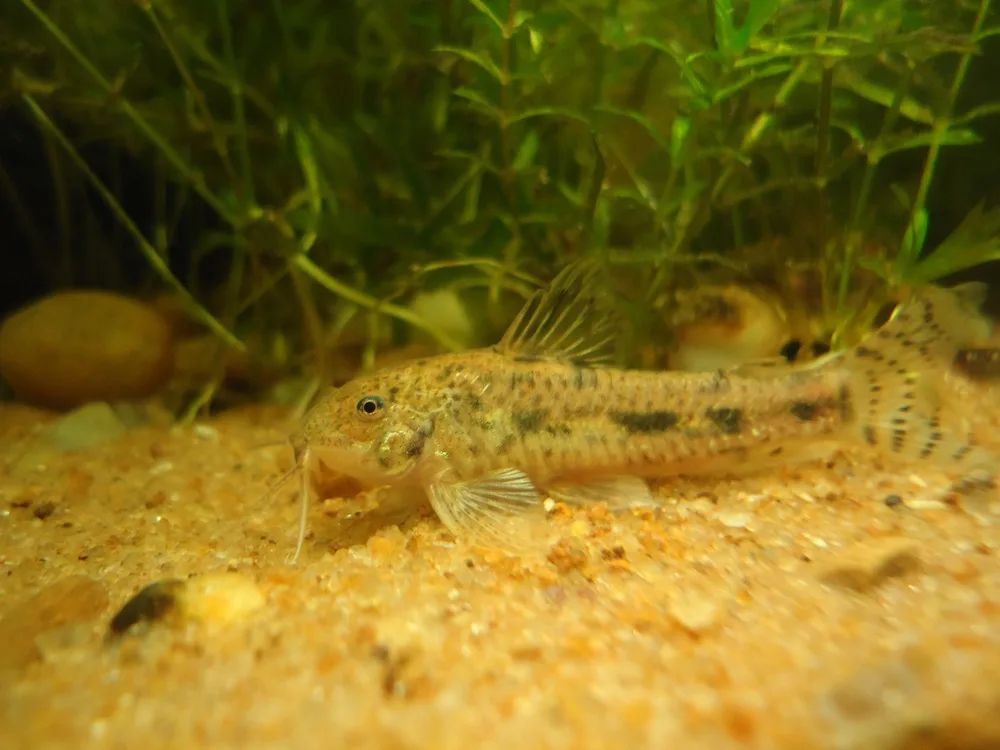
Aspidoras is not a nickname for a small Corydoras. Aspidoras fuscoguttatus is a slender, brown-dotted catfish from Brazil’s upper Paraná world, with a dual cranial fontanel that anatomists use to separate the genus. In the room it reads as a tiny, nervous, mottled sand-sifter that wants cooler, cleaner water than a discus cory and a crowd of its own kind. If you treat it as a budget panda, you will miss both the ID and the climate.
Brown dots on a pencil of armour
Adults are about 3.5–4.5 cm, slimmer than a chunky aeneus of similar length. The pattern is fuscoguttatus: dusky spots and blotches on a tan to grey-brown body, more peppered than leopard, more elongate than a round-nosed Hoplisoma. The head is pointed compared with a panda but not a Farlowella. Barbels are present and just as destroyable. Fins are lightly marked. Sexing follows the usual “females fuller” rule; they do not grow Scleromystax beards.
Shop labels say “dwarf cory,” “aspidoras mix,” or nothing useful. Other Aspidoras (pauciradiatus, raimundi, and so on) are different species. Fuscoguttatus is the brown-spotted Paraná fish, not the tiny Araguaia pauciradiatus with fewer dorsal rays, and not a Corydoras habrosus.
Upper Paraná, not Amazon blackwater
The genus Aspidoras is largely a Brazilian plateau and Paraná–São Francisco story. A. fuscoguttatus is tied to the upper Paraná basin: streams with sand, seasonal temperature swings, and water that can run cooler than equatorial forest creeks. It is closer in climate thinking to some SE Brazilian fishes than to Adolfoi. That does not make it a hillstream loach. It still lives on the bed, in groups, taking gulps of air like other callichthyids.
Wild streams can be clear or stained depending on rain. The constant is a soft bed and a need for oxygen.
A delicate floor in a modest tank
A 60 litre long tank can house a group if you do not fill it with angels. Fine sand, gentle flow, plants, wood, lid, covered intakes — the intakes matter more than with Brochis because these fish are skinny enough to disappear. They are shy; dimmer light or plant cover gets them out. Gravel is still a barbel shredder. Because they are small, they lose heat and water-quality arguments quickly. A mature, stable tank is kinder than a new scape you are still adjusting daily.
Water on the cooler side of tropical
Temperature 20–25°C is a sensible target; avoid chronic 28–30°C. pH 6.0–7.5. Soft to moderate. High oxygen. Zero ammonia. They are less famous than corys, so fewer people cycle tanks for them; that is how shipments die. Water changes should be small and matched. They are not a species for the heater-max crowd who also keep seussi.
A swarm of brown dots
Eight or more if you can. Six is a floor. They mill as a nervous little flock, more easily spooked than schwartzi. A pair vanishes. Mixed “aspidoras and corys” in ones and twos gives you neither a cory shoal nor an Aspidoras flock. Other tiny catfish can share a large sand tank if you feed micro-foods; in a small tank the slightly larger corys win.
Micro diet
Small sinking granules, crushed flake, baby brine, microworms, cyclops, finely chopped bloodworm. They cannot handle a Brochis feeding schedule of whole worms tossed once a day while tetras intercept. Feed tiny amounts, more often. They are omnivores of small items, not algae grazers, not wafer specialists.

Companions that do not treat them as moving seasoning
Small tetras, ember tetras, dwarf rasboras, shrimp in calm tanks. No large cichlids, no big synodontis, no “community barbs.” Cool-tolerant tank mates beat discus. Hastatus can share a planted Paraguay/Paraná-themed tank if both groups are large and well fed; they use overlapping but not identical space.
Spawning a dotted Aspidoras
Cory-like T-position spawn, smaller eggs, plants as egg sites. Cooler water changes may help. Adults eat eggs. Fry are tiny — infusoria first. This is closer to pygmy cory breeding than to Brochis breeding. Do not cross with pauciradiatus. Label fry as fuscoguttatus.
Health on a skinny fish
Weight loss shows fast. Barbels fail on sharp sand. Ich appears as white dots on brown, easy to miss. Warm dirty water is a death sentence. Quarantine, feed, then display. They jump through gaps you would swear were too small.
Genus first, then the dots
Keep Aspidoras fuscoguttatus because you want a slender, brown-spotted Paraná aspidoras, cooler and tinier than a typical Amazon cory group. Keep pauciradiatus if you wanted the even smaller, few-rayed Araguaia species. Keep Corydoras if you wanted the classic chubby sand cat. The dual fontanel is the anatomy. The dots are the name. The plateau stream is the climate. That is not a schwartzi article shrunk in the wash.
Plateau streams versus Amazon folklore
Upper Paraná water is a Brazilian plateau story: seasonal rain, sand, and temperatures that can sit cooler than a discus room. People who have only kept Amazon Corydoras bring 27°C heat, strong tannins, and a “they’ll be fine” shrug. Fuscoguttatus answers by going skinny and sitting in the plants. Drop the heater toward 22–24°C, add oxygen, and keep the group large enough that a dotted ribbon actually exists. The dual fontanel will not show through the glass; the behaviour will. They mill like small, nervous, elongate catfish, not like chubby pandas.
If you already run a warm sterbai tank, this is the wrong aspidoras to squeeze in “because they are both brown catfish.” Give fuscoguttatus its own cooler box or pick a tropical Corydoras instead. Genus is not a size category. It is a skull and a map.
Watching brown dots without losing them
Because the pattern is mottled brown, they vanish on tannin-dark sand and on messy beds. Pale sand and a wood backscene make the flock readable. Count them after every water change; a missing 4 cm fish is often in the filter sock. Prefilter sponges are not optional jewellery. When you siphon, kneel down and look: they freeze, then bolt. Move the hose as if the fish were shrimp.
A mature tank grows tiny foods in the sand fluff. That helps. It does not replace microworms and crushed granules. If the tetras are embers, you still have to feed the floor. If the tetras are serpae, you have already lost. Fuscoguttatus is a Paraná aspidoras for people who will fuss over a small flock, not a cleanup crew for a half-hearted community.
Explore other topics
Dive into more aquarium guides across the site.