

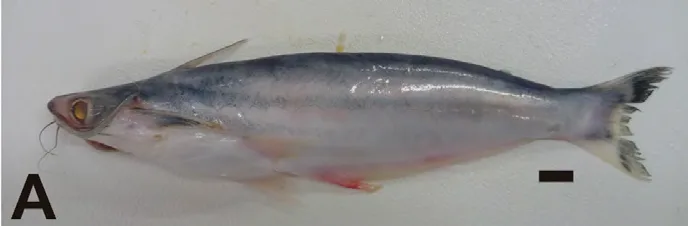
Most catfish in shops are advertised as bottom furniture. Auchenipterus nuchalis is a reminder that some auchenipterids use the water column. The Auchenipterus catfish is a slender, silvery to olive, weakly mottled nocturnal fish of Amazonian channels that schools or aggregations in midwater at night to take insects and other small prey. Adults often reach the 15–25 cm range. By day it may sink to structure. By night it is a drifting hunter. It is not Trachelyopterus galeatus stuffed in a log. It is not a pleco. It is not a giant pimelodid. Care that only offers a cave and a wafer misses the swimming and the feeding ecology entirely.
Open channels after dark
The species is tied to Amazonian (and related) river systems, including reservoir records such as Lajeado, where biologists photograph it as a channel catfish of the driftwood family. Wild fish use the water mass of rivers and the night hatch of insects. They are not hillstream clingers. They are not estuarine ariids. They are freshwater, tropical, and oriented to the open volume of a river at night.
Internal fertilisation belongs to the family. That fact should change how you think about “breeding caves.” These fish are not bristlenoses. They are not hoplos with a bubble raft. They are drifting, internally fertilising catfishes of big water.
Daytime habitat may include shade and structure. If you only ever see yours glued to the glass at noon, you have lighting, stocking, or fear problems, or you have not waited for night.
A torpedo with barbels, not a sucker
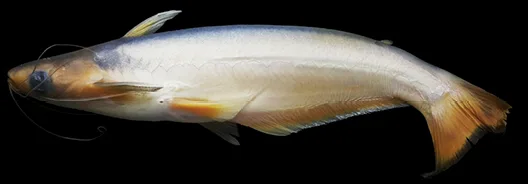
The body is elongate, compressed, built to swim, with a forked tail and a modest dorsal spine. Colour is often plain enough that shops ignore it — silvery, yellowish, or pale brown with faint mottling. The mouth is for snapping insects, not for rasping. Eyes are larger than a woodcat’s buried-in-log look, because this fish hunts in the column.
Healthy fish are sleek, not pinched, and they show coordinated night activity in a group. A single specimen in a tiny tank is a neurotic swimmer that glass-surfs. That is not “shark catfish” energy; it is a schooling channel fish kept alone.
Males show the family’s modified anal fin. You may sex adults if you look. You still keep a group for behaviour, not a “pair” in the cichlid sense.
Length to cruise, shade to rest
Give a group a long tank — 150 litres and up is a serious starting point for several adults — with open swimming water, a lid, and some daytime structure (wood, plants) that does not block the cruise lane. Sand or smooth substrate. Flow that suggests a channel, not a whirlpool and not a swamp. They need oxygen and turnover without being pinned.
Height helps a midwater fish more than it helps a rubberlip. Length still wins. A tall, narrow column is a bad river.
Lighting on a dimmer, with a long dusk, lets you see them hunt without blasting them all day. They are not a display fish for a spotlight scape.
Amazon channel chemistry
Temperature 25–29 °C, pH 6.0–7.5, typical river softness. Clean water. They are active and they eat protein; filters must match. They are not brackish. They are not cool-water. They are not a substitute for Pangasius in a “shark” tank — completely different fish, different size, different ethics.

Water changes should be substantial enough for a group of night hunters, matched to temperature so you do not shock a cruising school.
Insects in the current, not wood pulp
Feed at dusk and after dark: floating and sinking insect-based foods, frozen bloodworm, mysis, quality micro-pellets that they can snatch in midwater. They will miss food that only sits on the sand if they are up in the column. Watch the night feeding. A group that ignores food is ill, scared, or already full of tank-mate fry.
They are not algae eaters. They are not xylophages. They are not scavengers of the Raphael type, though they may take a leftover. Build the menu around nocturnal insectivory.
Overfeeding a school clouds a channel tank fast. Feed what they intercept in a few minutes of darkness.
A school, or a lonely glass-surfer
Keep several. Midwater companions should be peaceful, similar-water fishes that will not nip and that are too large to eat — or accept that small tetras may be hunted at night as the catfish grow. Do not house them with giant pimelodids. Do not house them as “bottom cleaners.” They are not on the bottom.
Trachelyopterus in the same tank will occupy the logs while Auchenipterus uses the lane if the tank is huge; in a small tank they just compete for night food and oxygen. Pick the species that matches the scape you actually built.
Quarantine a group together if you can, with swimming space, not a crowded box that shreds fins.
Fertilisation you will not see
Internal fertilisation means breeding is not a public nest on the glass. Eggs, when produced, are a specialist’s problem. Do not buy A. nuchalis as a spawning project. Buy it as a nocturnal channel schooler.
Daytime rest versus night shift
If you only visit the tank at breakfast, you will conclude A. nuchalis is a dull stick on wood. Come back two hours after dusk. A group in a long tank will be off the bottom, snapping at foods in the lane, looking like a small pelagic catfish rather than furniture. Design feeding around that clock. A pinch of food at noon trains you, not them.
Glass surfing in daylight often means the school is too small, the tank is too short, or a light is blasting the cruise lane. Add fish of the same species, add length, or add a background and floating cover before you add medicine.
Catfish that swim
Auchenipterus nuchalis is a midwater, night-hunting auchenipterid of Amazon channels. Give it length, a group, and insects after dark. Do not give it a pleco’s job or a giant predator’s reputation. See driftwood catfish, chemistry, cycling.
Explore other topics
Dive into more aquarium guides across the site.