

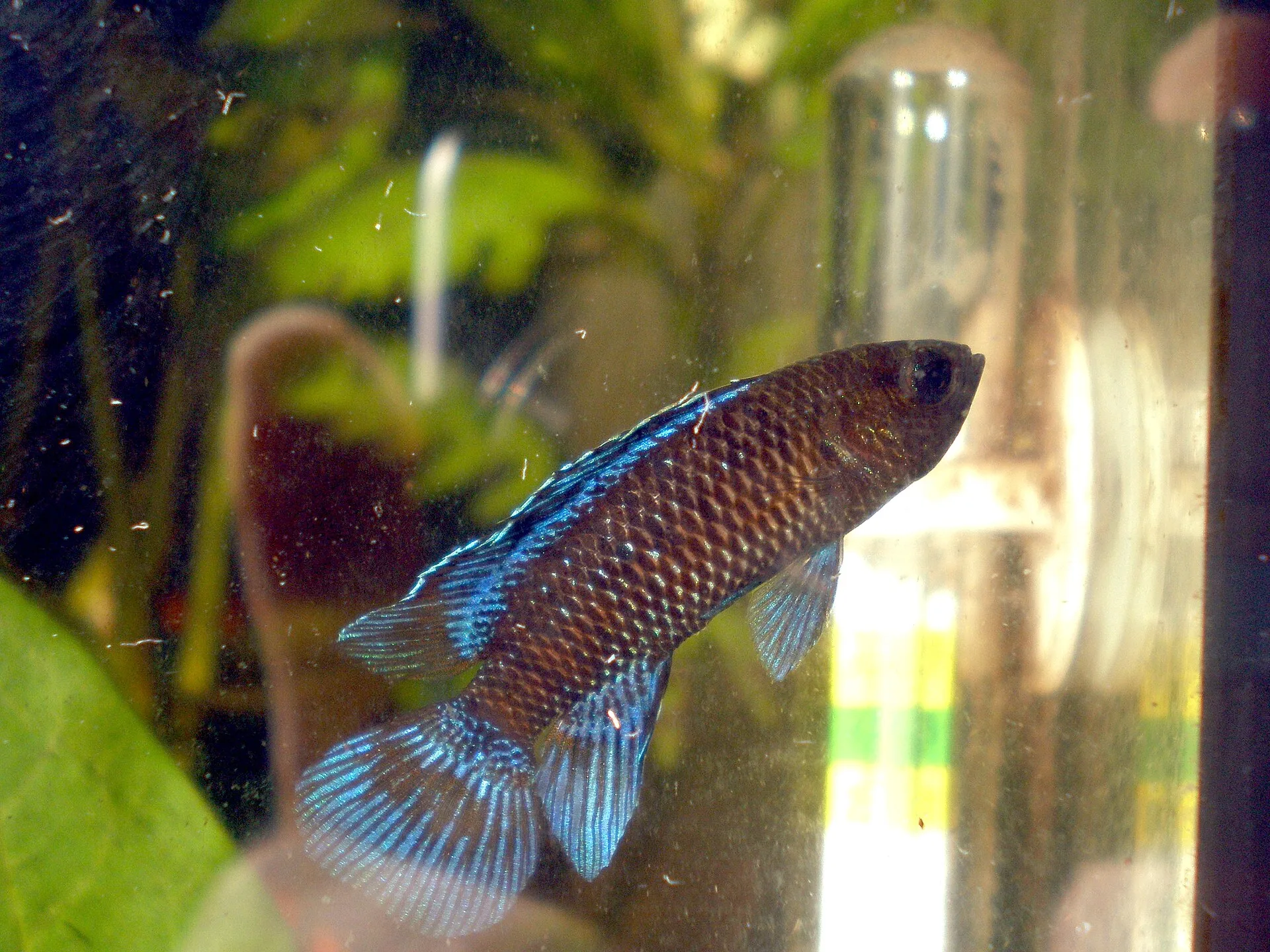
Most community fish advertise themselves. Badis badis does the opposite. It hangs in a knot of Java moss the colour of the moss, then, when a male decides a cave is his, it turns blue, red, and barred as if someone had thrown a switch. The chameleon fish of the Ganges drainage is a slow, methodical micropredator, and it is starved in more aquaria than it is murdered. Fast tetras take the food. The badis fades back into the plants and dies thin. If you cannot feed a shy hunter, do not buy this species.
It is not a dwarf cichlid, though it acts like one. Badids are their own family. They spawn in caves. Males are territorial toward other males. They do not have the same water needs as a rift-lake cichlid and they do not have the speed of a danio. The tank has to be built around stillness, cover, and live or frozen food that reaches the floor.
A hunter in the weeds of the Ganges
Badis badis is native to parts of India, including the Ganges basin, in slow, vegetated, often turbid water. It works the edges and the bottom, among leaf and plant stems, taking insect larvae and small crustaceans. Current is low. Light at the fish is broken. The water is typically soft to moderately hard, not a blackwater extreme and not a soda lake.
Aquarium strains include the familiar blue badis. Colour is mood. A male in a display cave looks nothing like the same fish in a bag. Females stay browner and smaller. If you only ever see brown, you either have females, or you have males that have given up.
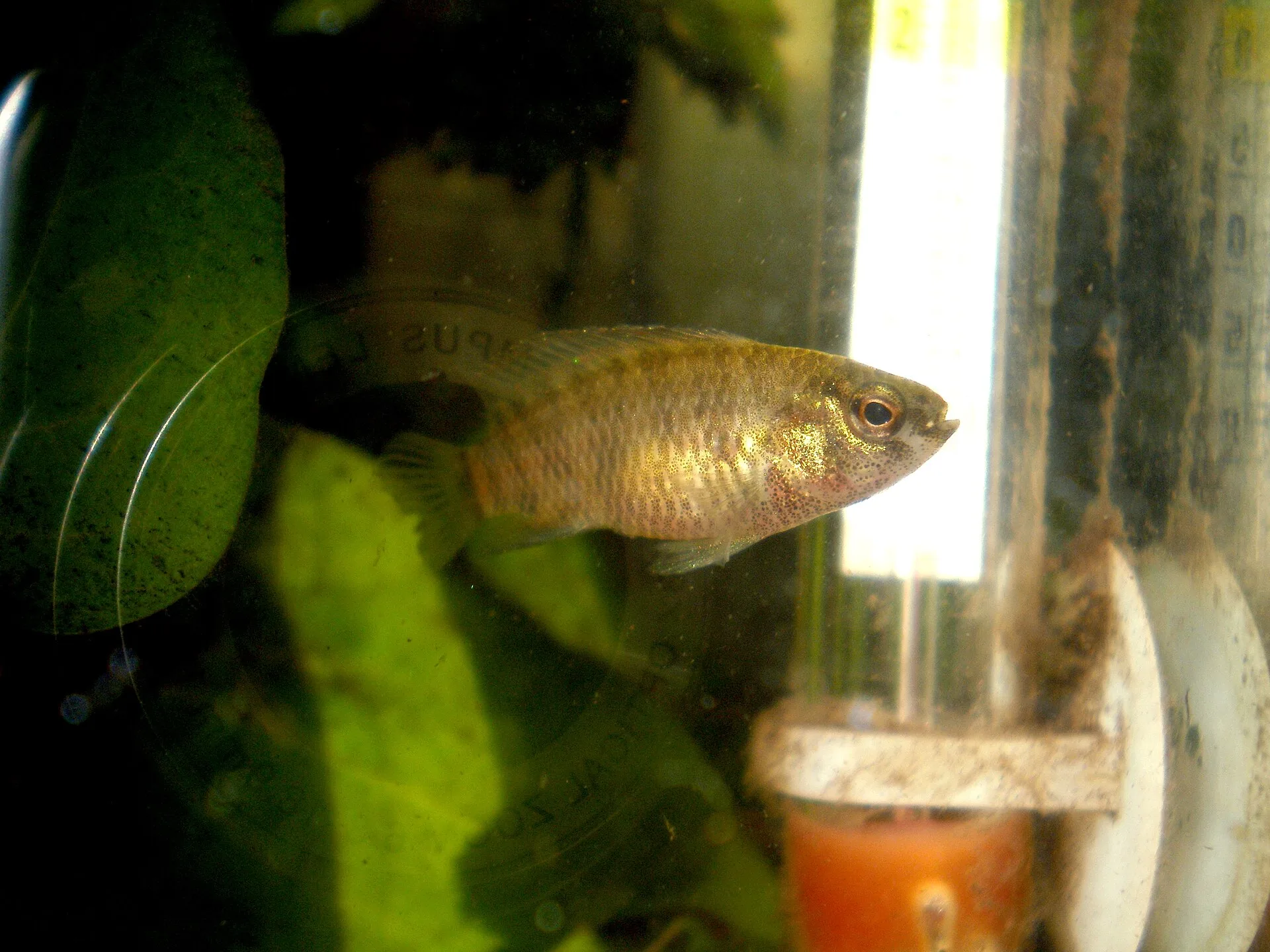
Blue is a decision the male makes
Males reach about 6–8 cm, females less. The male’s body can flush with blue and red; bars appear and vanish. The dorsal is taller. Females are rounder when gravid and stay cryptically brown-gold. Unsexed groups of six in a planted tank will usually reveal one or two dominant males who take caves and colour up. The others remain dull. That is social, not a second species.
They move with a rowing flick, pause, and inspect. If your idea of a healthy fish is constant swimming, you will think they are ill. Sit down. Watch a male work a moss wall for ten minutes. That is the animal.
Moss, caves, and no racetrack
Sixty litres can hold a pair. A male and two females in 80 litres of dense planting is more comfortable. Caves — coconut, pipe, slate lean-to — are essential. Java moss, Java fern, crypts, and floating plants create the visual clutter they hunt in. Sand or fine gravel. Flow so gentle it barely moves a leaf. A sponge filter is not a compromise; it is appropriate.
Bright open sand with a single plastic log produces a fish that never colours. They need to feel unseen to become visible. A lid is sensible; they are not Olympic jumpers but a fright plus a gap will lose you a male you waited months to colour.
Ordinary Indian-stream water
Temperature 22–26°C suits them; they do not need 28°C and often look worse when kept that warm. pH 6.0–7.5, soft to moderately hard. They are more tolerant of a range than a wild-caught apisto, which is why they survived in older community tanks — survived, not thrived. Ammonia still kills them. Nitrate should stay modest. They show poor water as clamped fins and a refusal to leave cover even when you offer live brine shrimp, which for this species is saying something.

Weekly changes of matched water. No Malawi salt. No Amazon acid-bottle heroics unless you know why.
If it does not wriggle, he may not eat
This is the centre of badis keeping. Many individuals ignore dry food, especially when new. Frozen bloodworm, brine shrimp, daphnia, and live grindal or baby brine are how you keep them alive. Some will eventually take small pellets if you feed in the same place at the same time with no competition. Some never will. Do not buy a badis as a “clean-up crew.” It will not eat algae. It will not outcompete platies at the surface.
Feed after dimming the lights a little if they are shy. Use a pipette to deliver frozen food to the cave mouth. Watch the belly. A knife-edge keel on a badis is a countdown. Target feeding is not optional in a mixed tank. In a species tank it is still wise.
Males, caves, and who gets to eat
One male per cave cluster. Extra males need space and extra holes or they fight in slow, damaging displays. Females are tolerated if they can leave. Tank mates must be small, peaceful, and incompetent at vacuuming food: perhaps a few small rasboras that stay up top, or shrimp if you accept that a hungry badis will eat juveniles. Danios, large tetras, and cichlids that patrol the bottom will starve them without ever nipping a fin. That is the usual death.
A species tank with moss and a sponge filter is the kindest keep. You will see colour, spawning, and hunting. You will not see that in a “community of leftovers.”
Eggs in a hole, male on duty
Unlike many cichlids, the male badis often takes the primary role at the cave. The pair spawn inside; he guards the eggs. She is driven off. Do not assume biparental krib behaviour. If you want fry, a dense moss tank with no egg-eaters can work, or you pull the cave. Fry are tiny and need infusoria then baby brine. The male may spawn with more than one female if caves and condition allow.
Failed spawns are often failed feeding. Thin fish do not raise young. Neither do fish kept at 30°C because the heater was set for discus.
The slow fish that still needs a hospital tank
Quarantine is where you learn whether yours will eat frozen food. A small planted box, a cave, a sponge, no roommates. Two weeks. If it only eats live food, you now know that before it faces your display. Ich happens after chills; they can be sensitive to some medications, so start with heat (carefully) and clean water, and use drugs with a species this small and still. Velvet is a risk in imports; gold dust and rapid breathing are an emergency.
Badis badis is not difficult in the way a wild discus is difficult. It is difficult in the way a specialist feeder is difficult. Build a weedy, quiet tank, feed it like a hunter, give the male a cave, and the blue was never rare. It was waiting for the danios to leave the dinner table.
Explore other topics
Dive into more aquarium guides across the site.