

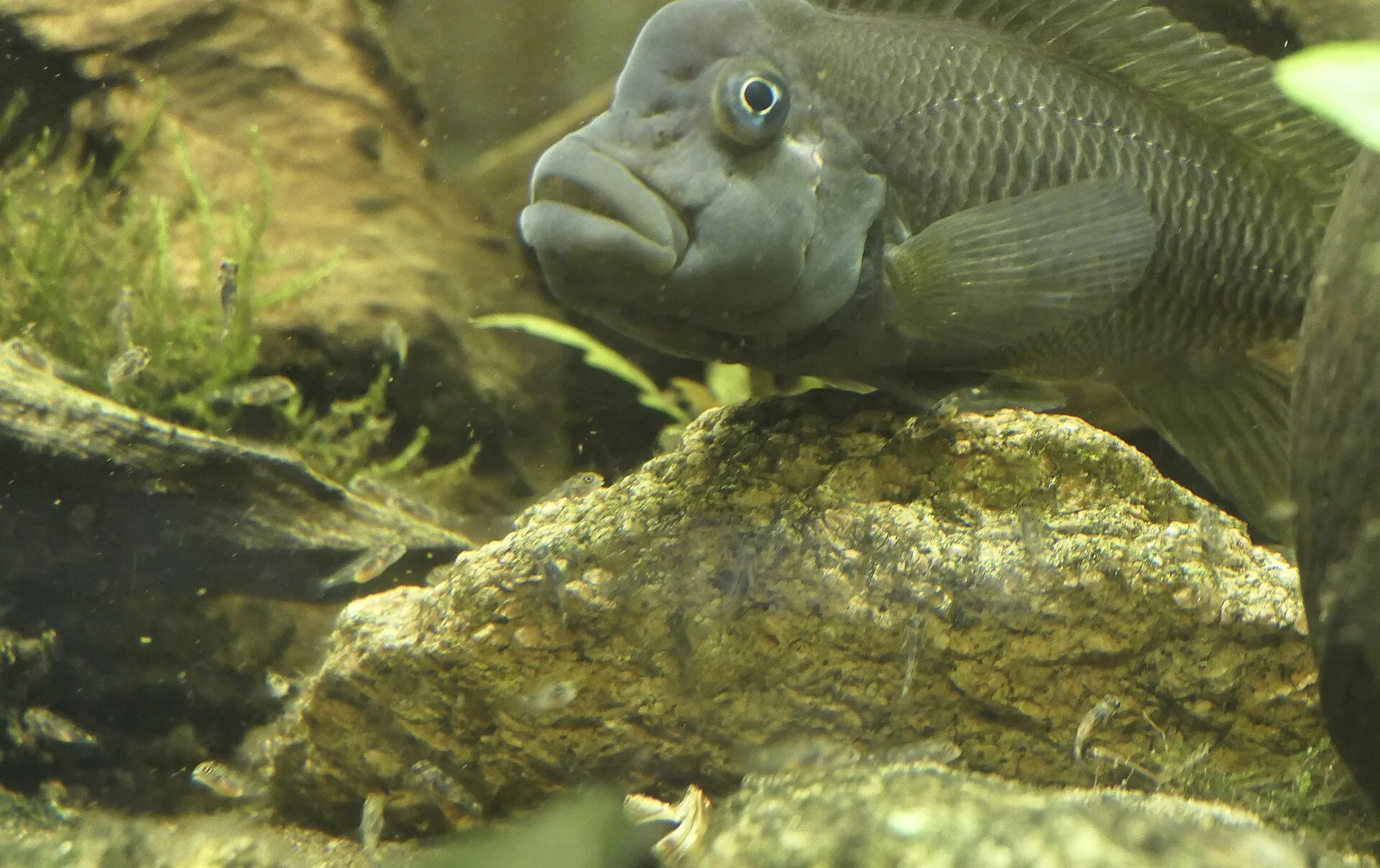
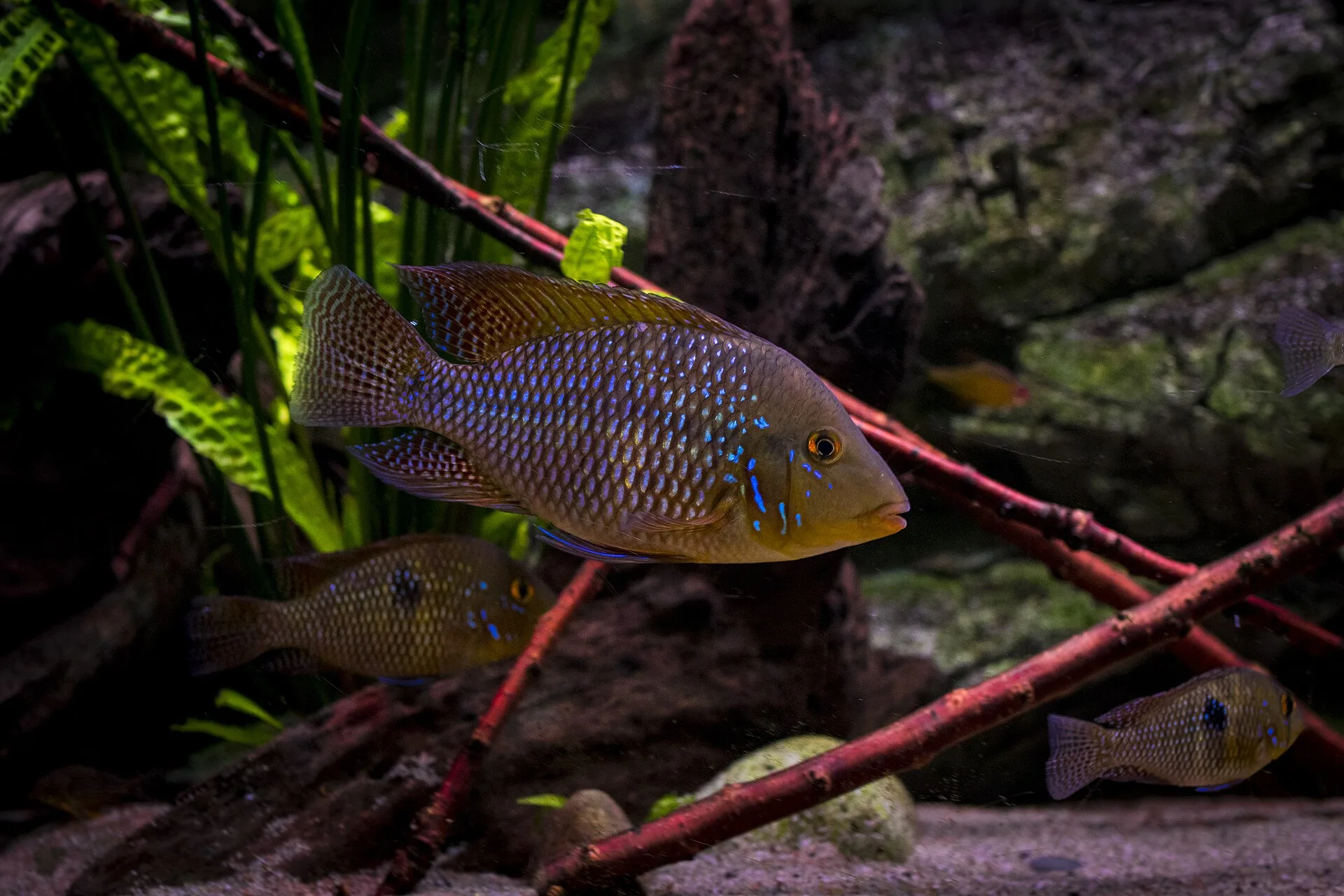
A blockhead cichlid does not swim so much as it hops. Steatocranus casuarius from the Congo River rapids has a reduced swim bladder, a blunt face, and, in males, a nuchal hump that looks like a helmet grown from bone and attitude. It lives on the bottom among rocks in current, and the aquarium has to be built for that body plan. If you wanted a fish that patrols midwater, you wanted something else. If you wanted a small African cichlid that treats the substrate like a street, this is the one.
People buy them because the hump is funny until they realise the fish is a territorial cave-holder with a pair bond and a need for flow. The humour survives. The husbandry has to catch up.
Rapids, not a lake shore
The species is native to the Congo basin in fast, rocky water. Oxygen is high. The bottom is stone, gravel, and cavities. Plants are scarce. The fish wedges into gaps, holds station with a wriggle of the body, and darts between rocks rather than cruising a sand flat like a Tanganyika featherfin. That is why a still, heavily planted community tank makes them look sick even when the water tests are fine: they are under-oxygenated and unemployed.
You do not need a true river tank with a pump that walks the stand across the floor. You need noticeable current along the bottom, lots of rock caves, and a pair — or a pair plus room — rather than a crowd of males.
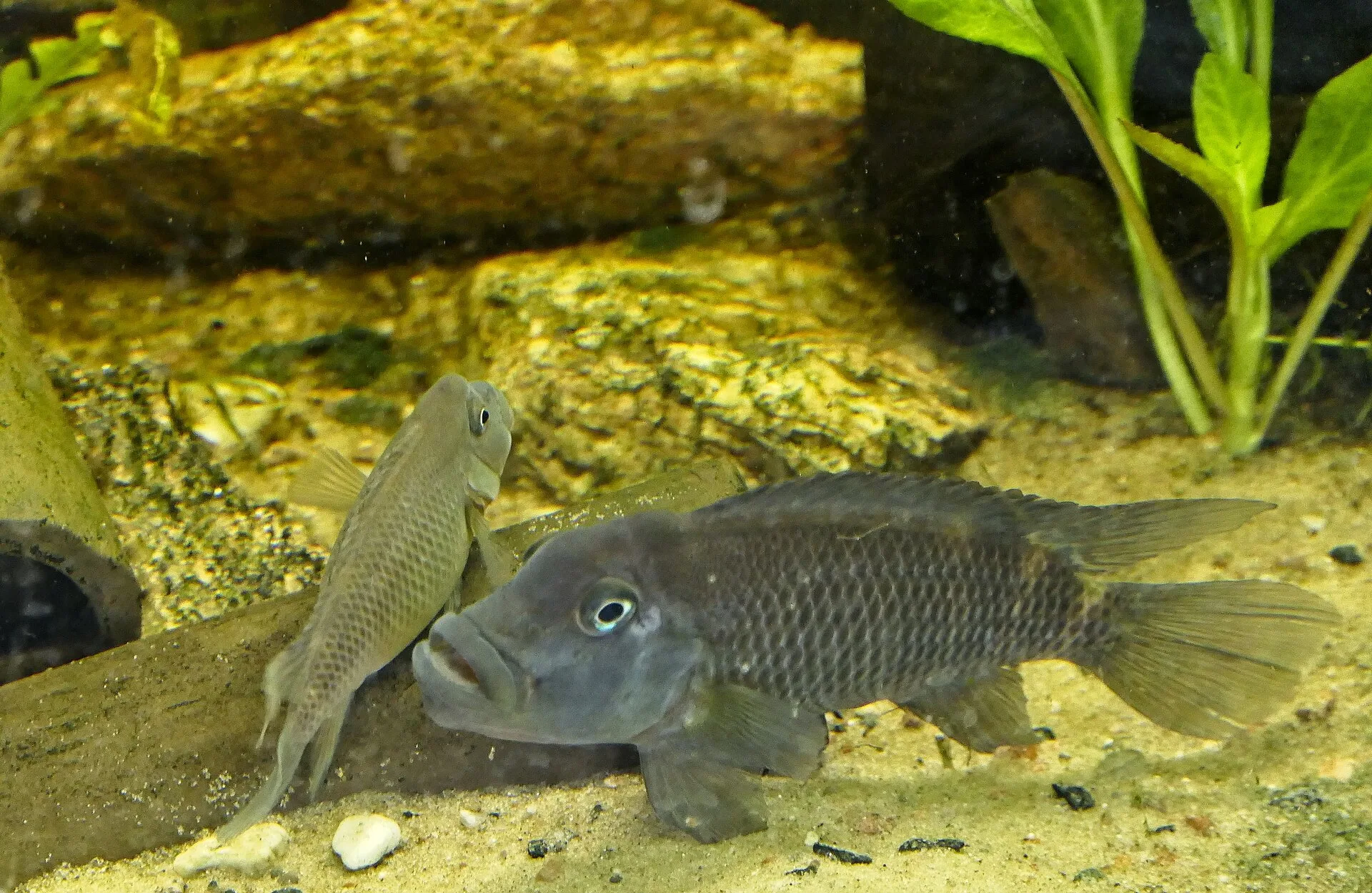
The hump is a sexing tool, not a deformity
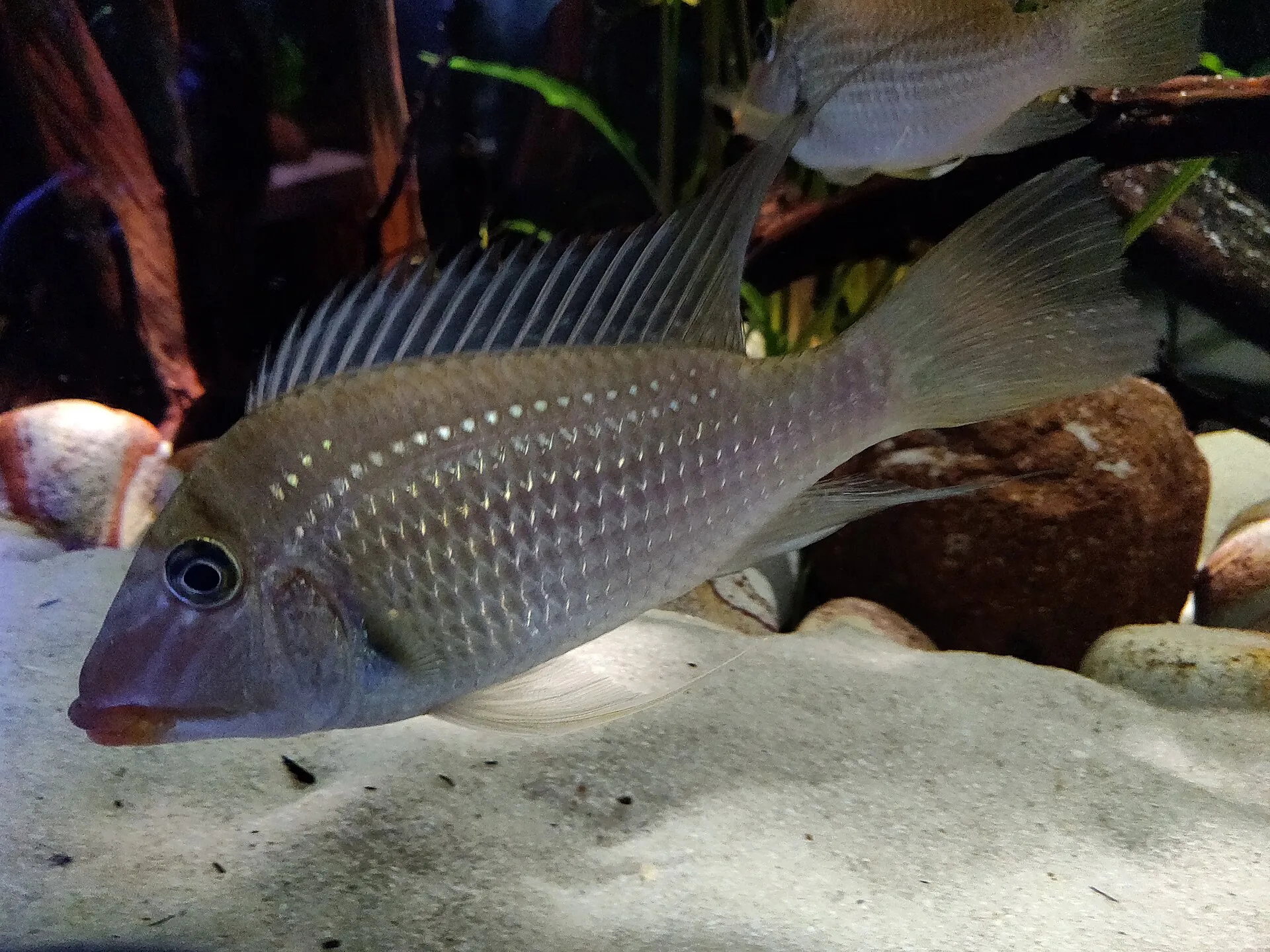
Males develop the blocky nuchal crest with age and status. Females stay slimmer in the head and are smaller overall. Adults are commonly in the 10–12 cm range, males at the top of that. Juveniles look like brown gobies with cichlid fins. Do not expect the helmet on a 5 cm fish. Do not buy four “males” based on wishful head shape.
Colour is brown to olive with darker barring that flashes when they display. They are not jewels. The appeal is motion, the face, and the way a pair works a pile of rock like a construction site.
Rock that makes streets and rooms
A hundred litres is a starting volume for a pair; more length is better. Stack rock so there are tunnels and at least two or three caves with more than one exit. Avoid death traps — piles that collapse, or caves with a single entrance a rival can block. Sand or fine gravel in the gaps is enough; they do not need a deep sand bed, and a storm of current will blow a deep bed into dunes anyway.
Point a powerhead or a strong filter return across the rock field, not straight at the glass in a way that leaves a dead zone on the bottom. They will sit in the flow. If they only sit in the one still corner, your “river” is a surface ripple and a stagnant floor. Plants can be Anubias or Java fern tied to rock if you want green; they may be ignored or mildly abused. A full Dutch scape is a waste of effort and will be rearranged.
A lid helps, though they are not famous jumpers compared to some cichlids. Heaters should be guarded; a hump used as a ram will crack glass or smash the tube.
Congo chemistry without mythology

Temperature 24–27°C, pH around 6.5–7.5, moderate hardness. They are not Tanganyika alkaline fish and they are not blackwater specialists. Clean, oxygenated water is the non-negotiable. In a rapids biotope, waste cannot sit. Overfilter. Change water weekly. Watch oxygen in summer if the room is hot and the surface is still — they will breathe hard at the return if the tank has gone stale, and you might mistake it for disease.
Do not add aquarium salt as a default “African” gesture. Do not pour Malawi mix into this tank. If your tap is decent and stable, use it. If it is wildly hard and alkaline, blend toward moderate. If it is pure rainwater softness, remineralise a little so pH does not collapse.
Omnivores that hunt the cracks
They take sinking pellets, frozen mysis, bloodworm, brine shrimp, and vegetable matter. A mix is better than a carnivore-only menu. Feed where they live: on the bottom. Midwater flakes will be missed or claimed by any dither fish you added. They will also pick at aufwuchs on rock. That does not make them algae eaters you can starve between wafer days.
A pair with fry will still eat, but they will also guard. Feed small amounts more often so the parents do not have to leave the cave empty for long.
A pair that owns a pile
Keep them as a pair. Extra males fight, and the fights are grinding, not theatrical. In a very large rockscape you might run more than one pair with visual breaks, but that is not the starter layout. Tank mates must live off the bottom or be robust enough to ignore a charge: some larger tetras or Congo tetras in a big tank, or other rapids-associated fish that use different rock. Small corys and shrimp are a bad idea. Mbuna are a chemistry and temperament mismatch. A jewel cichlid in the same footprint is a war.
They are not community dwarfs. They are small by cichlid standards and still cichlids. Anything that tries to share the best cave will be evicted.
Spawning in the tunnel
They are cave spawners with biparental care. The pair cleans a site, lays, and guards. You may not see eggs. You will see the pair more intense, the hops more frequent, and other fish driven off the rock pile. Fry appear as tiny versions that stay near the stone. Parents will allow them in the territory and wreck anything that approaches. Raising fry is easier in a species tank than in a community where the first cloud is a snack for someone else.
If the pair never spawns, check whether they are actually a pair, whether the caves have two exits, and whether the flow is all at the top. Also check age. Helmets and breeding both wait on adulthood.
The long hop
New fish should be quarantined in a rock-equipped tank with current, not in a bare hospital tub that leaves a rapids fish exposed and unoccupied. They travel poorly if packed without cover. Look for damage to the mouth from bagging and for thin bodies. They usually eat sinking food readily once settled.
Health problems that show up are the usual cichlid set: ich after a chill, bacterial issues after injuries from rock fights, hexamita-type gut problems if diet and water stay poor. The species-specific “problem” is hypoxia and boredom — a still, empty tank. Keep the water moving over stone, keep them as a pair, feed the floor, and the blockhead starts to look like a design, not a joke: a fish built to hop through a river you have folded into a glass box.
Explore other topics
Dive into more aquarium guides across the site.