

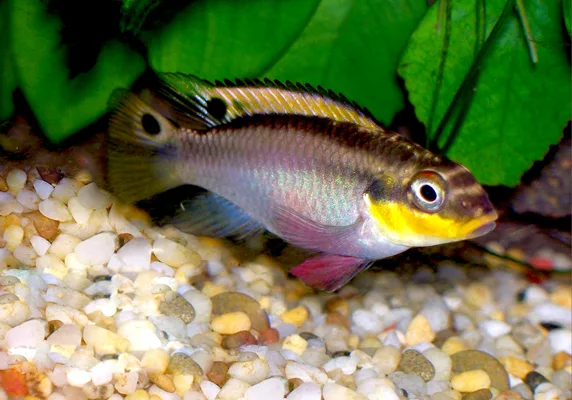
Location names do more work than the Latin on a bag of Pelvicachromis taeniatus. Moliwe, Nigerian red, Dehane, Wouri — these are not marketing stickers. They are populations of a West African cave cichlid that differ in colour, in how soft they like the water, and sometimes in how tightly they pair. Treat “taeniatus” as a species with geography attached, not as a generic krib in a different font.
Pelvicachromis taeniatus shares the family habits of P. pulcher: a cave, a bonded pair, a female who colours up hard when she is ready to spawn. It is usually a little more particular, a little less forgiving of hard tap, and often more expensive because the fish in the shop is a locality rather than a mass-produced mix. If you wanted the easy West African dwarf, you wanted pulcher. If you wanted the one that looks like stained glass when the pair is right, you are in the right article.
Rivers with a proper name
The species is native to drainages in Nigeria and Cameroon. Different localities come from different rivers and coastal systems. Some are slightly more tannin-stained, some clearer, some closer to the estuary. In all of them the fish use cavities in banks, among roots, and in laterite-like structure. Current is usually moderate, not a Congo rapid. Temperature sits in the mid-twenties. The forest overhead cuts the light.
An aquarium that copies “Africa” with a lump of petrified wood and a plastic plant does not copy this. Copy the cavity, the stain, the gentle flow, and the pair. Leave the savanna ornaments in the drawer.
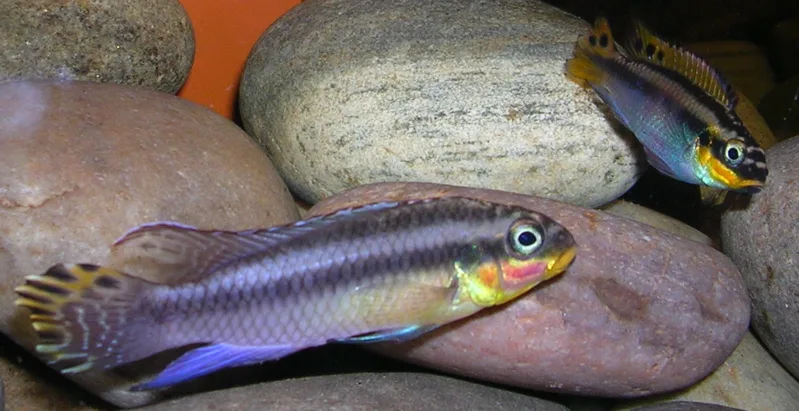
Fins that tell you the population
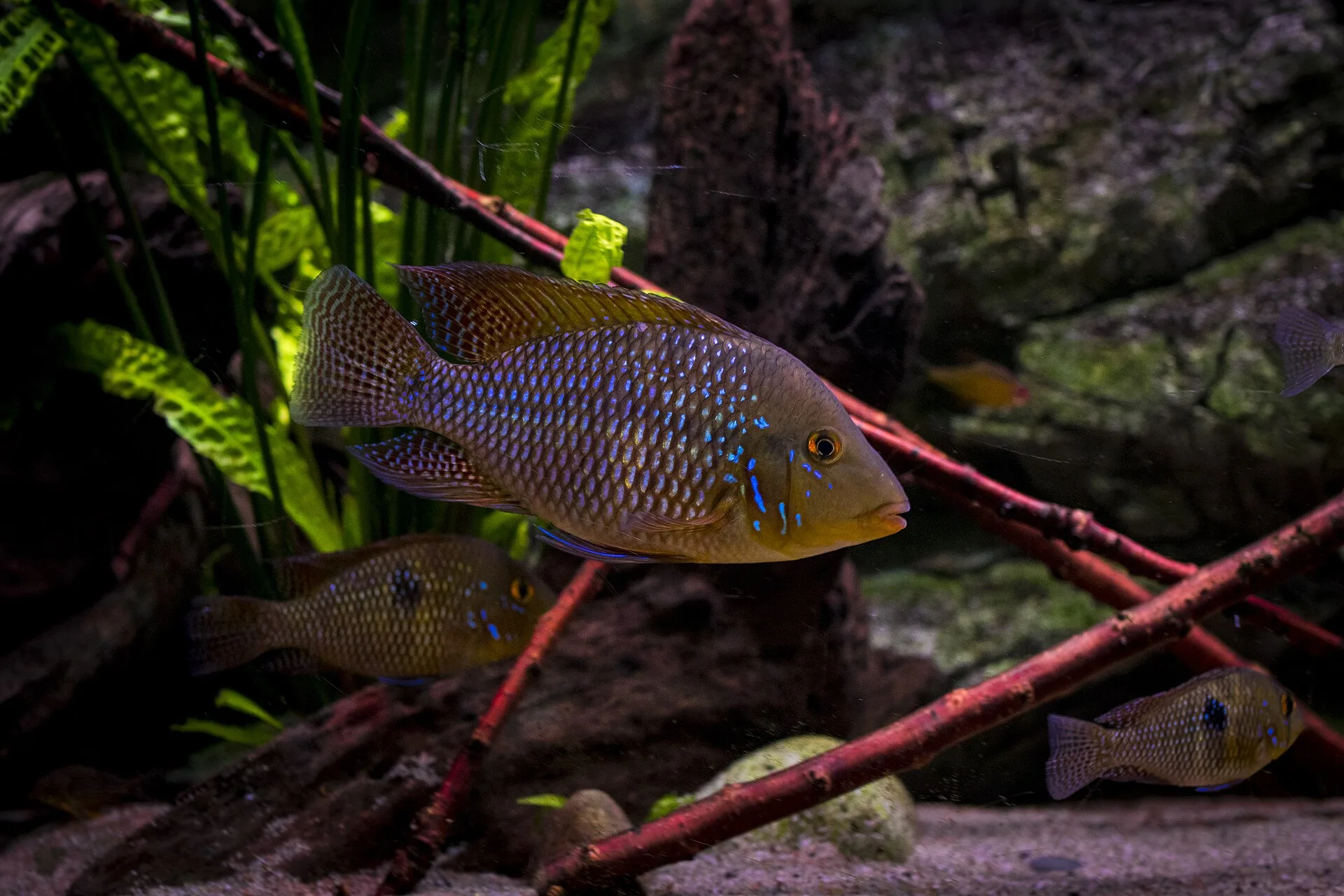
Adults are in the same size class as kribs: males often 7–9 cm, females smaller and rounder. The caudal pattern, the amount of red or yellow in the body, and the eye-spot on the dorsal vary by locality. Females of several forms show a striking belly — wine, rose, or gold — when they are gravid. Males have longer fins and a more elongated body. Mixing localities in one tank because they are “all taeniatus” is how you lose the reason you paid for a named form. Keep lines separate if the locality matters to you. If it does not, say so, and do not sell the fry as Moliwe.
Shop fish are often unsexed juveniles. A group of six in a grow-out tank will usually produce a pair. The extra males are not colony members; they are fish that need another aquarium.
A cave in stained water
One pair in 80 litres of planted, tannin-tinted water is the standard good keep. Give them two or three caves so they can reject the ones they dislike. Coconut, clay, and rock all work. Sand on the floor. Botanicals if you want the look of a forest stream and a slight pH nudge. Plants — ferns on wood, crypts, floaters — make them bold. A bright, bare tank makes them hide and then surprise you with a spawn you never saw coming, followed by a territorial explosion.
Filtration stays modest. They appreciate oxygen. They do not appreciate a gyre. Cover the tank; startled Pelvicachromis go up.
Softer than the average community

Aim for pH 5.5–7.2, soft water, 24–26°C (a little cooler than a discus tank is fine; hotter is unnecessary). Many localities colour and spawn more reliably toward the acidic side. If your tap is liquid limestone, use RO and remineralise lightly. Do not chase pH 5.0 with acid bottles. Leaves, peat in a bag in the filter if you know how to use it, and RO blending are slower and safer.
Stability matters more than a heroic number. A pair that lives at pH 6.8 every day will beat a pair that sees 6.0 after a water change and 7.4 two days later. Test GH, KH, and pH on a schedule until you know your tap through the seasons. Spring snowmelt and summer drought change municipal water more than hobbyists admit.
Conditioning without a secret recipe
Omnivore granules, frozen small crustaceans, and live foods if you have them. Females need extra to fill out. Males that display all afternoon still have to eat. Target-feed at the cave if dither fish are faster. This species will take flake but looks better and spawns more often on a mix that includes frozen baby brine and daphnia. Skip the garlic miracle additives. Skip feeding them like Oscars.
Company that leaves the pot alone
A pair can live with small, peaceful West African or general community fish that share the water: some tetras, small barbs that are not nippy, Corydoras. The usual caveat applies — when they spawn, the cave radius is closed. In 80 litres that can mean the whole tank. Either keep the pair alone, or keep dither fish that can stay at the other end of a longer aquarium, or be ready to rearrange when eggs appear.
Do not combine them with P. pulcher in a small tank. Do not combine two taeniatus pairs. Do not add them to a tank of jewel cichlids because both are “African.” Hemichromis will use them as moving targets.
Biparental, like the krib, unlike an apisto
Eggs go in the cave. Both parents guard. The female is usually tighter on the eggs; the male works the perimeter. Fry become a cloud at the entrance and are escorted. You can raise them on baby brine in the display if nothing else eats them. Locality keepers often pull the cave to a rearing tank to keep the line clean and to let the pair spawn again without filling the display with dozens of young.
Not every spawn survives. First-time pairs eat eggs. Hard water funguses eggs. A male who was never bonded kills more than he guards. If it fails, change one variable — cave, diet, pairing — not all of them at once.
Imports, localities, and patience
Named forms should be quarantined like any wild or tank-bred cichlid: separate tank, sponge filter, cave, two weeks of eating. Watch for ich after the heater catches up. Watch for thin fish that need deworming only if faeces and appetite say so, not because an internet protocol says every African fish gets metronidazole on landing.
Colour in this species is a conversation between genetics, water, and whether the pair feels unobserved. You cannot extract it with a colour flake. You can suppress it with hard water, no cave, and a tank mate that stares into the hole. Give Pelvicachromis taeniatus a named home — the right chemistry for the form you bought, a pot, a partner — and the location on the bag starts to mean something in the glass, not only on the receipt.
Explore other topics
Dive into more aquarium guides across the site.